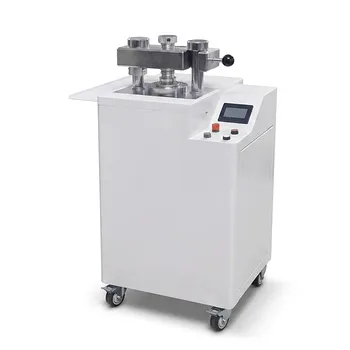
Programmable controls act as the central nervous system of modern laboratory presses, elevating them from simple mechanical devices to precision instruments. These systems allow operators to define and execute specific pressing requirements with a level of accuracy that manual operation simply cannot replicate. By automating critical parameters, manufacturers ensure that every cycle meets exact standards for consistency and quality.
Modern programmable controls are the key to unlocking high-quality production in laboratory settings. They minimize human error to maximize efficiency and significantly reduce material waste.
Driving Consistency and Quality
Achieving Exact Specifications
The primary role of programmable controls is to bridge the gap between intent and execution. They allow users to input specific requirements for variables such as tonnage, temperature, and time.
Once programmed, the press executes these commands with strict adherence to the defined parameters. This ensures that the final product matches the design intent with high accuracy.
Ensuring Repeatability
In a laboratory or manufacturing environment, a single successful press cycle is not enough; you must be able to repeat it. Programmable controls remove the variability inherent in manual operator adjustments.
This feature guarantees consistency across multiple batches. Whether running ten samples or ten thousand, the pressing conditions remain identical, leading to uniform product quality.
Operational Efficiency and Waste Reduction
Maximizing Workflow Efficiency
Beyond quality, programmable controls play a crucial role in optimizing the speed and flow of operations. By automating the process, the equipment can run at optimal cycles without constant manual intervention.
This capability allows manufacturers to maximize efficiency, ensuring that time and energy are utilized effectively. It transforms the press into a streamlined component of the broader production line.
Minimizing Material Waste
Inconsistent pressure or temperature application often leads to defective parts that must be scrapped. Programmable controls drastically reduce the likelihood of these errors.
By maintaining precise control over the process, manufacturers can minimize waste. This leads to significant cost savings on raw materials and ensures a higher yield of usable high-quality products.
Understanding the Trade-offs
Complexity vs. Necessity
While programmable controls offer superior performance, they introduce a layer of complexity that may not be necessary for every application. Simple, manual tasks that do not require high precision may not justify the investment in advanced automation.
Implementation and Maintenance
Adopting programmable systems requires ensuring that the specific features align with your process needs, such as available tonnage or platen sizes. Users must verify that the sophisticated nature of these controls does not complicate the low maintenance and low noise benefits typically sought in compact laboratory environments.
Making the Right Choice for Your Goal
To determine if programmable controls are essential for your laboratory press, evaluate your specific production targets.
- If your primary focus is Quality Assurance: Leverage programmable controls to ensure strict adherence to specific requirements and eliminate batch-to-batch variability.
- If your primary focus is Cost Reduction: Utilize the automation capabilities to maximize efficiency and minimize the financial impact of material waste.
By integrating programmable controls, you secure a reliable path to producing high-quality components with precision and economy.
Summary Table:
| Feature | Manual Control | Programmable Control |
|---|---|---|
| Consistency | Variable (Human dependent) | High (Automated repeatability) |
| Accuracy | Estimated pressure/temp | Precise digital inputs |
| Efficiency | Constant supervision required | Automated cycles for workflow optimization |
| Waste Reduction | High risk of defective parts | Minimal waste due to precise parameters |
| Complexity | Low / Straightforward | High / Requires initial setup |
Elevate Your Lab Research with KINTEK Precision
Consistency and accuracy are non-negotiable in battery research and material science. KINTEK specializes in comprehensive laboratory pressing solutions, offering a versatile range of manual, automatic, heated, multifunctional, and glovebox-compatible models, alongside advanced cold and warm isostatic presses.
Whether you need the simplicity of a manual press or the high-tech automation of programmable controls, our equipment is designed to maximize efficiency and minimize waste in your facility.
Ready to optimize your pressing workflow? Contact us today to find the perfect model for your specific laboratory requirements!
Related Products
- Automatic Heated Hydraulic Lab Press with Programmable Touch Screen Controls and Precision Temperature Regulation
- Automatic Heated Hydraulic Press Machine with Hot Plates for Laboratory
- Automatic Heated Hydraulic Lab Press 120x120mm Plate Fully Automated Material Research Press
- Automatic Laboratory Hydraulic Press Lab Pellet Press Machine
- Automatic Laboratory Hydraulic Press for XRF and KBR Pellet Pressing
People Also Ask
- Why is a laboratory heated hydraulic press required? Ensure Precise Vulcanization for NBR/EPDM Nanocomposites
- What are the industrial applications of heated hydraulic presses? Master Heat & Force for Precision Manufacturing
- Why is an automatic heated lab press preferred for PEEK & CNT laminates? Achieve Precise Crystallization Control
- What is the necessity of a laboratory hydraulic press with heating functions? Master Rubber Vulcanization Precision
- How does a heated laboratory hydraulic press contribute to the formation of dense mycelium-based materials? Expert Tips