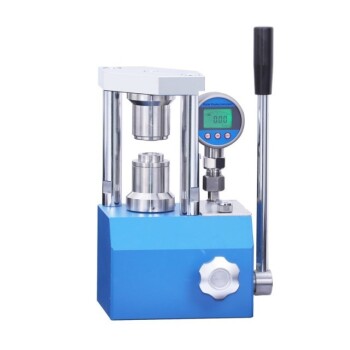
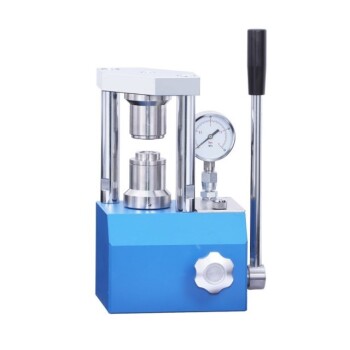
A high-precision laboratory pressure molding device acts as the fundamental enabler of ionic conductivity in all-solid-state batteries (ASSBs). It applies constant and uniform mechanical pressure to force the cathode, solid-state electrolyte layer, and lithium anode into tight physical contact. This mechanical compression bridges the microscopic gaps inherent in solid materials, significantly reducing interfacial resistance and ensuring the efficient ion transport necessary for stable battery performance.
The central challenge in solid-state batteries is that solid electrolytes cannot "wet" electrodes like liquids do. Therefore, high-precision pressure is the only mechanism available to eliminate voids and create the atomic-level contact required for ions to move between layers.
The Critical Role of Interfacial Contact
The primary function of pressure molding devices is to overcome the physical limitations of solid-solid interfaces. Without precise compression, these batteries simply cannot function effectively.
Bridging the Solid-Solid Gap
In liquid batteries, the electrolyte naturally flows into porous electrodes, creating excellent contact. Solid-state batteries lack this wetting capability. A pressure device forces the hard solid electrolyte against the active materials to simulate this contact mechanically.
Reducing Interfacial Resistance
High-quality interfacial connection is vital for performance. By applying uniform pressure, the device minimizes the interfacial impedance between the cathode and the electrolyte. This allows lithium ions to migrate smoothly across boundaries that would otherwise act as barriers.
Enhancing Compaction Density
Pressure devices, such as automatic lab presses, are used to compress dried cathode sheets. This increases the compaction density of active materials, which directly enhances the volumetric energy density of the electrode.
Engineering the Internal Structure
Beyond simple contact, these devices allows for the precise engineering of the battery's internal architecture during assembly.
Eliminating Internal Voids
During fabrication, high pressures (often ranging from 240 MPa to 320 MPa for specific cold-pressing tasks) are used to compact electrolyte powders. This high-pressure processing significantly reduces gaps between particles, increasing the density of the electrolyte layer itself.
Enabling Multi-Layer Integration
Precision presses facilitate sequential pressing within a single mold. Researchers can press the electrolyte layer first, then add cathode powders, and press again. This gradient technique ensures strong mechanical bonding between different material layers.
Managing Volume Changes
During charge and discharge cycles, electrode materials expand and contract. Pressure fixtures or crimpers apply continuous external pressure to accommodate this volume change, preventing interface delamination (separation of layers) and inhibiting the growth of lithium dendrites.
Understanding the Trade-offs
While pressure is essential, applying it incorrectly can be detrimental. It is crucial to balance mechanical force with material limits.
The Risk of Over-Pressurization
More pressure is not always better. Thermodynamic analysis suggests that maintaining stack pressure at appropriate levels (often below 100 MPa for operation) is necessary to prevent unwanted material phase changes. Excessive pressure can alter the fundamental structure of the materials, degrading performance.
Uniformity vs. Localized Stress
The pressure must be perfectly uniform across the cell surface. Uneven pressure distribution can lead to localized stress points. These stress points often become nucleation sites for dendrite growth, which can cause short circuits and battery failure.
Making the Right Choice for Your Goal
Selecting the right pressure protocol depends heavily on the specific stage of battery development you are focusing on.
- If your primary focus is Assembly and Fabrication: Prioritize devices capable of high pressures (240–320 MPa) to maximize compaction density and eliminate initial voids in powder composites.
- If your primary focus is Cycle Life Testing: Focus on fixtures that maintain constant lower-range pressure (<100 MPa) to manage volume expansion without inducing phase changes.
- If your primary focus is Energy Density: Ensure your device can achieve high compaction of the cathode layer to maximize active material utilization per volume.
Mastering the application of pressure is not just a mechanical step; it is the defining factor that transforms a stack of powders into a functional high-performance energy storage device.
Summary Table:
| Feature | Role in ASSB Assembly | Impact on Performance |
|---|---|---|
| Interfacial Contact | Bridges gaps between solid electrolyte and electrodes | Lowers interfacial resistance & impedance |
| Compaction Density | Compresses cathode and electrolyte powders | Increases volumetric energy density |
| Void Elimination | Removes internal gaps via high-pressure (240-320 MPa) | Improves electrolyte layer density |
| Mechanical Bonding | Facilitates multi-layer sequential pressing | Prevents layer delamination during cycling |
| Volume Management | Accommodates material expansion/contraction | Inhibits lithium dendrite growth |
Elevate Your Battery Research with KINTEK Precision
Unlock the full potential of your all-solid-state battery research with KINTEK’s industry-leading laboratory pressing solutions. From manual and automatic presses to heated and glovebox-compatible models, we provide the high-precision tools necessary to achieve perfect interfacial contact and superior compaction density.
Whether you require Cold Isostatic Presses (CIP) for uniform powder compaction or specialized coin cell crimpers for reliable assembly, our equipment is designed to meet the rigorous demands of modern energy storage development.
Ready to optimize your assembly process? Contact our laboratory specialists today to find the perfect pressing solution for your research goals.
References
- Matthew Tudball, Thomas S. Miller. Enhancing solid-state battery performance with spray-deposited gradient composite cathodes. DOI: 10.1039/d4se01736f
This article is also based on technical information from Kintek Solution Knowledge Base .
Related Products
- Button Battery Sealing Machine for Button Batteries
- Manual Button Battery Sealing Machine for Battery Sealing
- Lab Button Battery Disassembly and Sealing Mold
- Button Battery Sealing Press Machine for Lab
- Lab Button Battery Tablet Press Sealing Mold
People Also Ask
- Why is a laboratory hydraulic press or battery sealing machine essential? Ensure Coin Cell Data Integrity
- What role does a laboratory press perform for CR2032 coin cell assembly? Ensure Precision in Battery Research
- Why is a high-pressure manual or automatic coin cell crimper required? Optimize Solid-State Battery Performance
- How does a high-precision lab press or coin cell crimper affect the performance of assembled lithium-metal batteries?
- How does the mechanical pressure provided by a laboratory crimper affect the performance of assembled 2032-type coin cells?