
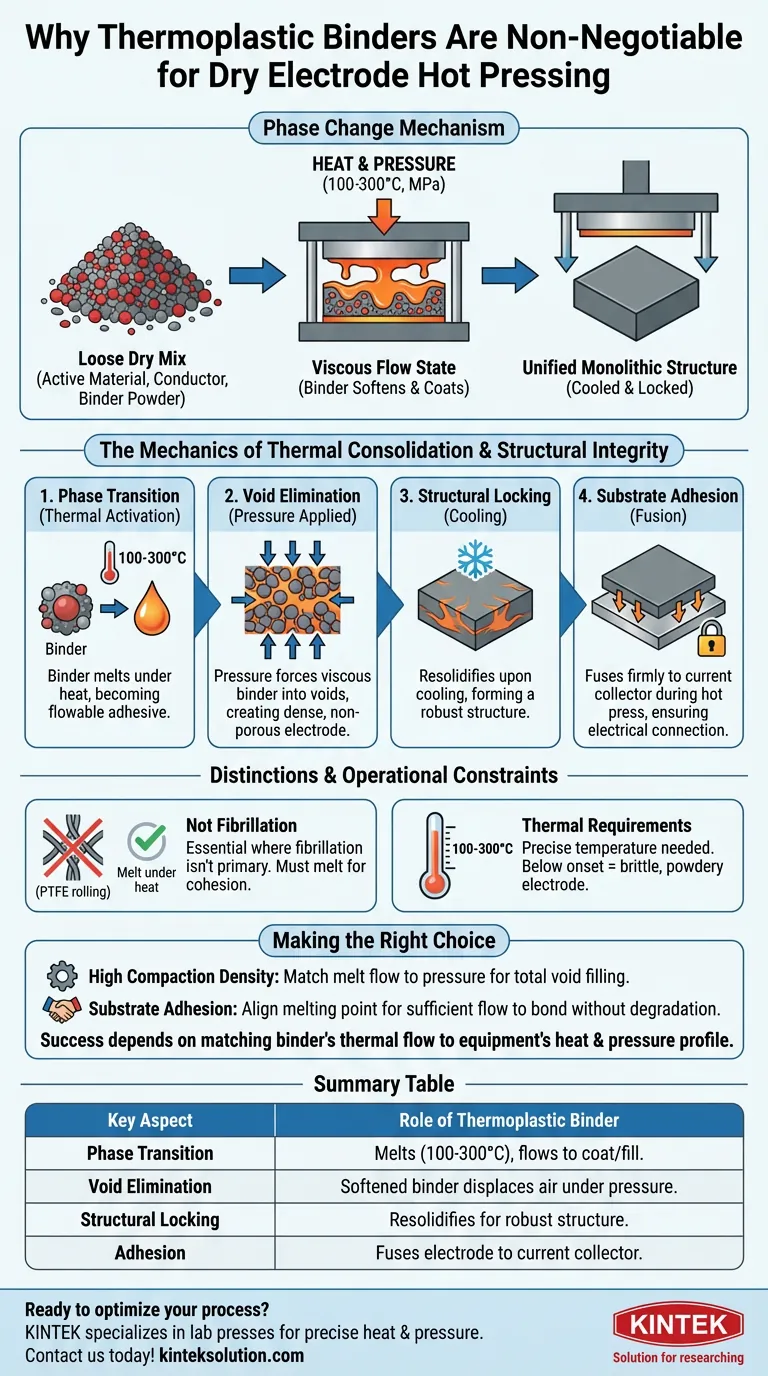
Thermoplastic binders are non-negotiable in hot pressing because they possess the unique physical capability to undergo a reversible phase change from solid to a viscous flow state when heated.
In a dry manufacturing environment devoid of liquid solvents, the binder must still coat active materials and fill interstitial gaps. Thermoplastic binders achieve this by softening at specific temperatures (typically 100-300°C), allowing them to flow under pressure to create a unified structure, then locking that structure in place as they cool and resolidify.
The Core Mechanism The necessity of thermoplastic binders lies in their melt-processing capability: they convert the thermal energy of the hot press into mechanical cohesion. This allows for the creation of high-density, non-porous electrodes by eliminating voids via binder flow rather than solvent evaporation.
The Mechanics of Thermal Consolidation
The Role of Phase Transition
In dry electrode manufacturing, you are starting with a loose mix of active materials, conductive agents, and binder powder.
Without a solvent to dissolve and distribute the binder, the process relies on the thermoplastic binder’s ability to melt.
Upon heating, the binder transitions to a malleable state, enabling it to act as a flowable adhesive solely through thermal activation.
Void Elimination Under Pressure
The hot press applies significant mechanical force, often several MPa, simultaneously with heat.
While the heat softens the binder, the pressure forces this viscous material into the voids between active material particles.
This combination effectively eliminates porosity, resulting in a dense electrode film that would be impossible to achieve with a non-thermoplastic binder in a dry state.
Structural Integrity and Cohesion
Locking the Structure via Cooling
The binding process is finalized not by evaporation, but by cooling.
As the electrode creates thermal equilibrium after the hot press, the thermoplastic binder resolidifies.
This "locks" all components into a mechanically robust, monolithic structure that resists delamination.
Adhesion to Current Collectors
In processes like dry spray deposition, the binder must secure the powder not just to itself, but to the substrate.
The hot pressing step cures the deposited powder, ensuring the softened binder fuses firmly to the current collector.
This establishes the necessary electrical and mechanical connection required for a functional battery cell.
Distinctions and Operational Constraints
Alternative to Fibrillation
It is critical to distinguish this mechanism from other dry coating methods that rely on fibrillation (such as PTFE-based rolling).
Thermoplastic binders are essential specifically in systems where fibrillation is not the primary binding mechanism.
If the polymer does not fibrillate under shear force, it must melt under heat to provide cohesion.
Thermal Requirements
Using thermoplastic binders introduces specific process constraints regarding temperature.
The equipment must be capable of maintaining distinct temperature ranges, typically between 100°C and 300°C.
Failure to reach the onset temperature of the binder will result in a brittle, powdery electrode with poor internal cohesion.
Making the Right Choice for Your Goal
To maximize the effectiveness of dry electrode manufacturing, align your binder selection with your processing capabilities:
- If your primary focus is High Compaction Density: Select a thermoplastic binder with a melt flow index that allows for total void filling at your maximum operating pressure.
- If your primary focus is Substrate Adhesion: Ensure the binder's melting point aligns with a hot pressing temperature that allows for sufficient flow to bond with the current collector without degrading the active material.
Success in hot pressing ultimately depends on matching the binder's thermal flow characteristics to the precise heat and pressure profile of your equipment.
Summary Table:
| Key Aspect | Role of Thermoplastic Binder |
|---|---|
| Phase Transition | Melts under heat (100-300°C), flows to coat materials and fill gaps. |
| Void Elimination | Softened binder displaces air under pressure, creating dense electrodes. |
| Structural Locking | Resolidifies upon cooling, forming a mechanically robust, monolithic structure. |
| Adhesion | Fuses electrode layer to current collector during hot pressing. |
Ready to optimize your dry electrode manufacturing process? KINTEK specializes in lab press machines (including automatic lab presses, isostatic presses, and heated lab presses) designed to deliver the precise heat and pressure profiles required for thermoplastic binder activation. Our equipment ensures high compaction density, strong substrate adhesion, and consistent results for your laboratory needs. Contact us today to discuss how our solutions can enhance your electrode production!
Visual Guide
Related Products
- Automatic High Temperature Heated Hydraulic Press Machine with Heated Plates for Lab
- Heated Hydraulic Press Machine with Heated Plates for Vacuum Box Laboratory Hot Press
- Automatic Heated Hydraulic Press Machine with Hot Plates for Laboratory
- Heated Hydraulic Press Machine With Heated Plates For Vacuum Box Laboratory Hot Press
- Laboratory Split Manual Heated Hydraulic Press Machine with Hot Plates
People Also Ask
- Function of a Laboratory Hydraulic Press with Heated Platens in SSE? Enhance Battery Density & Conductivity
- How does a laboratory heated hydraulic press facilitate PBN sample prep for WAXS? Achieve Precise X-Ray Scattering
- What are the requirements for electrode pressing with high-viscosity ionic liquids like EMIM TFSI? Optimize Performance
- What are the industrial applications of heated hydraulic presses? Master Heat & Force for Precision Manufacturing
- Why is a laboratory hydraulic press with heating plates required for PLA/TEC films? Achieve Precise Sample Integrity



















