
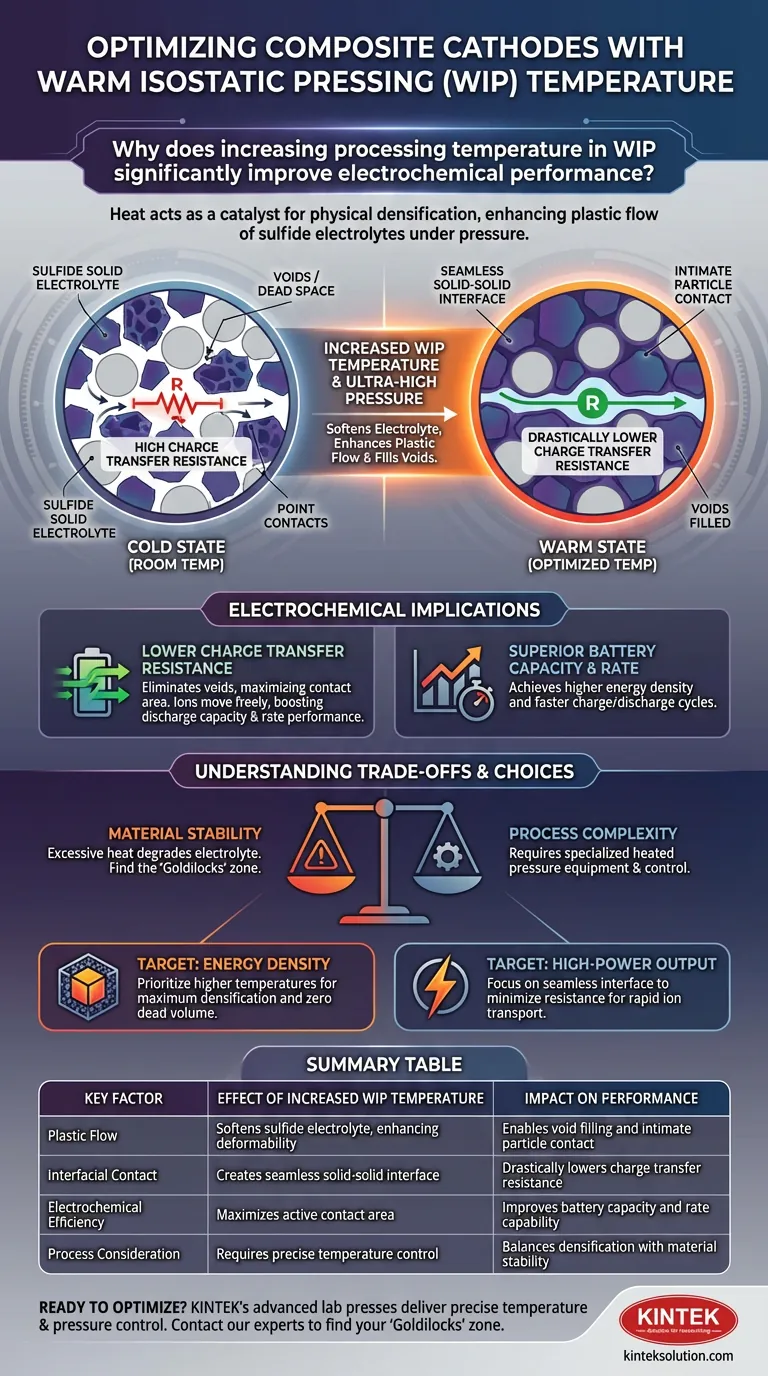
Increasing the temperature within a Warm Isostatic Pressing (WIP) process acts as a catalyst for physical densification. By heating the composite cathode, you significantly enhance the plastic flow capability of the sulfide solid electrolyte. This softening effect allows the electrolyte to deform more easily under ultra-high pressure, effectively filling microscopic voids and establishing a continuous, intimate contact between particles.
The primary driver for improved performance is the creation of a seamless solid-solid interface. Higher temperatures allow the electrolyte to mechanically adapt to the active material, drastically reducing charge transfer resistance and unlocking superior battery capacity.
The Mechanics of Interface Formation
Enhancing Plastic Flow
At room temperature, sulfide solid electrolytes can be rigid and brittle. Raising the WIP temperature softens the material, increasing its plastic flow capability.
This thermodynamic change allows the electrolyte to behave less like a solid rock and more like a malleable substance. It can deform without fracturing, which is essential for uniform processing.
Filling Microscopic Voids
In a composite cathode, "dead space" or voids between particles creates resistance. Under ultra-high pressure, the softened electrolyte is forced into these interstitial gaps.
The combination of heat and pressure ensures that the electrolyte penetrates the porous structure of the active material. This eliminates the voids that typically plague cold-pressed composites.
Electrochemical Implications
Creating a Seamless Interface
The ultimate goal of WIP is to maximize the active contact area. The softened electrolyte effectively wraps around the active material particles.
This transforms the internal structure from a series of weak "point contacts" into a robust, "seamless solid-solid interface." This physical continuity is the foundation of electrochemical efficiency.
Lowering Charge Transfer Resistance
Resistance is the enemy of battery performance. By eliminating voids and maximizing contact, you drastically reduce charge transfer resistance.
Lower resistance means ions can move freely between the cathode and the electrolyte. This directly translates to higher discharge capacities and better rate performance (the ability to charge/discharge quickly).
Understanding the Trade-offs
Material Stability
While heat aids densification, there is a thermal limit. Excessive temperatures can potentially degrade the sulfide electrolyte or trigger unwanted chemical reactions with the active material.
You must identify the "Goldilocks" zone where plastic flow is maximized without compromising the chemical integrity of the components.
Process Complexity
Implementing WIP adds variables to the manufacturing process compared to Cold Isostatic Pressing (CIP).
It requires specialized equipment capable of maintaining precise temperature control under high pressure. This increases operational costs and cycle times, which must be weighed against the performance gains.
Making the Right Choice for Your Goal
To optimize your composite cathode manufacturing, consider your specific performance targets:
- If your primary focus is Energy Density: Prioritize higher temperatures (within stability limits) to achieve maximum densification and eliminate dead volume in the cathode.
- If your primary focus is High-Power Output: Focus on creating the most seamless interface possible to minimize resistance, allowing for rapid ion transport during fast charging.
Ultimately, temperature serves as the critical lever that transforms a porous assembly into a highly integrated, efficient electrochemical system.
Summary Table:
| Key Factor | Effect of Increased WIP Temperature | Impact on Performance |
|---|---|---|
| Plastic Flow | Softens sulfide electrolyte, enhancing deformability | Enables void filling and intimate particle contact |
| Interfacial Contact | Creates seamless solid-solid interface | Drastically lowers charge transfer resistance |
| Electrochemical Efficiency | Maximizes active contact area | Improves battery capacity and rate capability |
| Process Consideration | Requires precise temperature control | Balances densification with material stability |
Ready to optimize your composite cathode manufacturing and achieve superior battery performance? KINTEK's advanced lab press machines, including heated and isostatic presses, are designed to deliver the precise temperature and pressure control required for your R&D and production. Our expertise in materials processing can help you identify the perfect 'Goldilocks' zone for your specific cathode materials. Contact our experts today to discuss how our solutions can enhance your battery development.
Visual Guide
Related Products
- Warm Isostatic Press for Solid State Battery Research Warm Isostatic Press
- Lab Isostatic Pressing Molds for Isostatic Molding
- Electric Lab Cold Isostatic Press CIP Machine
- Automatic Lab Cold Isostatic Pressing CIP Machine
- Electric Split Lab Cold Isostatic Pressing CIP Machine
People Also Ask
- Why must composite cathodes be sealed in vacuum lamination bags for WIP? Ensure Battery Stability and Density
- How do sacrificial volume materials (SVM) maintain microchannels in isostatic pressing? Ensure Structural Integrity
- What is the function of elastic molds in warm isostatic pressing? Achieve Uniform Density in Composite Particles
- What is the significance of temperature control in Warm Isostatic Pressing? Unlock Uniform Densification and Process Stability
- What is the process involved in warm isostatic pressing? Mastering Uniform Density with WIP Technology



















