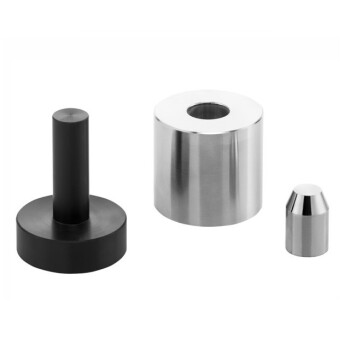
A high-precision laboratory press is the definitive tool for assembling borohydride-based all-solid-state batteries because it applies the extreme, stable pressure required to transform loose electrolyte powders into dense, functional layers. By compressing these materials into pellets or layered structures, the press ensures tight physical contact at the electrode-electrolyte interface. This mechanical densification is the only way to eliminate microscopic voids and reduce impedance to a level that allows the battery to function effectively.
In solid-state battery assembly, the primary adversary is contact resistance between solid particles. A laboratory press overcomes this by densifying components to ensure intimate physical contact, which is critical for preventing lithium dendrite growth and facilitating smooth lithium-ion transport.
Overcoming the Solid-Solid Interface Challenge
Eliminating Voids Through Densification
Borohydride electrolytes typically start as powders. A laboratory press forces these particles together to form high-density pellets or thin sheets. This process eliminates internal porosity and voids that naturally exist between loose powder particles.
Reducing Interfacial Impedance
Unlike liquid electrolytes that flow into gaps, solid electrolytes require mechanical force to touch the electrodes. The press ensures intimate physical contact between the electrolyte particles and the electrode materials. This tight junction significantly lowers interfacial impedance, which is the resistance ions face when moving from one material to another.
Establishing Ion Transport Pathways
Efficient lithium-ion transport relies on continuous pathways within the material. By compressing the components, often between 80 MPa and 360 MPa, the press creates a seamless solid-solid interface. This structure allows ions to move freely across the cell, directly influencing charge-discharge capacity.
Critical Performance Mechanisms
Inducing Plastic Deformation
To achieve a truly "solid" state, the materials must undergo plastic deformation. The high pressure from the press deforms the cathode, solid electrolyte, and anode layers so they mold into one another. This deformation is essential for creating a low-impedance physical foundation that supports high-rate performance.
Preventing Lithium Dendrite Growth
One of the most significant risks in battery chemistry is the formation of dendrites—needle-like structures that can cause short circuits. By ensuring a dense, void-free structure, the press creates a physical barrier that suppresses dendrite propagation. This directly contributes to the safety and long-term cycling stability of the battery.
Enhancing Grain Boundary Conductivity
Pressure doesn't just join layers; it improves the material itself. High-pressure preparation reduces resistance at the grain boundaries (the interfaces between individual crystals) within the electrolyte. This enhances the overall ionic conductivity of the borohydride material.
The Importance of Precision and Control
Ensuring Structural Integrity
A laboratory press does more than squash materials; it ensures the mechanical integrity of the entire cell assembly. It facilitates the tight and uniform sealing of the anode, cathode, separator, and casing. This structural soundness is vital for maintaining performance during repeated cycling.
Repeatability in Prototyping
In a research setting, variables must be isolated. A high-precision press offers repeatable mechanical pressure, ensuring that every prototype is assembled under identical conditions. This allows researchers to attribute performance changes to material chemistry rather than assembly inconsistencies.
Understanding the Trade-offs
While high pressure is essential, it must be applied with precision. Excessive pressure can crush active material particles or damage the fragile solid electrolyte framework, potentially leading to short circuits. Conversely, insufficient pressure leaves voids that sever ionic pathways, rendering the cell inactive. The value of a high-precision press lies in its ability to find and hold the exact "Goldilocks" pressure zone required for borohydride materials.
Making the Right Choice for Your Goal
When selecting or utilizing a laboratory press for battery assembly, focus on what your specific project phase requires.
- If your primary focus is Electrochemical Performance: Prioritize a press capable of reaching higher pressures (up to 360 MPa) to maximize densification and minimize interfacial impedance.
- If your primary focus is Prototype Consistency: Ensure your press features programmable pressure controls to guarantee identical assembly conditions for every test cell.
- If your primary focus is Material Stability: Monitor pressure carefully to induce plastic deformation without fracturing the electrode particles or the solid electrolyte layer.
By controlling the mechanical environment with high precision, you transform raw chemical potential into a reliable, high-performance energy storage device.
Summary Table:
| Feature | Impact on Borohydride Batteries |
|---|---|
| Densification | Eliminates internal porosity and voids in powder electrolytes |
| Interfacial Contact | Reduces ionic impedance between electrodes and electrolytes |
| Plastic Deformation | Creates low-impedance pathways via 80 MPa - 360 MPa pressure |
| Dendrite Suppression | Establishes a dense physical barrier to prevent short circuits |
| Repeatability | Ensures identical assembly conditions for reliable prototyping |
Elevate Your Battery Research with KINTEK Precision
Achieving the perfect "Goldilocks" pressure zone is critical for the structural integrity and electrochemical performance of borohydride-based all-solid-state batteries. KINTEK specializes in comprehensive laboratory pressing solutions designed specifically for the rigorous demands of energy storage research.
Whether you require manual, automatic, heated, or multifunctional models, our presses—including glovebox-compatible and isostatic (CIP/WIP) systems—provide the repeatable precision needed to minimize interfacial impedance and suppress dendrite growth.
Ready to transform your raw chemical potential into high-performance devices?
References
- Liwen Jin. Borohydride Solid-State Electrolytes: Ion Transport Mechanisms and Modifications. DOI: 10.54254/2755-2721/2025.gl23368
This article is also based on technical information from Kintek Solution Knowledge Base .
Related Products
- Warm Isostatic Press for Solid State Battery Research Warm Isostatic Press
- Lab Button Battery Tablet Press Sealing Mold
- Laboratory Hydraulic Press Lab Pellet Press Button Battery Press
- Lab Infrared Press Mold for Laboratory Applications
- Carbide Lab Press Mold for Laboratory Sample Preparation
People Also Ask
- Why must composite cathodes be sealed in vacuum lamination bags for WIP? Ensure Battery Stability and Density
- How do sacrificial volume materials (SVM) maintain microchannels in isostatic pressing? Ensure Structural Integrity
- What is the function of elastic molds in warm isostatic pressing? Achieve Uniform Density in Composite Particles
- What are the advantages of using a Warm Isostatic Press (WIP) for batteries? Achieve Superior Interface Contact
- What is the role of the flexible material in warm isostatic pressing? Key to Uniform Density & Precision