
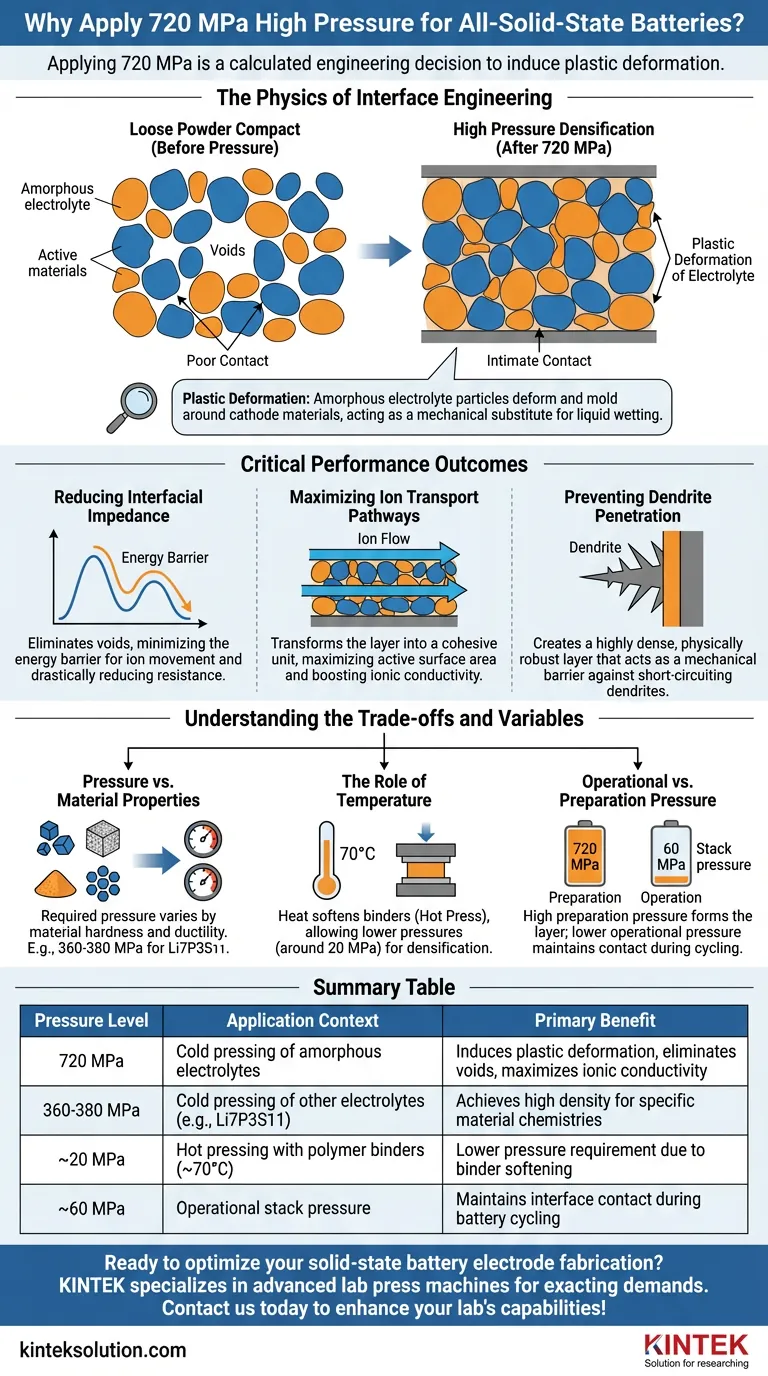
Applying a specific high pressure of 720 MPa is a calculated engineering decision to induce plastic deformation. This massive force causes the amorphous electrolyte particles, which possess slight ductility, to physically flow and fill the microscopic voids between the active material particles, creating a seamless, dense interface.
The fundamental challenge in solid-state batteries is the absence of liquid electrolytes to wet surfaces and bridge gaps. High-pressure processing acts as the mechanical substitute for wetting, forcing rigid particles into intimate contact to establish the continuous pathways required for ion transport.
The Physics of Interface Engineering
The Necessity of Plastic Deformation
At 720 MPa, you are not simply packing powder; you are altering the material's physical state. Amorphous electrolyte particles are generally rigid but possess a degree of ductility.
When subjected to this specific pressure threshold, these particles undergo plastic deformation. Instead of cracking or remaining static, they deform and mold themselves around the cathode active materials.
Eliminating Interfacial Voids
The primary enemy of solid-state performance is the microscopic void. In a liquid battery, the electrolyte flows into these spaces naturally.
In a solid-state system, these voids act as insulators that block ion movement. High uniaxial pressure collapses these voids, ensuring that the electrolyte fills the interstitial spaces between the electrode particles.
Critical Performance Outcomes
Reducing Interfacial Impedance
The direct result of eliminating voids is a drastic reduction in interfacial resistance (or impedance). Resistance occurs where materials fail to touch.
By establishing a tightly bonded interface, you minimize the energy barrier the lithium ions must overcome to move from the electrode to the electrolyte.
Maximizing Ion Transport Pathways
Ion transport relies on continuous physical pathways. A loose powder compact offers few routes for ions to travel.
High-pressure densification transforms the layer into a cohesive unit. This maximizes the active surface area where the solid electrolyte and active material are in contact, significantly boosting ionic conductivity.
Preventing Dendrite Penetration
Pressure also serves a safety function. A highly dense electrolyte layer with low porosity is physically robust.
This density creates a mechanical barrier that effectively prevents the penetration of lithium dendrites, which can short-circuit the battery.
Understanding the Trade-offs and Variables
Pressure vs. Material Properties
While 720 MPa is effective for specific amorphous electrolytes, it is not a universal constant. The required pressure depends heavily on the material's hardness and ductility.
For example, other protocols achieve high density at 360 MPa to 380 MPa for different electrolyte powders (like Li7P3S11). The goal is always intimate contact, but the force required to achieve it varies by chemistry.
The Role of Temperature
It is important to note that pressure requirements change if heat is introduced.
Using a hot press (e.g., at 70°C) allows for significantly lower pressures (around 20 MPa) if a polymer binder is present. The heat softens the binder, facilitating particle rearrangement without requiring the extreme force of cold pressing.
Operational vs. Preparation Pressure
The extreme pressure of 720 MPa is primarily a preparation step to form the layer.
However, maintaining contact during battery operation or testing also requires pressure, though often lower (e.g., 60 MPa). This "stack pressure" ensures that the interfaces remain connected as the battery breathes (expands and contracts) during cycling.
Making the Right Choice for Your Goal
The application of pressure must be tailored to the specific stage of battery fabrication and the materials involved.
- If your primary focus is maximizing ionic conductivity in amorphous electrolytes: Utilize ultra-high cold pressure (720 MPa) to induce plastic deformation and maximize active material contact.
- If your primary focus is processing composite layers with polymer binders: Incorporate heat (hot pressing) to lower the pressure requirement to the 20 MPa range, utilizing the binder's softening point to achieve density.
- If your primary focus is cycle life and safety: Ensure the electrolyte layer is pressed to sufficient density (360+ MPa) to eliminate pores that allow dendrite propagation.
Ultimately, the pressure applied is not just about compaction; it is the critical enabler that transforms loose powder into a functional, conductive electrochemical system.
Summary Table:
| Pressure Level | Application Context | Primary Benefit |
|---|---|---|
| 720 MPa | Cold pressing of amorphous electrolytes | Induces plastic deformation, eliminates voids, maximizes ionic conductivity |
| 360-380 MPa | Cold pressing of other electrolytes (e.g., Li7P3S11) | Achieves high density for specific material chemistries |
| ~20 MPa | Hot pressing with polymer binders (~70°C) | Lower pressure requirement due to binder softening |
| ~60 MPa | Operational stack pressure | Maintains interface contact during battery cycling |
Ready to optimize your solid-state battery electrode fabrication? The precise application of high pressure is critical for performance. KINTEK specializes in advanced lab press machines, including automatic and heated presses, designed to meet the exacting demands of battery research and development. Our expertise ensures you achieve the dense, void-free layers necessary for superior ionic conductivity and safety. Contact us today to discuss how our solutions can enhance your lab's capabilities and accelerate your battery development projects. Get in touch now!
Visual Guide
Related Products
- Split Automatic Heated Hydraulic Press Machine with Heated Plates
- Electric Split Lab Cold Isostatic Pressing CIP Machine
- Automatic Laboratory Hydraulic Press Lab Pellet Press Machine
- Manual Heated Hydraulic Lab Press with Integrated Hot Plates Hydraulic Press Machine
- Laboratory Split Manual Heated Hydraulic Press Machine with Hot Plates
People Also Ask
- What are the requirements for electrode pressing with high-viscosity ionic liquids like EMIM TFSI? Optimize Performance
- How does a laboratory heated hydraulic press facilitate PBN sample prep for WAXS? Achieve Precise X-Ray Scattering
- What are the industrial applications of heated hydraulic presses? Master Heat & Force for Precision Manufacturing
- Why is a laboratory hydraulic press with heating plates required for PLA/TEC films? Achieve Precise Sample Integrity
- Function of a Laboratory Hydraulic Press with Heated Platens in SSE? Enhance Battery Density & Conductivity



















