
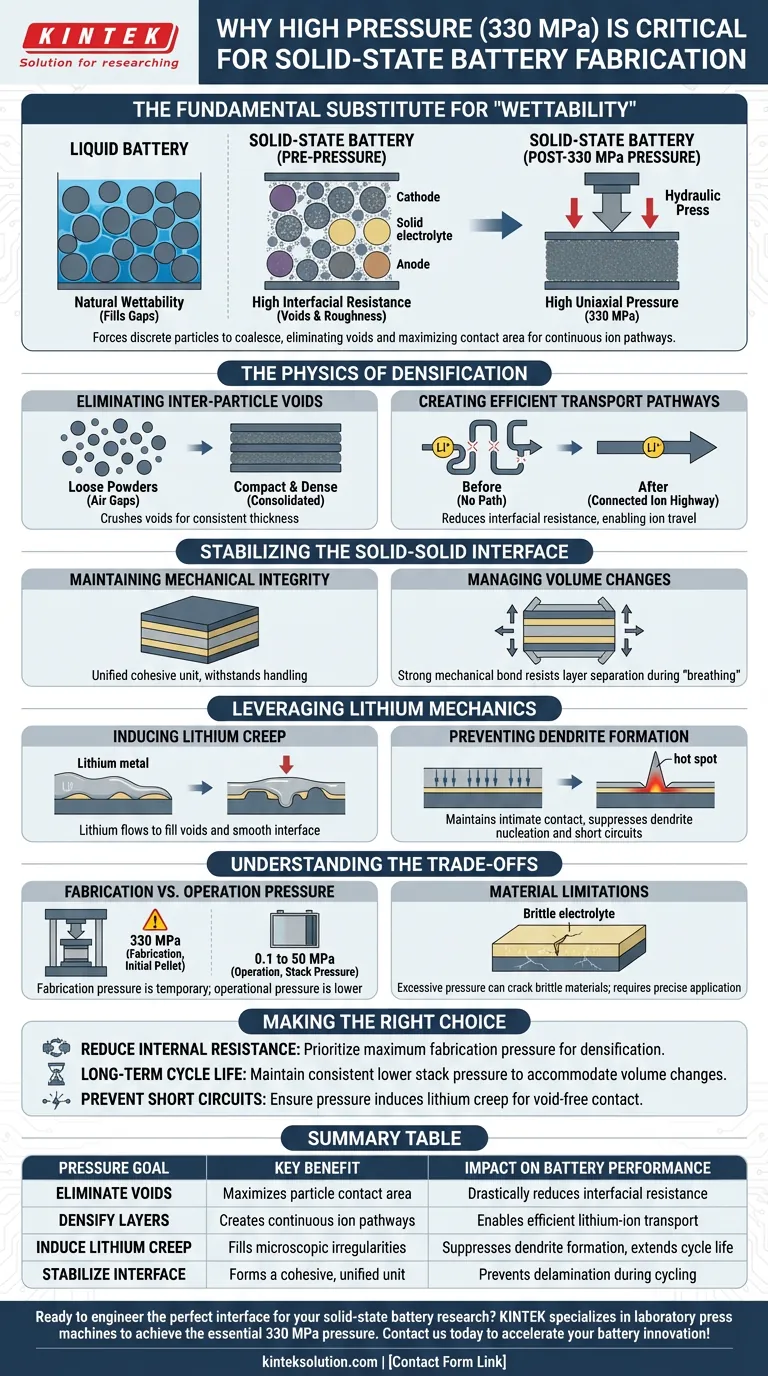
High uniaxial pressure is the fundamental substitute for the natural "wettability" found in liquid batteries. Applying 330 MPa via a hydraulic press during fabrication forces the discrete powder particles of the cathode, solid electrolyte, and anode to coalesce into a single, dense unit. This extreme mechanical force eliminates microscopic air voids and maximizes the contact area between particles, creating the continuous physical pathways necessary for lithium ions to move.
Core Takeaway Unlike liquid electrolytes that naturally fill gaps, solid-state materials suffer from high interfacial resistance due to microscopic roughness and voids. High pressure mechanically bridges these gaps, ensuring the low-impedance solid-solid contact required for the battery to function.
The Physics of Densification
Eliminating Inter-Particle Voids
In their raw state, the components of a solid-state battery exist as loose powders.
Between these powder particles lie significant air gaps (voids).
Applying 330 MPa compacts these layers, effectively crushing the voids out of existence to form a dense microstructure with consistent thickness.
Creating Efficient Transport Pathways
Lithium ions cannot travel through air; they require a continuous solid medium.
By densifying the material, you create a connected "highway" for ions to travel from the anode to the cathode.
This drastically reduces interfacial resistance, which is often the primary bottleneck in solid-state battery performance.
Stabilizing the Solid-Solid Interface
Maintaining Mechanical Integrity
Solid-state batteries are rigid systems.
Without sufficient compaction, the layers within the stack act as separate components rather than a unified device.
High pressure molds the sample into a cohesive unit that can withstand handling and testing without structural failure or delamination.
Managing Volume Changes
Battery electrodes expand and contract during charging and discharging cycles.
This "breathing" can cause layers to separate, breaking the electrical contact established during fabrication.
Initial high-pressure fabrication ensures the mechanical bond is strong enough to resist these separation forces during early cycling.
Leveraging Lithium Mechanics
Inducing Lithium Creep
Lithium metal is malleable.
Under high pressure, lithium exhibits creep behavior, meaning it slowly flows like a very viscous liquid.
This allows the lithium to actively fill interfacial voids and smooth out irregularities on the electrolyte surface.
Preventing Dendrite Formation
In anode-free configurations or lithium-metal cells, voids at the interface can lead to "hot spots" of current density.
These hot spots often act as nucleation sites for dendrites (metal spikes that short-circuit the battery).
By maintaining intimate contact through pressure, current distribution remains uniform, suppressing dendrite penetration and extending cycle life.
Understanding the Trade-offs
Fabrication vs. Operation Pressure
It is critical to distinguish between fabrication pressure and operating stack pressure.
While 330 MPa is used to create the initial pellet in the lab, maintaining such high pressure during actual battery operation is impractical for commercial applications due to the heavy steel casing required.
Material Limitations
While pressure improves contact, excessive pressure on brittle solid electrolytes (like certain ceramics) can induce cracks.
Furthermore, if the pressure is not applied uniaxially and precisely, it can lead to defects such as uneven thickness or overflow at the mold edges.
Making the Right Choice for Your Goal
To apply this to your specific research or fabrication process, consider your primary objective:
- If your primary focus is reducing internal resistance: Prioritize maximizing fabrication pressure to densify the electrolyte layer and minimize void space at the cathode interface.
- If your primary focus is long-term cycle life: Focus on maintaining a consistent, lower "stack pressure" (e.g., 0.1 to 50 MPa) during testing to accommodate volume expansion without cracking the electrolyte.
- If your primary focus is preventing short circuits: Ensure the pressure applied is sufficient to induce lithium creep, ensuring void-free contact that suppresses dendrite nucleation.
Success in solid-state fabrication relies on using pressure not just to compress, but to engineer the interface at the microscopic level.
Summary Table:
| Pressure Goal | Key Benefit | Impact on Battery Performance |
|---|---|---|
| Eliminate Voids | Maximizes particle contact area | Drastically reduces interfacial resistance |
| Densify Layers | Creates continuous ion pathways | Enables efficient lithium-ion transport |
| Induce Lithium Creep | Fills microscopic irregularities | Suppresses dendrite formation, extends cycle life |
| Stabilize Interface | Forms a cohesive, unified unit | Prevents delamination during cycling |
Ready to engineer the perfect interface for your solid-state battery research?
The precise application of high uniaxial pressure is critical for fabricating high-performance, dense battery pellets. KINTEK specializes in laboratory press machines, including automatic lab presses, isostatic presses, and heated lab presses, designed to meet the exacting demands of battery research and development.
Our equipment helps you achieve the essential 330 MPa pressure required to eliminate voids, reduce resistance, and create efficient ion pathways—ensuring your solid-state batteries deliver superior performance and longevity.
Contact us today to discuss your specific needs and discover how KINTEK's lab presses can accelerate your battery innovation!
Visual Guide
Related Products
- Automatic High Temperature Heated Hydraulic Press Machine with Heated Plates for Lab
- Manual Heated Hydraulic Lab Press with Integrated Hot Plates Hydraulic Press Machine
- Heated Hydraulic Press Machine with Heated Plates for Vacuum Box Laboratory Hot Press
- Laboratory Hydraulic Press 2T Lab Pellet Press for KBR FTIR
- Laboratory Hydraulic Press Lab Pellet Press Machine for Glove Box
People Also Ask
- Function of a Laboratory Hydraulic Press with Heated Platens in SSE? Enhance Battery Density & Conductivity
- What are the requirements for electrode pressing with high-viscosity ionic liquids like EMIM TFSI? Optimize Performance
- How does a laboratory heated hydraulic press facilitate PBN sample prep for WAXS? Achieve Precise X-Ray Scattering
- What are the industrial applications of heated hydraulic presses? Master Heat & Force for Precision Manufacturing
- Why is a laboratory hydraulic press with heating plates required for PLA/TEC films? Achieve Precise Sample Integrity



















