
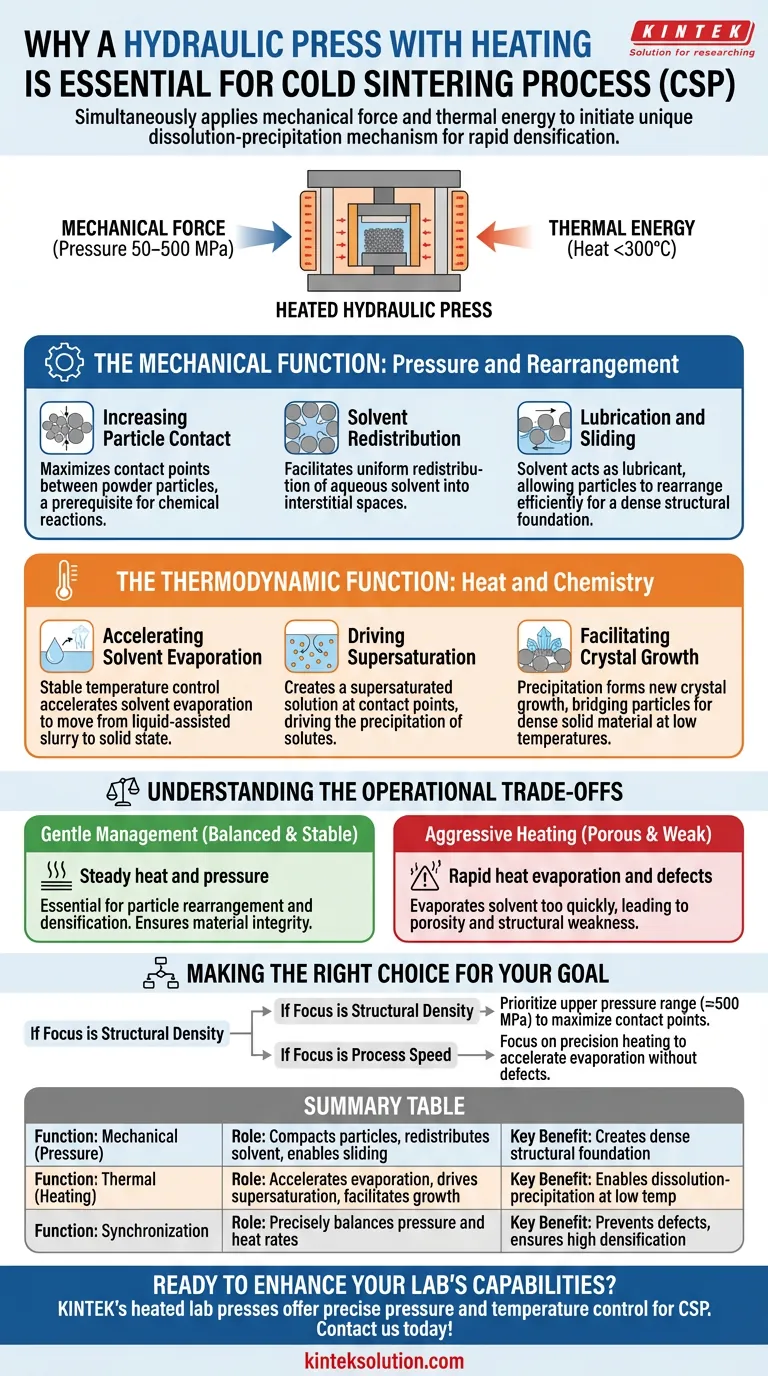
A hydraulic press with heating capabilities is utilized in the Cold Sintering Process (CSP) to simultaneously apply mechanical force and thermal energy, initiating a unique dissolution-precipitation mechanism. By combining high pressure (typically 50–500 MPa) with controlled low-temperature heat (below 300°C), this equipment enables rapid densification that standard pressing or heating cannot achieve in isolation.
The heated hydraulic press is not merely a compaction tool; it serves as a reactor that synchronizes particle rearrangement with solvent evaporation to drive chemically mediated crystal growth.
The Mechanical Function: Pressure and Rearrangement
Increasing Particle Contact
In the initial stage of CSP, the application of significant pressure is the primary driver of structure.
The hydraulic press compacts powder particles to maximize the number of contact points between them. This physical proximity is a prerequisite for the chemical reactions that follow.
Solvent Redistribution
Pressure does more than just squash particles; it manages the transient liquid phase.
The force facilitates the uniform redistribution of the aqueous solvent into the interstitial spaces (gaps) between particles. Without this uniform distribution, the chemical consolidation process would be uneven and ineffective.
Lubrication and Sliding
The applied pressure works in synergy with the solvent, which acts as a lubricant.
This allows particles to slide and rearrange efficiently. This rearrangement establishes a dense structural foundation before the solvent fully evaporates and the material hardens.
The Thermodynamic Function: Heat and Chemistry
Accelerating Solvent Evaporation
While CSP is a "cold" process relative to traditional sintering, thermal energy is still critical.
The heating capability of the press allows for stable temperature control up to 300°C. This heat accelerates the evaporation of the transient solvent, which is necessary to move the process from a liquid-assisted slurry to a solid state.
Driving Supersaturation
The application of heat does not just dry the material; it alters the chemical state of the liquid at particle boundaries.
As the solvent evaporates under heat, it creates a supersaturated solution at the contact points. This supersaturation is the thermodynamic engine that drives the precipitation of solutes.
Facilitating Crystal Growth
The final densification mechanism is the result of precipitation.
The gentle thermal management ensures that as solutes precipitate, they form new crystal growth between particles. This "bridges" the particles together, resulting in a dense solid material at temperatures far below the material's melting point.
Understanding the Operational Trade-offs
The Necessity of "Gentle" Management
While heating is essential, the references highlight the need for gentle temperature management.
Aggressive heating could evaporate the solvent too quickly. If the liquid phase disappears before the particles have rearranged and densified under pressure, the resulting material will be porous and structurally weak.
Stability vs. Speed
The equipment must offer precise, stable control rather than just raw power.
Fluctuations in temperature or pressure can disrupt the rate of supersaturation. To achieve high densification rates, the equipment must balance the mechanical compaction rate with the solvent evaporation rate perfectly.
Making the Right Choice for Your Goal
To maximize the effectiveness of the Cold Sintering Process, you must tune the hydraulic press parameters to your specific material objectives.
- If your primary focus is Structural Density: Prioritize the upper range of pressure (closer to 500 MPa) to maximize particle contact points before thermal activation begins.
- If your primary focus is Process Speed: Focus on the precision of the heating element to accelerate solvent evaporation without inducing boiling or rapid drying defects.
Ultimately, the heated hydraulic press acts as the bridge between mechanical compaction and chemical synthesis, enabling high-performance ceramics and composites to be processed at energy-efficient temperatures.
Summary Table:
| Function | Role in Cold Sintering Process (CSP) | Key Benefit |
|---|---|---|
| Mechanical (Pressure) | Compacts particles, redistributes solvent, enables particle sliding. | Creates dense structural foundation for chemical reactions. |
| Thermal (Heating) | Accelerates solvent evaporation, drives supersaturation, facilitates crystal growth. | Enables dissolution-precipitation mechanism at low temperatures (<300°C). |
| Synchronization | Precisely balances pressure and heat application rates. | Prevents defects, ensures high densification and material integrity. |
Ready to enhance your lab's capabilities in advanced material synthesis?
KINTEK's range of heated lab presses, including automatic and isostatic models, are engineered for the precise pressure and temperature control required by the Cold Sintering Process. Whether your goal is maximum structural density or optimized process speed for ceramics and composites, our equipment provides the stability and precision you need.
Contact us today via our [#ContactForm] to discuss how a KINTEK heated hydraulic press can bridge mechanical compaction and chemical synthesis for your research and development goals.
Visual Guide
Related Products
- Heated Hydraulic Press Machine with Heated Plates for Vacuum Box Laboratory Hot Press
- Automatic High Temperature Heated Hydraulic Press Machine with Heated Plates for Lab
- Heated Hydraulic Press Machine With Heated Plates For Vacuum Box Laboratory Hot Press
- 24T 30T 60T Heated Hydraulic Lab Press Machine with Hot Plates for Laboratory
- Automatic Heated Hydraulic Press Machine with Hot Plates for Laboratory
People Also Ask
- What are the requirements for electrode pressing with high-viscosity ionic liquids like EMIM TFSI? Optimize Performance
- How does a laboratory heated hydraulic press facilitate PBN sample prep for WAXS? Achieve Precise X-Ray Scattering
- What are the industrial applications of heated hydraulic presses? Master Heat & Force for Precision Manufacturing
- Function of a Laboratory Hydraulic Press with Heated Platens in SSE? Enhance Battery Density & Conductivity
- How are heated hydraulic presses utilized in the preparation of thin films? Key Mechanisms and Applications



















