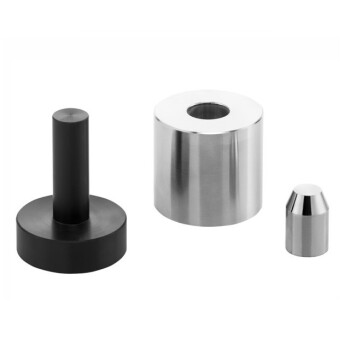
Maintaining constant external pressure is critical to the viability of all-solid-state battery testing because active materials naturally expand and contract during operation. A high-precision pressure device dynamically offsets the mechanical stress caused by these volume changes, preventing the physical separation of the electrode from the electrolyte. Without this precise compensation, the solid-solid interface breaks down, leading to a spike in resistance and rapid battery failure.
The Core Reality: Unlike liquid electrolytes, solid electrolytes cannot flow to fill gaps. Precision pressure acts as a mechanical stabilizer, forcing intimate contact between changing surfaces to ensure ion transport channels remain open throughout the battery's lifespan.
The Mechanical Challenge of Solid-State Chemistry
Volume Expansion and Contraction
During charging and discharging, cathode active materials and high-capacity anodes (such as silicon) undergo significant physical changes. They effectively "breathe," expanding as they store ions and contracting as they release them.
The Problem of Rigidity
In traditional batteries, liquid electrolytes easily flow to fill any voids created by this movement. However, solid-state batteries rely on solid-solid interfaces.
Because solid electrolytes lack fluidity, they cannot self-repair. If an electrode shrinks away from the electrolyte, a physical gap forms immediately. This gap cuts off the ion transport path, rendering that portion of the battery inactive.
Disruption of the Conductive Network
When volume expansion occurs without regulation, it can push materials apart permanently. This leads to the physical detachment of the active material from the solid electrolyte.
Once this contact is lost, the internal electronic conductive network degrades. The immediate result is a sharp increase in interfacial impedance (resistance), which severely limits the battery's performance and cycle life.
How High-Precision Devices Solve the Problem
Dynamic Stress Compensation
A high-precision pressure device (often a uniaxial press with monitoring capabilities) applies a constant "stack pressure," typically ranging from 5 MPa to over 100 MPa depending on the materials.
This pressure acts as a counter-force. As materials expand, the device maintains containment; as they contract, the device presses inward to ensure the surfaces remain locked together.
Preserving Ion Channels
By forcing tight physical contact, the device ensures that ions can move freely between the cathode and the solid electrolyte. This creates a stable environment where the "pores" of the cathode material remain penetrated by the electrolyte.
This intimate contact is essential for minimizing interfacial charge transfer resistance. It allows the battery to function efficiently even as its internal structure undergoes mechanical stress.
Simulation of Real-World Constraints
Testing with high-precision pressure mimics the conditions a battery will face inside a commercial package. Commercial cells are constrained within rigid cases; therefore, testing without external pressure would yield unrealistic data that does not reflect how the battery will perform in an actual application.
Understanding the Risks of Inconsistency
The Cost of Poor Precision
Using a device that cannot maintain constant pressure introduces a major variable into your data. If the pressure fluctuates, the contact quality at the interface changes unpredictably.
Data Reliability
Variations in pressure lead to variations in interfacial resistance. This makes it impossible to distinguish whether a drop in performance is due to the material's chemistry or simply a loss of mechanical contact.
For researchers to obtain repeatable electrochemical data—such as impedance spectra or capacity retention—the forming pressure and cycling pressure must be uniform across all tests.
Making the Right Choice for Your Goal
To maximize the value of your cycling tests, align your pressure strategy with your specific material objectives.
- If your primary focus is Silicon Anodes: Ensure your device can handle and compensate for massive volume expansion, as silicon requires significant pressure (often higher than standard cathodes) to prevent particle cracking and detachment.
- If your primary focus is Material Screening: Prioritize high-precision stability to eliminate contact variance, ensuring that any performance differences observed are due to the material chemistry, not mechanical inconsistencies.
- If your primary focus is Commercial Viability: Select pressure parameters that realistically simulate the mechanical constraints of your target battery pack design (e.g., 5 MPa vs. 100 MPa) to validate real-world performance.
Success in solid-state battery testing is not just about chemistry; it is about mechanically engineering a stable interface through precise pressure control.
Summary Table:
| Challenge | Impact without Precision Pressure | Role of High-Precision Device |
|---|---|---|
| Volume Expansion | Mechanical stress and particle cracking | Dynamically offsets stress and maintains containment |
| Solid-Solid Interface | Physical gaps and loss of contact | Forces intimate contact for continuous ion transport |
| Interfacial Impedance | Sharp increase in resistance | Minimizes charge transfer resistance for efficiency |
| Data Reliability | High variance and unrepeatable results | Eliminates mechanical variables for accurate research |
Maximize Your Battery Research Precision with KINTEK
Don't let mechanical inconsistencies undermine your solid-state battery breakthroughs. KINTEK specializes in comprehensive laboratory pressing solutions, offering a versatile range of manual, automatic, heated, multifunctional, and glovebox-compatible models, alongside advanced cold and warm isostatic presses.
Whether you are mitigating silicon anode expansion or screening new electrolyte chemistries, our high-precision devices ensure the constant stack pressure required to maintain stable interfaces and deliver repeatable, commercial-grade data.
Ready to elevate your lab's testing capabilities? Contact us today to find the perfect pressing solution for your research!
References
- Philip Henkel, Torsten Brezesinski. Beyond Conventional Coatings: Melt‐Infiltration of Antiperovskites for High‐Voltage All‐Solid‐State Batteries. DOI: 10.1002/celc.202500286
This article is also based on technical information from Kintek Solution Knowledge Base .
Related Products
- Warm Isostatic Press for Solid State Battery Research Warm Isostatic Press
- Laboratory Hydraulic Press Lab Pellet Press Button Battery Press
- Button Battery Sealing Press Machine for Lab
- Lab Button Battery Tablet Press Sealing Mold
- Lab Infrared Press Mold for Laboratory Applications
People Also Ask
- Why must composite cathodes be sealed in vacuum lamination bags for WIP? Ensure Battery Stability and Density
- How do sacrificial volume materials (SVM) maintain microchannels in isostatic pressing? Ensure Structural Integrity
- What is the function of elastic molds in warm isostatic pressing? Achieve Uniform Density in Composite Particles
- How does Warm Isostatic Pressing differ from traditional pressing methods? Unlock Uniform Density for Complex Parts
- What is the function of hydraulic pressure in warm isostatic pressing? Achieve Uniform Material Density