Grinding potassium bromide (KBr) directly is a procedural error that significantly degrades the quality of your infrared spectrum. While your sample must be ground to a fine powder to prevent light scattering, you should generally avoid grinding the KBr powder because it exposes fresh crystal facets. These exposed surfaces are highly reactive and rapidly absorb atmospheric moisture, ruining the pellet's transparency and introducing water peaks.
The objective is to disperse a sample into a neutral matrix, not to alter the physical properties of the matrix itself. Grinding KBr increases its hygroscopic nature, causing it to pull water from the air which compromises the "dryness" essential for a clean background signal.
The Chemistry of Contamination
The Hygroscopic Nature of KBr
Potassium bromide is inherently hygroscopic, meaning it naturally attracts and holds water molecules from the surrounding environment.
Under normal storage conditions, the outer surface of KBr powder eventually stabilizes. However, mechanical agitation disrupts this stability.
Exposing Crystal Facets
When you grind KBr, you fracture its crystalline structure.
This fracturing exposes new, high-energy crystal facets that have not yet equilibrated with the atmosphere. These fresh surfaces act like a sponge, aggressively absorbing moisture from the air during the grinding process.
The Consequence for Spectroscopy
Absorbed moisture creates a cloudy pellet rather than a transparent one.
In an IR spectrum, this results in broad, intense absorption bands around 3400 cm⁻¹ (O-H stretch). These bands can easily mask or distort the peaks of the sample you are actually trying to analyze.
Why the Sample Must Be Ground
Preventing Light Scattering
While the KBr should remain relatively coarse, the sample itself must be ground to an extremely fine powder.
If sample particles are larger than the wavelength of the infrared radiation, they will scatter the light rather than absorb it. This scattering causes a sloping baseline and distorts peak shapes, making quantitative analysis impossible.
Ensuring Homogeneity
You are typically mixing a very small amount of sample into a much larger mass of KBr.
Standard protocols suggest a sample concentration of just 0.2% to 1%. For a standard pellet, this means mixing roughly 1-2 mg of sample into 200-250 mg of KBr.
Achieving Uniform Distribution
To distribute such a tiny quantity evenly throughout the pellet, the sample particles must be microscopic.
A finely ground sample ensures the mixture is homogeneous, preventing "hot spots" where the concentration is too high.
Common Pitfalls to Avoid
The "Grind-Mix" Confusion
A common mistake is treating the mixing stage as a grinding stage.
You should grind the sample separately first. When adding it to the KBr, use a gentle folding or mixing motion to blend them, rather than a vigorous grinding action that pulverizes the KBr.
Concentration Overload
It is tempting to add more sample to get a stronger signal, but this often backfires.
Exceeding the recommended 1% concentration limit can lead to total absorption of the IR beam. This results in "flat-topped" peaks where no spectral detail is resolved, rendering the data useless.
Making the Right Choice for Your Goal
To achieve a publication-quality spectrum, you must balance the need for small sample particles with the need for a dry KBr matrix.
- If your primary focus is minimizing water interference: Do not grind the KBr powder; simply mix your pre-ground sample into it gently to preserve the crystal lattice.
- If your primary focus is baseline flatness: Ensure your sample is ground to a flour-like consistency before mixing to minimize scattering artifacts.
Success lies in treating the KBr as a delicate carrier medium, not a reactant to be processed.
Summary Table:
| Process Component | Recommended Action | Reason for Strategy |
|---|---|---|
| Sample Material | Grind to fine powder | Prevents light scattering; ensures homogeneity and flat baselines. |
| KBr Powder | Do not grind directly | Prevents exposure of reactive facets that absorb atmospheric moisture. |
| Mixing Stage | Gentle folding/blending | Distributes sample without fracturing KBr crystals or inducing cloudiness. |
| Concentration | 0.2% to 1.0% | Avoids peak saturation (flat-topping) and maintains signal clarity. |
Elevate Your Spectroscopic Accuracy with KINTEK
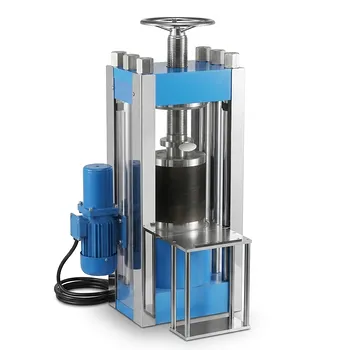
Achieving the perfect pellet requires more than just technique—it requires precision equipment. KINTEK specializes in comprehensive laboratory pressing solutions tailored for high-stakes research. Whether you are conducting battery research or material analysis, our range of manual, automatic, heated, and multifunctional presses, as well as cold and warm isostatic presses, ensures your samples are prepared to the highest standards.
Don't let moisture or poor homogeneity compromise your results. Contact us today to find the ideal pressing solution for your lab and experience the KINTEK advantage in precision and durability.
Related Products
- XRF KBR Plastic Ring Lab Powder Pellet Pressing Mold for FTIR
- XRF KBR Steel Ring Lab Powder Pellet Pressing Mold for FTIR
- Lab Infrared Press Mold for No Demolding
- Square Bidirectional Pressure Mold for Lab
- Laboratory Hydraulic Press 2T Lab Pellet Press for KBR FTIR
People Also Ask
- What is the purpose of making KBr pellets for FTIR? Achieve Precise Molecular Analysis with Solid Samples
- What factors should be considered when choosing a lab press for XRF pellet preparation? Ensure Accurate and Consistent Results
- Why are pellets used in XRF analysis, and what is their limitation? Boost Accuracy and Speed in Your Lab
- How are pellets prepared for XRF analysis and what is a potential drawback? Master XRF Sample Prep and Accuracy
- What are the different types of XRF pellet preparation methods available? Manual, Hydraulic, and Automated Presses Explained