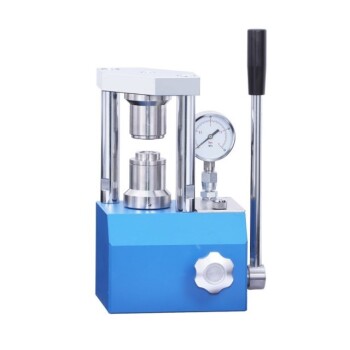
Precise pressure control is critical for ensuring both the safety and the scientific validity of Aluminum-doped Sodium Titanate (NTO-Al) half-cells. A laboratory hydraulic sealing machine applies a specific, constant force—such as 0.65 MPa—to create a hermetic seal and ensure uniform internal contact between battery components.
Failure to apply precise pressure results in two primary failure modes: electrolyte leakage and high internal resistance. The hydraulic sealing machine standardizes the assembly process, ensuring that any observed performance metrics reflect the material's chemistry rather than assembly defects.
The Mechanics of a Perfect Seal
Preventing Electrolyte Leakage
The most immediate function of the hydraulic sealing machine is establishing a perfect mechanical seal.
The machine compresses the coin cell's steel casing to deformation, locking the contents inside. Without this precise crimping force, the volatile electrolyte can escape, rendering the cell useless and potentially damaging testing equipment.
Securing the Internal Stack
Inside the casing, the cell consists of a stack of layers: the NTO-Al electrode, the separator, and the gaskets.
These components must remain in fixed positions relative to one another. The hydraulic pressure locks these layers in place, preventing shifting during the handling or testing phases of the experiment.
Optimizing Electrochemical Performance
Minimizing Contact Resistance
For an NTO-Al half-cell to function correctly, electrons must flow freely between the active material and the current collector.
Precise pressure ensures tight physical contact between the electrodes and the separator. This tight contact minimizes contact resistance (impedance), which is a common source of voltage drop and poor power performance in loosely assembled cells.
Ensuring Data Accuracy
In laboratory settings, the goal is to characterize the specific properties of the NTO-Al material.
If the sealing pressure varies from cell to cell, the internal resistance will also vary. By maintaining a constant pressure (e.g., 0.65 MPa), you ensure that electrochemical test data is accurate, reproducible, and comparable across different experiments.
Risks of Improper Pressure Control
The Consequence of Insufficient Force
If the hydraulic machine is not set to the required pressure, the seal will likely be incomplete.
This leads to immediate leakage or gradual evaporation of the electrolyte solvent. Furthermore, "loose" internal components create voids that interrupt ion flow, leading to noisy or erratic data.
The Problem of Inconsistency
Manual sealing methods often fail to reproduce the exact same force on every crimp.
The hydraulic machine mitigates this by regulating the pressure automatically. Without this consistency, it becomes impossible to determine if a cell failed due to the NTO-Al chemistry or simply because the casing was not crimped tight enough.
Ensuring Success in Your Assembly
To ensure your NTO-Al half-cells yield useful data, prioritize the calibration of your sealing equipment.
- If your primary focus is Safety and Longevity: Ensure the machine consistently hits the target pressure to guarantee a leak-proof mechanical seal for long-term cycling.
- If your primary focus is Data Fidelity: Verify that the pressure is sufficient to minimize contact resistance, ensuring your voltage and capacity readings are not skewed by poor connection artifacts.
Standardizing your sealing pressure is the first step toward obtaining defensible research results.
Summary Table:
| Feature | Impact of Precise Pressure | Risk of Improper Pressure |
|---|---|---|
| Sealing Integrity | Hermetic seal prevents electrolyte leakage | Electrolyte evaporation & equipment damage |
| Internal Contact | Minimizes contact resistance for better ion flow | High impedance & poor power performance |
| Data Reliability | Ensures reproducible & comparable results | Inconsistent data due to assembly defects |
| Component Stability | Prevents shifting of electrodes and separators | Physical layer displacement during testing |
Elevate Your Battery Research with KINTEK Precision
Don’t let assembly variables compromise your material breakthroughs. KINTEK specializes in comprehensive laboratory pressing solutions designed for the rigorous demands of battery research. From manual and automatic hydraulic sealing machines to multifunctional, heated, and glovebox-compatible models, our equipment ensures the precise pressure control required for NTO-Al half-cells and beyond.
Whether you need cold or warm isostatic presses or specialized coin-cell crimpers, KINTEK provides the consistency your data deserves. Contact us today to find the perfect sealing solution for your lab!
References
- Chen Wu, Chunliu Xu. Improving Na2Ti3O7 Anode Performance in Sodium-Ion Batteries via a Al Doping. DOI: 10.3390/nano15120885
This article is also based on technical information from Kintek Solution Knowledge Base .
Related Products
- Button Battery Sealing Press Machine for Lab
- Laboratory Hydraulic Press Lab Pellet Press Machine for Glove Box
- Automatic Laboratory Hydraulic Press Lab Pellet Press Machine
- Automatic Heated Hydraulic Press Machine with Heated Plates for Laboratory
- 24T 30T 60T Heated Hydraulic Lab Press Machine with Hot Plates for Laboratory
People Also Ask
- Why use standardized CR2032 components & high-precision presses? Ensure reliability in lithium metal battery research.
- Why is a laboratory battery sealing press essential for desolvation energy testing? Ensure Reliable Kinetic Data
- Why is a laboratory hydraulic press or battery sealing machine essential? Ensure Coin Cell Data Integrity
- How do laboratory battery sealing machines ensure performance consistency? Master Your Lithium and LFP Battery Assembly
- What role does a laboratory sealing press play in thermal analysis of solid dispersion films? Ensure Data Integrity