
The hot-pressing process is the critical enabler for activating the electrochemical potential of LLZTO/PVDF electrolytes. It physically transforms the material from a loose, porous membrane into a dense, integrated sheet. By applying heat to soften the polymer and pressure to compact the structure, you effectively eliminate insulating air gaps and force the polymer to bond tightly with ceramic particles, establishing the continuous pathways necessary for lithium-ion transport.
Core Insight: The as-cast state of a composite electrolyte is inherently flawed due to microscopic porosity caused by solvent evaporation. Hot-pressing corrects this by doubling the membrane's density, often increasing ionic conductivity by three orders of magnitude.
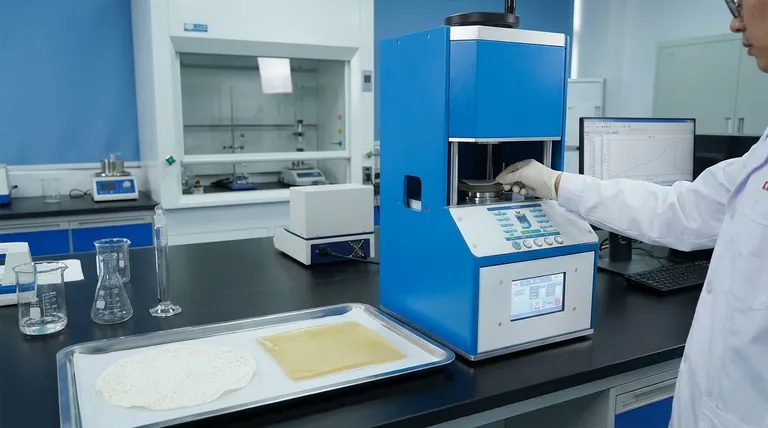
The Physical Barrier in Composite Electrolytes
The Problem of Residual Porosity
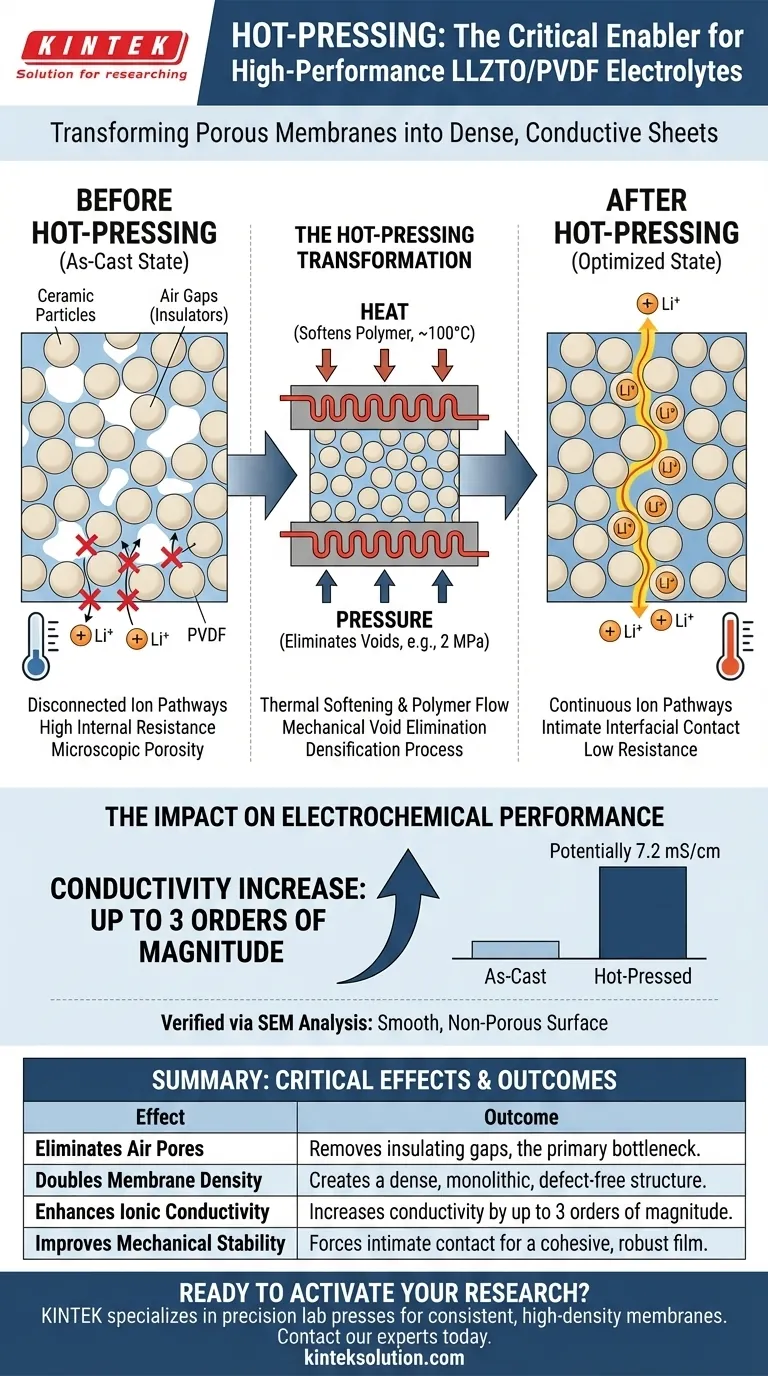
When LLZTO/PVDF membranes are formed via spray coating or casting, the evaporation of solvents inevitably leaves behind microscopic pores. These voids are filled with air, which acts as an electrical insulator within the material.
Disconnected Ion Pathways
In this loose, "as-cast" state, the contact between the conductive ceramic fillers (LLZTO) and the polymer matrix (PVDF) is poor. Ions cannot travel efficiently because the physical pathways are interrupted by gaps, resulting in high internal resistance and poor battery performance.
How Hot-Pressing Transforms the Microstructure
Thermal Softening and Polymer Flow
The heated platens of the press raise the temperature of the membrane, usually to around 100°C. This heat reduces the viscosity of the PVDF polymer, causing it to soften and flow.
Mechanical Void Elimination
Simultaneously, the application of pressure (e.g., 2 MPa) forces this softened polymer into the interstitial spaces between the ceramic particles. This action squeezes out the air pockets and fills the voids that were created during the initial drying process.
Creating a Monolithic Structure
The result is a "densification" process where the membrane's density can effectively double. The material shifts from a collection of loosely associated layers into a single, defect-free monolithic film with intimate interfacial contact.
The Impact on Electrochemical Performance
Orders of Magnitude Improvement
The elimination of porosity has a drastic effect on conductivity. Research indicates that this densification can increase room-temperature ionic conductivity by up to three orders of magnitude.
Establishing Continuous Transport Channels
By creating tight contact at the grain boundaries and between the polymer and ceramic, hot-pressing establishes continuous diffusion pathways. This allows lithium ions to move freely through the composite, potentially achieving conductivity levels as high as 7.2 mS/cm.
Verification via Microscopic Analysis
The success of this process is visibly measurable. Scanning Electron Microscopy (SEM) comparisons typically show a stark contrast: a porous, rough cross-section before pressing, versus a smooth, non-porous surface after pressing.
Critical Process Variables and Trade-offs
The Necessity of Precision
While hot-pressing is vital, it is not a brute-force method; it requires precise control. You must balance the temperature to ensure the polymer flows without degrading, and apply the correct pressure to densify the film without crushing the ceramic fillers.
Physical Property interdependence
The process does not just improve conductivity; it also impacts mechanical stability. A well-pressed film has better mechanical properties and optimized glass transition temperatures, but achieving this requires optimizing the press cycle for the specific thickness and composition of your membrane.
Making the Right Choice for Your Goal
To maximize the performance of your LLZTO/PVDF electrolyte, align your processing parameters with your specific objectives:
- If your primary focus is maximizing ionic conductivity: Prioritize higher pressures within the polymer's stability window to ensure absolute elimination of microscopic voids, as air gaps are the primary bottleneck for ion transport.
- If your primary focus is mechanical integrity: Focus on the temperature variable to ensure sufficient polymer flow and molecular chain rearrangement, creating a cohesive, monolithic film that resists physical stress.
Hot-pressing is not merely a finishing step; it is the fundamental activation mechanism that turns a raw composite mixture into a functional solid-state electrolyte.
Summary Table:
| Hot-Pressing Effect | Outcome |
|---|---|
| Eliminates Air Pores | Removes insulating gaps, the primary bottleneck for ion transport. |
| Doubles Membrane Density | Creates a dense, monolithic structure from a loose, porous film. |
| Enhances Ionic Conductivity | Can increase conductivity by up to three orders of magnitude (e.g., to 7.2 mS/cm). |
| Improves Mechanical Stability | Forces intimate polymer-ceramic contact for a cohesive, robust film. |
Ready to activate the full potential of your solid-state electrolyte research?
KINTEK specializes in precision lab press machines, including automatic lab presses and heated lab presses, designed to deliver the exact temperature and pressure control required to replicate the critical hot-pressing process for materials like LLZTO/PVDF. Achieve consistent, high-density membranes and unlock superior ionic conductivity in your lab.
Contact our experts today to find the ideal press for your specific electrolyte development goals.
Visual Guide
Related Products
- Automatic Heated Hydraulic Press Machine with Hot Plates for Laboratory
- Automatic High Temperature Heated Hydraulic Press Machine with Heated Plates for Lab
- Lab Heat Press Special Mold
- Laboratory Manual Heated Hydraulic Press Machine with Hot Plates
- Heated Hydraulic Press Machine with Heated Plates for Vacuum Box Laboratory Hot Press
People Also Ask
- Function of a Laboratory Hydraulic Press with Heated Platens in SSE? Enhance Battery Density & Conductivity
- Why is a laboratory hydraulic press with heating plates required for PLA/TEC films? Achieve Precise Sample Integrity
- What are the requirements for electrode pressing with high-viscosity ionic liquids like EMIM TFSI? Optimize Performance
- How does a laboratory heated hydraulic press facilitate PBN sample prep for WAXS? Achieve Precise X-Ray Scattering
- What are the industrial applications of heated hydraulic presses? Master Heat & Force for Precision Manufacturing

















