
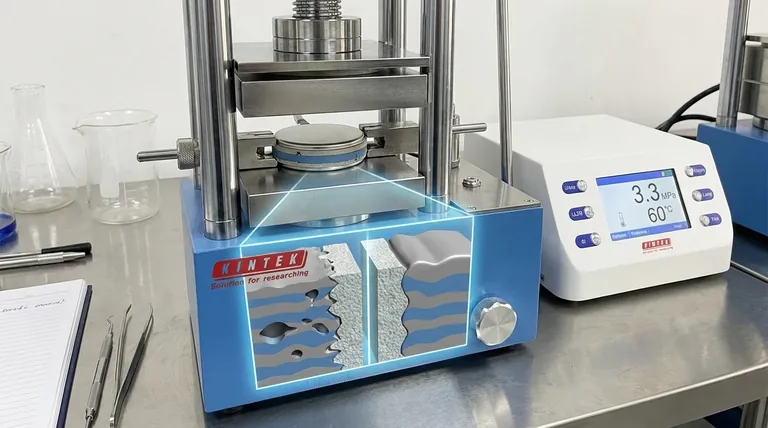
Precise stack pressure is the mechanical catalyst required to activate the electrochemical interface. Applying a specific load, such as 3.3 MPa, forces the malleable metallic lithium anode into intimate physical contact with the rigid, microscopic surface irregularities of the LLZO electrolyte. This mechanical bridging is the only way to eliminate insulating voids and establish a continuous pathway for ion transport in a solid-state system.
The Core Insight In liquid batteries, the electrolyte naturally wets the electrode to create perfect contact. In solid-state batteries (like Li|LLZO|Li), the interface is inherently rough and discontinuous. Precise pressure artificially replicates this "wetting" by physically deforming the lithium against the ceramic, minimizing resistance and enabling the cell to function reliably.
The Physical Challenge of Solid Interfaces
Overcoming Microscopic Roughness
Even highly polished LLZO pellets possess surface roughness on a microscopic scale. When placed against a lithium foil without pressure, the two materials only touch at the highest peaks of their topography.
This results in a severely limited effective contact area, leaving the majority of the interface separated by air or vacuum gaps.
Eliminating Interfacial Voids
Voids at the interface are essentially dead zones where no electrochemical reaction can occur. These gaps act as insulators, blocking the flow of lithium ions.
Applying precise pressure, such as 3.3 MPa, utilizes the ductility of lithium metal. It forces the lithium to deform and fill these voids, transitioning the interface from a series of discrete contact points to a seamless, void-free boundary.
The Electrochemical Impact
Drastic Reduction of Impedance
The primary obstacle in Li|LLZO|Li cells is interfacial resistance (impedance). High resistance signifies a barrier to ion movement, leading to voltage drops and poor efficiency.
By maximizing the contact area through pressure, you significantly lower this resistance. This creates an unobstructed pathway for ions to move rapidly between the electrode and the electrolyte.
Achieving Uniform Ion Flux
When contact is poor (low pressure), the current is forced to funnel through the few tiny points where the materials actually touch. This creates "hot spots" of extremely high local current density.
Uniform pressure ensures the current is distributed evenly across the entire surface. This uniformity is critical for preventing the formation of lithium dendrites, which thrive in high-current-density hotspots.
Enabling High Critical Current Density (CCD)
References indicate that high-quality interfaces are fundamental for obtaining a high Critical Current Density. This is the maximum current the cell can handle before failing (usually via short-circuiting).
Without the intimate contact provided by stack pressure, the cell will fail prematurely even at low currents because the local flux at the contact points exceeds the material's limits.
Understanding the Trade-offs
The Balance of Precision
While the goal is intimate contact, the pressure must be "precise" rather than simply "maximum."
Stability vs. Deformation
The pressure must be sufficient to maintain contact during the volume changes associated with cycling. However, it must be controlled to avoid fracturing the brittle ceramic electrolyte or causing excessive creep of the lithium metal, which could lead to short circuits around the edges of the pellet.
The value of 3.3 MPa represents a specific optimization point—likely high enough to ensure void-free contact for testing, but controlled enough to maintain the structural integrity of the specific cell setup.
Making the Right Choice for Your Goal
How to Apply This to Your Project
The specific pressure required often depends on the surface finish of your LLZO and the hardness of your lithium source, but the principles remain constant.
- If your primary focus is Impedance Reduction: Ensure your pressure is uniform across the entire face of the pellet to maximize the active surface area.
- If your primary focus is Long-Term Cycling: Maintain the pressure consistently throughout the test to prevent contact loss as the lithium is stripped and plated.
- If your primary focus is High-Rate Performance: You may need higher pressures to ensure the interface can sustain rapid ion transport without creating flux hotspots.
Ultimately, stack pressure is not just an assembly variable; it is a structural component that defines the effective surface area and stability of your solid-state battery.
Summary Table:
| Aspect | Low/No Pressure | Precise Pressure (e.g., 3.3 MPa) |
|---|---|---|
| Contact Area | Limited to microscopic peaks | Maximized, void-free interface |
| Interfacial Resistance | High, blocking ion flow | Drastically reduced |
| Ion Flux | Uneven, creates hotspots | Uniform across the interface |
| Critical Current Density (CCD) | Low, premature failure | High, stable performance |
| Dendrite Risk | High due to localized current | Mitigated through even distribution |
Achieve reliable, reproducible results in your solid-state battery research with KINTEK's precision lab press machines.
Our automatic lab presses and heated lab presses are engineered to deliver the precise, uniform stack pressure required for assembling Li|LLZO|Li symmetric cells and other advanced battery configurations. Whether your focus is impedance reduction, long-term cycling stability, or high-rate performance, KINTEK equipment ensures your interfacial conditions are consistently controlled.
Let us help you eliminate interfacial voids and unlock accurate electrochemical data. Contact our experts today to discuss how our lab press solutions can enhance your solid-state battery development.
Visual Guide

Related Products
- Warm Isostatic Press for Solid State Battery Research Warm Isostatic Press
- Lab Button Battery Tablet Press Sealing Mold
- Laboratory Hydraulic Press Lab Pellet Press Button Battery Press
- Button Battery Sealing Press Machine for Lab
People Also Ask
- Why must composite cathodes be sealed in vacuum lamination bags for WIP? Ensure Battery Stability and Density
- What is the function of elastic molds in warm isostatic pressing? Achieve Uniform Density in Composite Particles
- How do sacrificial volume materials (SVM) maintain microchannels in isostatic pressing? Ensure Structural Integrity
- What is the significance of temperature control in Warm Isostatic Pressing? Unlock Uniform Densification and Process Stability
- What is the mechanism of a Warm Isostatic Press (WIP) on cheese? Master Cold Pasteurization for Superior Safety



