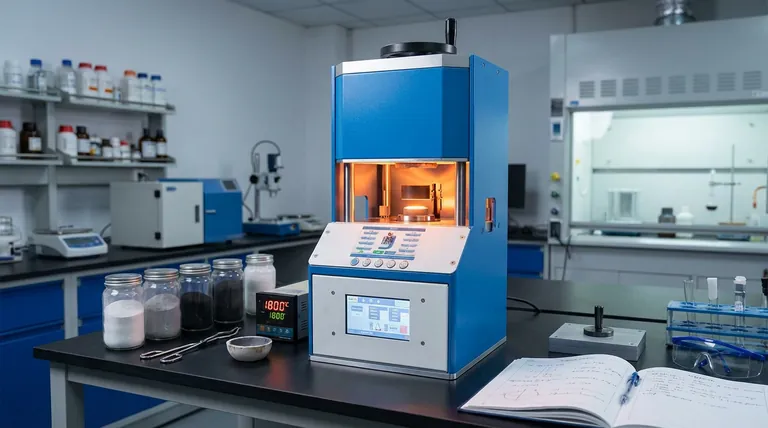
The Psychology of Reluctant Materials
In the world of materials science, some elements bond with the cheerful ease of old friends. They flow, mix, and solidify into predictable structures.
Others are profoundly stubborn.
Think of advanced ceramics like silicon carbide. Their atoms are locked in rigid, covalent bonds, unwilling to move or rearrange. They resist consolidation. Trying to densify them with heat alone is like trying to merge two ice cubes by just warming the room—it doesn't work effectively.
This inherent reluctance isn't a flaw; it's the source of their incredible strength and resilience. But it presents a fundamental challenge: how do you convince these stubborn atoms to form a dense, flawless solid without destroying the very properties you seek?
You don't just ask. You apply overwhelming persuasion.
The Physics of Persuasion: How Hot Pressing Works
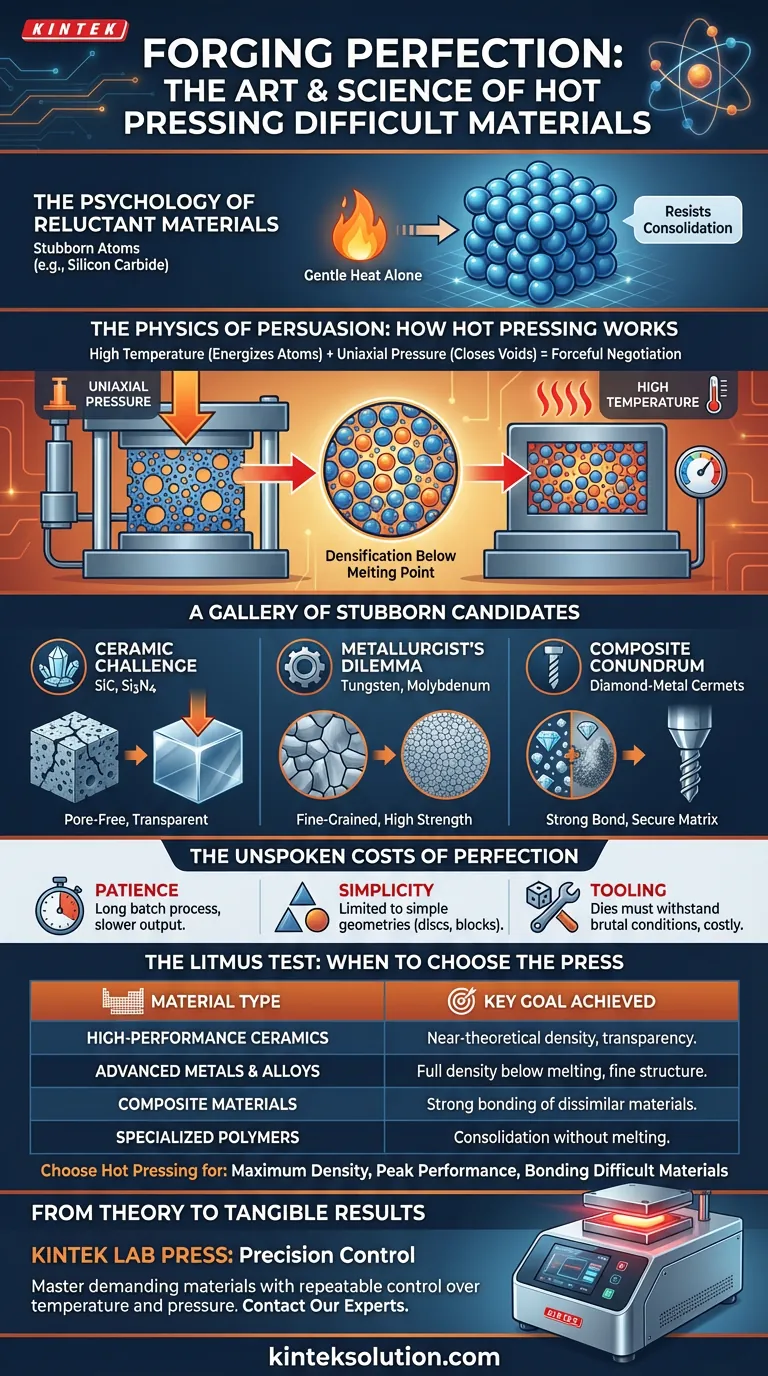
Hot pressing is a method of forceful negotiation with a material's atomic structure. It applies two powerful influences simultaneously:
- High Temperature: This energizes the atoms, making them more agitated and willing to move (increasing diffusion).
- Uniaxial Pressure: This physically forces the material's particles together, closing voids and accelerating plastic deformation.
The core principle is to achieve densification below the material's melting point. It’s a controlled, high-stress process for materials that refuse to cooperate under gentler conditions.
A Gallery of Stubborn Candidates
The need for this technique becomes clear when you look at the materials that depend on it. These are not your everyday plastics or alloys; they are elite performers on the material stage.
The Ceramic Challenge: Defying Covalent Bonds
For high-performance ceramics like Silicon Nitride (Si3N4) and Silicon Carbide (SiC), porosity is the enemy. Every tiny void is a potential point of failure. Conventional sintering often leaves residual pores because the material's atoms simply won't diffuse enough to fill them.
Hot pressing physically crushes these voids out of existence. This is the only practical way to create certain transparent ceramics, where even microscopic pores would scatter light and render the material opaque. It's the difference between a cloudy lens and a perfect window.
The Metallurgist's Dilemma: Density Without Destruction
Refractory metals like tungsten and molybdenum have incredibly high melting points. While you could melt them, doing so often leads to unwanted grain growth, which can compromise their mechanical properties.
Hot pressing allows metallurgists to achieve full density at temperatures well below melting. This preserves the fine-grained microstructure that is critical for high-strength applications in aerospace, defense, and industrial tooling. It’s a technique for achieving density while protecting the material’s delicate internal architecture.
The Composite Conundrum: Uniting Opposites
How do you create a cutting tool by embedding diamond particles into a metal matrix? The two materials are fundamentally dissimilar. They won't sinter together naturally.
Hot pressing is the answer. It provides the necessary energy and force to forge a powerful bond between the metal and the diamond grit. The pressure creates a dense, consolidated matrix that locks the functional particles securely in place, forming a high-performance cermet that is far greater than the sum of its parts.
The Unspoken Costs of Perfection
This level of material control is powerful, but it comes with significant trade-offs. Hot pressing is a scalpel, not a sledgehammer, and its use is deliberate and calculated.
- The Price of Patience: It is a batch process. The cycles of heating, pressing, and cooling are long, making it slower and more expensive per-part than continuous methods.
- The Constraint of Simplicity: The uniaxial pressure limits output to simple geometries like discs, blocks, and cylinders. Complex shapes require extensive and costly post-machining.
- The Burden of Tooling: The dies must withstand brutal conditions. Graphite is common but has a limited life. Reactive materials demand even more exotic and expensive tooling.
The Litmus Test: When to Choose the Press
Deciding on hot pressing is a strategic choice based on your final objective. It is not a universal solution, but for certain problems, it is the only solution.
| Material Type | Examples | Key Goal Achieved by Hot Pressing |
|---|---|---|
| High-Performance Ceramics | Silicon Carbide (SiC), Silicon Nitride (Si3N4) | Near-theoretical density, exceptional strength, transparency |
| Advanced Metals & Alloys | Tungsten, Molybdenum | Full densification below melting point, fine-grained structure |
| Composite Materials | Diamond-metal composites (cermets) | Strong bonding of dissimilar materials, secure matrix |
| Specialized Polymers | Polymer beads, sheet materials | Consolidation without melting, unique composite structures |
If your goal is maximum density and peak performance where cost is secondary, hot pressing is your method. If you need to bond materials that otherwise refuse to mix, it is essential.
From Theory to Tangible Results
Understanding these principles is the first step. The second is bridging the gap between theory and a tangible, perfectly densified part sitting on your lab bench. That requires an instrument capable of exerting precise, repeatable control over extreme temperature and pressure.
This is where a dedicated laboratory press becomes the critical tool. KINTEK's range of heated and automatic lab presses are engineered to provide researchers and engineers with the control necessary to master these demanding materials. They transform the forceful persuasion of hot pressing from a concept into a reliable, repeatable process.
Translating demanding material science principles into breakthrough results requires precision-engineered equipment. If you're ready to master the art of densification for your most challenging materials, Contact Our Experts.
Visual Guide
Related Products
- Automatic High Temperature Heated Hydraulic Press Machine with Heated Plates for Lab
- Heated Hydraulic Press Machine with Heated Plates for Vacuum Box Laboratory Hot Press
- Automatic Heated Hydraulic Press Machine with Hot Plates for Laboratory
- Heated Hydraulic Press Machine With Heated Plates For Vacuum Box Laboratory Hot Press
- Laboratory Split Manual Heated Hydraulic Press Machine with Hot Plates
Related Articles
- The Architecture of Slow: Why Physical Precision Dictates Chemical Destiny
- The Architecture of Certainty: Why the Laboratory Press is the Anchor of Material Science
- The Vanishing Boundary: The Hidden Thermodynamics of LTCC Lamination
- The Alchemy of 160°C: Why Precision Pressing is the Silent Backbone of Rubber Science
- The Invisible Forge: Why the Laboratory Press is the Soul of Nano-Composites



















