The Illusion of Control
A laboratory hot press seems simple. It heats. It squeezes. The controls are set, the parameters are logged, and we expect a predictable outcome.
Yet, many researchers have faced the frustration of an inconsistent result. An experiment, repeated under what appears to be identical conditions, yields a different outcome. The cause is often an invisible variable, a subtle deviation in the two most fundamental forces at play: heat and pressure.
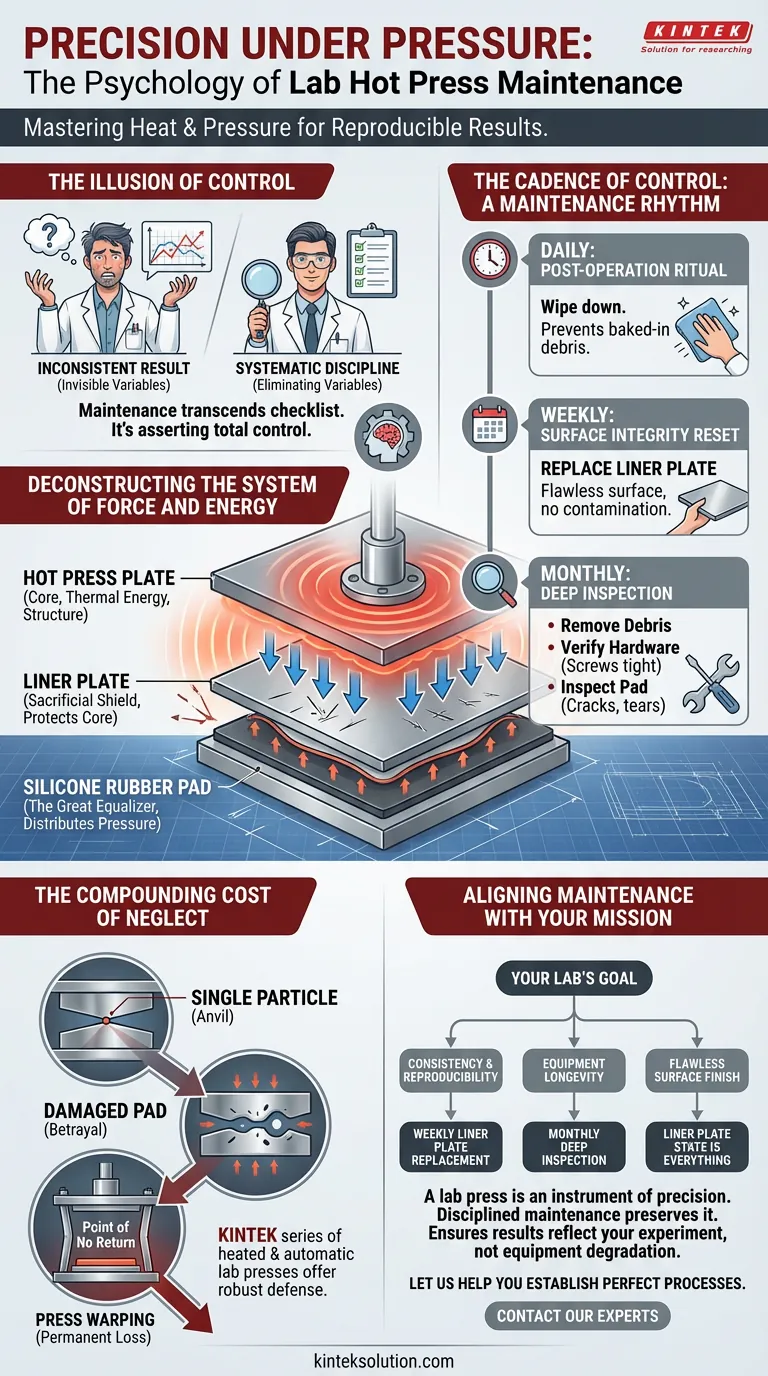
This is where maintenance transcends the checklist. It becomes a scientific discipline—a systematic effort to eliminate the unseen variables that undermine reproducibility. It's not about janitorial care; it's about asserting total control over your process.
Deconstructing the System of Force and Energy
To master the machine, you must understand its core components not as individual parts, but as a system designed for the uniform transfer of energy.
- The Hot Press Plate: This is the heart of the machine, the source of thermal energy and the structural foundation for pressure. Its integrity is paramount.
- The Liner Plate: This is the unsung hero—a sacrificial shield. It takes the scratches, spills, and abuse, preserving the pristine surface of the expensive hot plate. Its role is to be consumed so the core may endure.
- The Silicone Rubber Pad: This is the great equalizer. In applications like lamination, it conforms to micro-imperfections, translating raw force from the press into perfectly distributed pressure across your entire sample.
The Cadence of Control: A Maintenance Rhythm
Discipline is the bridge between a machine's potential and your actual results. A consistent maintenance schedule isn't a chore; it's a rhythm that ensures reliability.
Daily: The Post-Operation Ritual
Once the machine has cooled, wipe down all work surfaces. This simple act prevents the day's residual dust or material from becoming a baked-in, permanent variable in tomorrow's work.
Weekly: The Surface Integrity Reset
The upper liner plate is your sample's first point of contact. Replacing it weekly is the single most important habit for guaranteeing a flawless surface finish and preventing cross-contamination between different materials.
Monthly: The Deep Inspection
A monthly disassembly of the liner plate assembly allows for a forensic examination.
- Remove Debris: Clean out any trapped dust or resin that could create pressure points.
- Verify Hardware: Check that all screws are tight. Thermal cycling and vibration inevitably work to loosen them.
- Inspect for Damage: Examine the liner plate and silicone pad for cracks, tears, or hardening. A compromised pad doesn't just fail; it actively creates uneven pressure.
The Compounding Cost of Neglect
We often delay maintenance because the machine seems to be working fine. This is a cognitive bias. The degradation is often gradual, introducing subtle errors that we misattribute to other factors until a critical failure occurs.
- The Tyranny of a Single Particle: A tiny fleck of cured resin trapped between the plates becomes an anvil. It creates a high-pressure point, leading to inconsistent thickness, poor density, and a flawed surface finish.
- The Betrayal of a Damaged Pad: A hardened or cracked silicone pad betrays its purpose. Instead of distributing pressure, it concentrates it in some areas and creates voids in others, leading to delamination or incomplete curing.
- The Point of No Return: Over time, immense loads can cause physical warping in the press structure. This is a permanent loss of precision. Investing in a robustly engineered machine, like the KINTEK series of heated and automatic lab presses, provides a critical defense against such failures, but even the best equipment requires diligent care.
| Task | Frequency | Core Objective |
|---|---|---|
| Post-Operation Cleaning | Daily | Prevent debris from becoming a permanent process variable. |
| Liner Plate Replacement | Weekly | Guarantee pristine surface quality and prevent contamination. |
| Deep Inspection | Monthly | Proactively identify component fatigue before it causes failure. |
Aligning Maintenance with Your Mission
Your lab's primary goal should dictate your maintenance focus. It's not about doing everything, but about doing what matters most for your work.
- If your mission is process consistency and reproducibility: The weekly liner plate replacement is non-negotiable. It eliminates surface quality as a variable.
- If your mission is equipment longevity and maximum uptime: The monthly deep inspection is your priority. It catches small issues before they become catastrophic failures.
- If your mission is a high-quality, flawless surface finish: The state of the liner plate is everything. It must be pristine for every critical run.
Ultimately, a lab press is an instrument of precision. Disciplined maintenance is simply the act of preserving that precision. It ensures the results you record reflect your experiment, not the slow, silent degradation of your equipment.
Whether your work demands an automatic lab press, an isostatic press, or a heated lab press, a reliable machine is only the starting point. Let us help you establish the processes that ensure perfect results every time. Contact Our Experts
Visual Guide
Related Products
- 24T 30T 60T Heated Hydraulic Lab Press Machine with Hot Plates for Laboratory
- Manual Heated Hydraulic Lab Press with Integrated Hot Plates Hydraulic Press Machine
- Automatic High Temperature Heated Hydraulic Press Machine with Heated Plates for Lab
- Laboratory Split Manual Heated Hydraulic Press Machine with Hot Plates
- Automatic Heated Hydraulic Press Machine with Hot Plates for Laboratory
Related Articles
- The Invisible Forge: Why the Laboratory Press is the Soul of Nano-Composites
- The Architecture of Slow: Why Physical Precision Dictates Chemical Destiny
- The Architecture of Density: Why Pressure is the Silent Architect of Solid-State Batteries
- The Physics of Transparency: Why Pressure is the Silent Architect of Spectroscopic Clarity
- The Architecture of Certainty: Why the Laboratory Press is the Anchor of Material Science



















