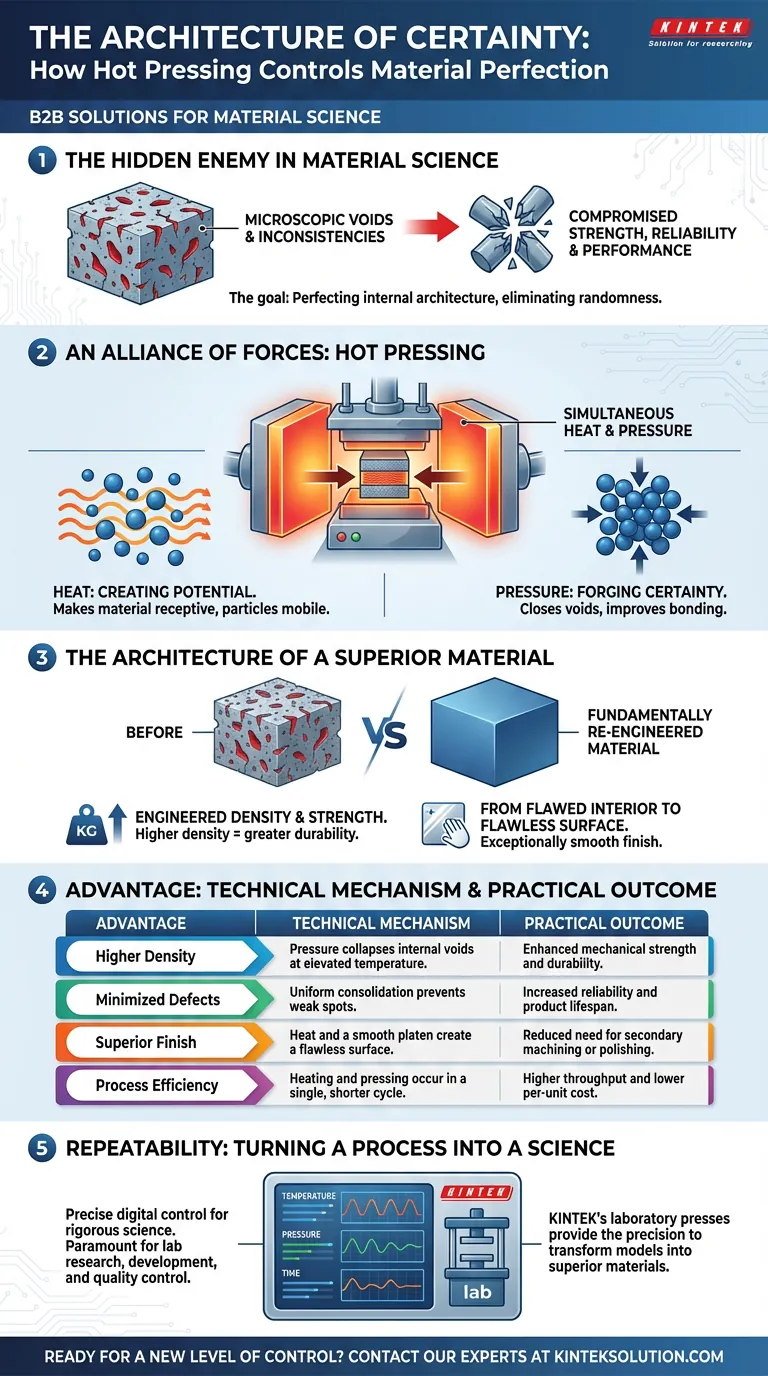
The Hidden Enemy in Material Science
Imagine a component failing. Not from a visible crack or an obvious design flaw, but from an enemy within: a network of microscopic voids, an inconsistent density that created an invisible point of weakness.
This is the silent battle fought in materials science and advanced manufacturing. The goal isn't just to shape a material, but to perfect its internal architecture. The enemy is randomness—the porosity and imperfections that compromise strength, reliability, and performance.
The pursuit of perfection is a quest for control.
An Alliance of Forces, Not Brute Force
Conventional methods often treat heat and pressure as separate, sequential steps. You heat something to make it pliable, then you press it into shape.
Hot pressing is fundamentally different. It's a strategic alliance where heat and pressure are applied simultaneously. This isn't just about combining two steps into one; it's about using their interaction to achieve a level of control that neither can offer alone.
It’s a simple concept with profound implications.
The Role of Temperature: Creating Potential
Heat makes the material receptive to change. By applying uniform, precisely controlled temperature, a hot press energizes the material's particles, reducing their bond strength and making them mobile.
This uniformity is critical. Uneven heating creates internal stresses and weak spots—the very flaws we aim to eliminate. A modern hot press acts like a symphony conductor, ensuring every part of the material is ready for transformation at the exact same moment.
The Role of Pressure: Forging Certainty
With the material in a receptive state, immense pressure is applied. This force is not just for shaping. Its primary purpose is consolidation.
The pressure physically closes the microscopic voids and pores that plague other processes. It forces the material particles into a tightly packed, ordered structure, dramatically improving the bonding between grains. This is how you build certainty into the very core of a workpiece.
The Architecture of a Superior Material
The result of this synchronized process is not merely a shaped object. It's a fundamentally re-engineered material with a new standard of quality.
Engineered Density and Strength
By eliminating internal voids, the hot press creates a workpiece with significantly higher density. Density is a direct proxy for strength and durability. The final product is tougher, more resilient, and capable of withstanding greater stress.
From Flawed Interior to Flawless Surface
The same forces that perfect the material's core also refine its exterior. The combination of heat and the smooth surface of the press platen produces an exceptionally smooth, high-quality surface finish.
This often eliminates the need for costly and time-consuming secondary finishing steps, streamlining the entire production workflow.
| Advantage | Technical Mechanism | Practical Outcome |
|---|---|---|
| Higher Density | Pressure collapses internal voids at elevated temperature. | Enhanced mechanical strength and durability. |
| Minimized Defects | Uniform consolidation prevents weak spots. | Increased reliability and product lifespan. |
| Superior Finish | Heat and a smooth platen create a flawless surface. | Reduced need for secondary machining or polishing. |
| Process Efficiency | Heating and pressing occur in a single, shorter cycle. | Higher throughput and lower per-unit cost. |
Repeatability: Turning a Process into a Science
The true beauty of a modern hot press lies in its digital control. The ability to precisely manage and repeat cycles of temperature, pressure, and time turns what could be an art form into a rigorous science.
In a laboratory setting, this is non-negotiable. Whether developing new composites, testing advanced ceramics, or performing quality control, the ability to replicate conditions perfectly is paramount. Each successful test must be repeatable, and each failure must be analyzable.
This is where the equipment itself becomes a partner in discovery. A lab-scale hot press is more than a tool; it's an instrument for imposing order and achieving predictable, high-quality results, batch after batch.
For research and development teams aiming to push the boundaries of material science, this level of control is the foundation of innovation. KINTEK's range of heated laboratory presses is engineered to provide this exact certainty, offering the precision needed to transform theoretical models into tangible, superior materials.
Ready to achieve a new level of control over your material processing? Contact Our Experts
Visual Guide
Related Products
- Heated Hydraulic Press Machine with Heated Plates for Vacuum Box Laboratory Hot Press
- Automatic High Temperature Heated Hydraulic Press Machine with Heated Plates for Lab
- Automatic Heated Hydraulic Press Machine with Hot Plates for Laboratory
- Laboratory Split Manual Heated Hydraulic Press Machine with Hot Plates
- Laboratory Manual Heated Hydraulic Press Machine with Hot Plates
Related Articles
- The Architecture of Slow: Why Physical Precision Dictates Chemical Destiny
- The Architecture of Certainty: Why the Laboratory Press is the Anchor of Material Science
- The Vanishing Boundary: The Hidden Thermodynamics of LTCC Lamination
- The Alchemy of 160°C: Why Precision Pressing is the Silent Backbone of Rubber Science
- The Invisible Forge: Why the Laboratory Press is the Soul of Nano-Composites



















