The Illusion of Solidity
A material's strength isn't just about its chemical formula. It's about its internal architecture.
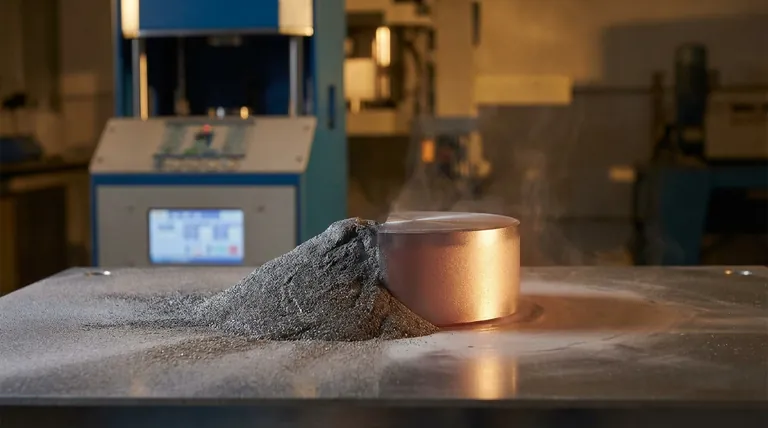
Imagine a pile of sand. You can compress it, but it will never be a sandstone pillar. The individual grains are strong, but the whole is weak because it lacks unity. It's filled with voids, and the particles have no real connection to one another.
This is the fundamental challenge in powder metallurgy: transforming a loose collective of particles into a monolithic, unified solid. The goal isn't just to reduce the space between them, but to erase the very memory that they were ever separate.
The Physics of Unity: Heat and Pressure
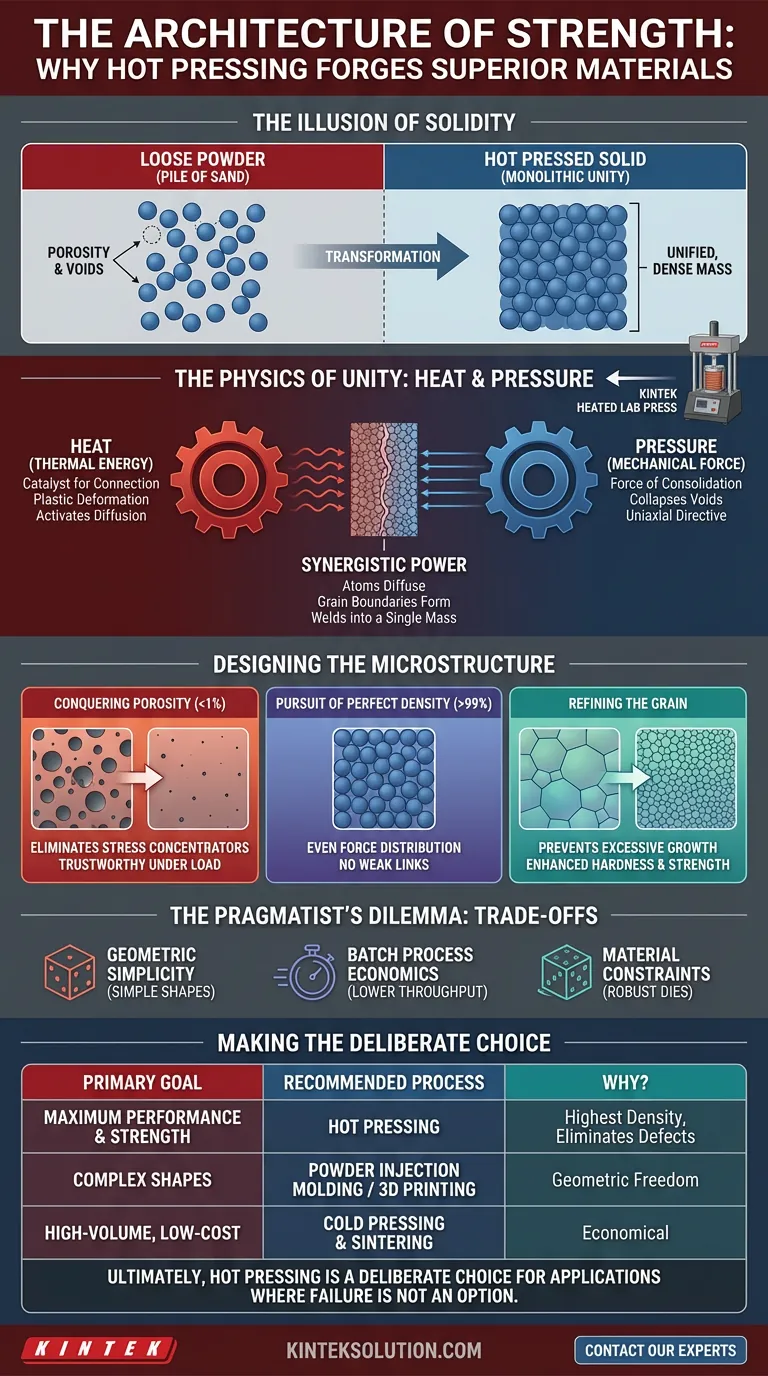
Hot pressing achieves this unity by orchestrating a powerful partnership between thermal energy and mechanical force. One coaxes, the other commands. Together, they remake the material from the inside out.
Heat: The Catalyst for Connection
Temperature is the great enabler. By heating a material below its melting point, you're not trying to liquefy it. You're giving its atoms the energy to move.
This thermal energy "softens" the particles, allowing them to change shape under pressure—a state known as plastic deformation. More importantly, it ignites diffusion, the slow, deliberate migration of atoms across particle boundaries. Heat lowers the social barriers between particles, making them ready to connect.
Pressure: The Force of Consolidation
While heat makes particles compliant, uniaxial pressure provides the unyielding directive. Applied through a rigid die, it forces the softened particles into intimate contact.
This pressure is the enemy of empty space. It physically collapses the voids, or porosity, that riddle a loose powder. It rearranges the particles into the most efficient, tightly-packed configuration possible, maximizing the surface area available for bonding.
The Synergistic Power
Neither heat nor pressure is enough on its own. Their true power is in their synergy.
Pressure creates the contact; heat solidifies the bond. As atoms diffuse across the newly formed interfaces, the original boundaries between particles begin to dissolve. They are replaced by strong, continuous grain boundaries, effectively welding the powder into a single, dense mass.
This delicate dance between thermal energy and mechanical force is where specialized equipment, like a KINTEK Heated Lab Press, becomes indispensable. It's the instrument that allows an engineer to command this transformation with precision, ensuring that heat and pressure work in perfect harmony.
Designing the Microstructure
The result of this process is a material with an intentionally engineered internal architecture, optimized for strength and reliability.
Conquering the Enemy Within: Porosity
Pores are the primary villain in the story of mechanical failure. These microscopic voids act as stress concentrators. When a load is applied, the stress amplifies at the edge of a pore, creating the perfect starting point for a crack.
Hot pressing can reduce porosity to less than 1%, effectively eliminating these built-in failure points. The resulting material is more trustworthy under load because its internal structure is sound.
The Pursuit of Perfect Density
Densification is the measure of success. By achieving over 99% of a material's theoretical maximum density, hot pressing ensures that any applied force is distributed evenly across a solid, continuous structure. There are no weak links or empty spaces to compromise its integrity.
Refining the Grain: A Lesson in Restraint
In many materials, smaller grain sizes correlate with higher strength. Because hot pressing is so efficient, it can often be performed at lower temperatures and for shorter durations than conventional sintering.
This disciplined approach helps prevent excessive grain growth, resulting in a fine-grained microstructure that further enhances hardness and fracture resistance. It’s a testament to the idea that sometimes, strength comes from restraint.
The Pragmatist's Dilemma: Understanding the Trade-Offs
No process is a universal solution. The exceptional performance delivered by hot pressing comes with practical constraints.
- Geometric Simplicity: The reliance on a rigid die and uniaxial pressure limits the process to simple shapes like discs, cylinders, and blocks.
- Batch Process Economics: Hot pressing is a cycle-based batch process. The heating, pressing, and cooling times result in lower throughput compared to continuous methods.
- Material Constraints: The die itself must be made from robust, often expensive materials like graphite or advanced ceramics to withstand the extreme conditions.
Making the Deliberate Choice
Choosing a manufacturing process is about aligning your primary objective with the right tool. The decision is a reflection of your priorities.
| Primary Goal | Recommended Process | Why? |
|---|---|---|
| Maximum Performance & Strength | Hot Pressing | Achieves the highest density and eliminates defects. |
| Complex Shapes | Powder Injection Molding / 3D Printing | Offers geometric freedom, though may need secondary steps. |
| High-Volume, Low-Cost | Cold Pressing & Sintering | More economical for less demanding applications. |
Ultimately, hot pressing is a deliberate choice for applications where failure is not an option. It is the method for architects of material science who seek to build strength from the atom up.
To achieve this level of control and create materials with superior density and mechanical integrity, having the right equipment is paramount. KINTEK's range of automatic, isostatic, and heated lab presses provides the precision and reliability needed to turn powdered potential into solid performance. Contact Our Experts
Visual Guide
Related Products
- Automatic High Temperature Heated Hydraulic Press Machine with Heated Plates for Lab
- Heated Hydraulic Press Machine with Heated Plates for Vacuum Box Laboratory Hot Press
- Automatic Heated Hydraulic Press Machine with Hot Plates for Laboratory
- Heated Hydraulic Press Machine With Heated Plates For Vacuum Box Laboratory Hot Press
- Laboratory Split Manual Heated Hydraulic Press Machine with Hot Plates
Related Articles
- The Architecture of Slow: Why Physical Precision Dictates Chemical Destiny
- The Architecture of Certainty: Why the Laboratory Press is the Anchor of Material Science
- The Vanishing Boundary: The Hidden Thermodynamics of LTCC Lamination
- The Alchemy of 160°C: Why Precision Pressing is the Silent Backbone of Rubber Science
- The Invisible Forge: Why the Laboratory Press is the Soul of Nano-Composites



















