The Ghost in the Data
A materials scientist stares at two X-Ray Fluorescence (XRF) readouts. They are from the same batch of ceramic powder, prepared just minutes apart. Yet, the results show a frustrating 8% variance in a key elemental concentration.
The analyzer is newly calibrated. The environment is controlled. The procedure was followed to the letter.
This scenario is familiar to anyone in a lab. The instinct is to blame the expensive, complex analytical instrument. But the real culprit is often silent, unassuming, and decided before the analysis ever began: the sample itself.
The greatest source of error in modern analytics is not the measurement, but the material being measured.
The Psychology of Doubt
Inconsistency is more than just bad data; it's a thief of confidence. It forces researchers to second-guess their methods, their instruments, and ultimately, their conclusions. It introduces a cognitive load that distracts from the real work of discovery.
Every time a result is questioned due to sample variance, time and resources are wasted on re-runs. More insidiously, a culture of "good enough" can emerge, where technicians develop an intuitive, unrepeatable "art" to packing powders, hoping to get a usable result.
This is the opposite of science. Science demands a system. It demands trust. That trust begins with the sample.
Forging Certainty from Chaos
A pile of loose powder is a chaotic system. Particle sizes vary. Packing density is inconsistent. The surface is uneven. Presenting this to a high-precision analyzer is like asking a master architect to build on a foundation of sand.
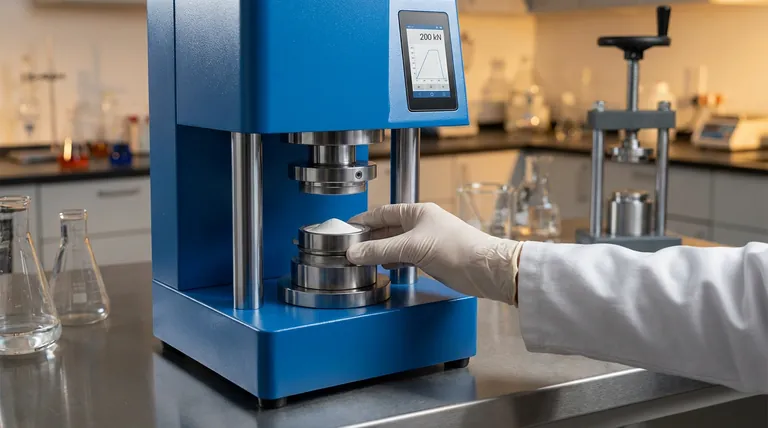
A laboratory pellet press is an instrument of order. Its sole purpose is to take that chaotic powder and forge it into a standardized, uniform solid.
It does this by addressing the ghost variables directly.
Eliminating Hidden Variables
By applying immense, controlled force, a press transforms the inconsistent into the consistent:
- Uniform Density: It eliminates air pockets and standardizes the material's density, ensuring the analyzer interacts with the same amount of matter in every test.
- Flawless Surface: It creates a perfectly flat, smooth surface, which is non-negotiable for surface-sensitive techniques like XRF.
- Standardized Geometry: Using precision-engineered dies, it produces pellets of exact and repeatable dimensions, ensuring they fit perfectly into instrument holders, every single time.
This isn't just about making the sample easier to handle. It's about building a physically identical foundation for every single analysis.
The Mechanics of Reproducibility
The value of a modern lab press lies in its ability to remove human guesswork and replace it with mechanical discipline. It's the embodiment of an engineered process designed for a single outcome: perfection in repetition.
The Discipline of the Machine
A hydraulic press applies the exact same force, for the same duration, on every sample. This mechanical consistency is the cornerstone of reproducible science. It ensures that the only variable being tested is the material itself, not the preparation method. Automatic lab presses take this a step further, managing the entire pressure cycle to eliminate operator-to-operator variance.
Control at Your Fingertips
High-quality presses feature clear, accurate force gauges that give operators fine-grained control. This allows them to develop and lock in a precise protocol for different materials—from creating robust pellets for mechanical testing to delicate, transparent KBr pellets for FTIR spectroscopy.
Adapting the Process for Advanced Materials
While cold pressing is the standard for many applications, the quest for new materials often requires more advanced techniques.
When Cold Isn't Enough: The Role of Heat
Some advanced polymers or ceramic composites refuse to bind properly under pressure alone. They require thermal energy to sinter or cure. A heated lab press, which combines high force and temperature in a single, controlled step, is essential for this type of materials research. It expands a lab's capability from routine analysis to genuine material innovation.
| Press Type | Primary Function | Ideal For |
|---|---|---|
| Automatic Lab Press | High-throughput, consistent cold pressing | Routine QC, XRF analysis |
| Heated Lab Press | Combines pressure and temperature | Polymers, composites, advanced ceramics |
| Isostatic Press | Applies uniform pressure from all directions | Achieving maximum, uniform density |
Choosing Your Instrument of Trust
The right press is an investment in the integrity of every piece of data your lab will ever produce. The choice depends entirely on your goal.
- For routine quality control, consistency and throughput are paramount. An automatic lab press ensures every operator produces identical samples, day in and day out.
- For chemical analysis like FTIR, precision and control are key to producing high-quality KBr pellets.
- For advanced materials R&D, versatility is crucial. A press with options for heated platens and a wide pressure range, like those engineered by KINTEK, opens the door to experimentation.
Ultimately, the humble lab press isn't an accessory. It is the architect of your data's credibility. It builds the foundation of trust upon which all subsequent conclusions rest.
To ensure your results are built on a rock-solid foundation, explore the right solution for your application. Contact Our Experts
Visual Guide

Related Products
- 24T 30T 60T Heated Hydraulic Lab Press Machine with Hot Plates for Laboratory
- Manual Heated Hydraulic Lab Press with Integrated Hot Plates Hydraulic Press Machine
- Laboratory Hydraulic Pellet Press for XRF KBR FTIR Lab Press
- Lab Infrared Press Mold for Laboratory Applications
- Laboratory Hydraulic Press Lab Pellet Press Machine for Glove Box
Related Articles
- The Invisible Forge: Why the Laboratory Press is the Soul of Nano-Composites
- The Architecture of Slow: Why Physical Precision Dictates Chemical Destiny
- The Architecture of Density: Why Pressure is the Silent Architect of Solid-State Batteries
- The Physics of Transparency: Why Pressure is the Silent Architect of Spectroscopic Clarity
- The Architecture of Certainty: Why the Laboratory Press is the Anchor of Material Science



















