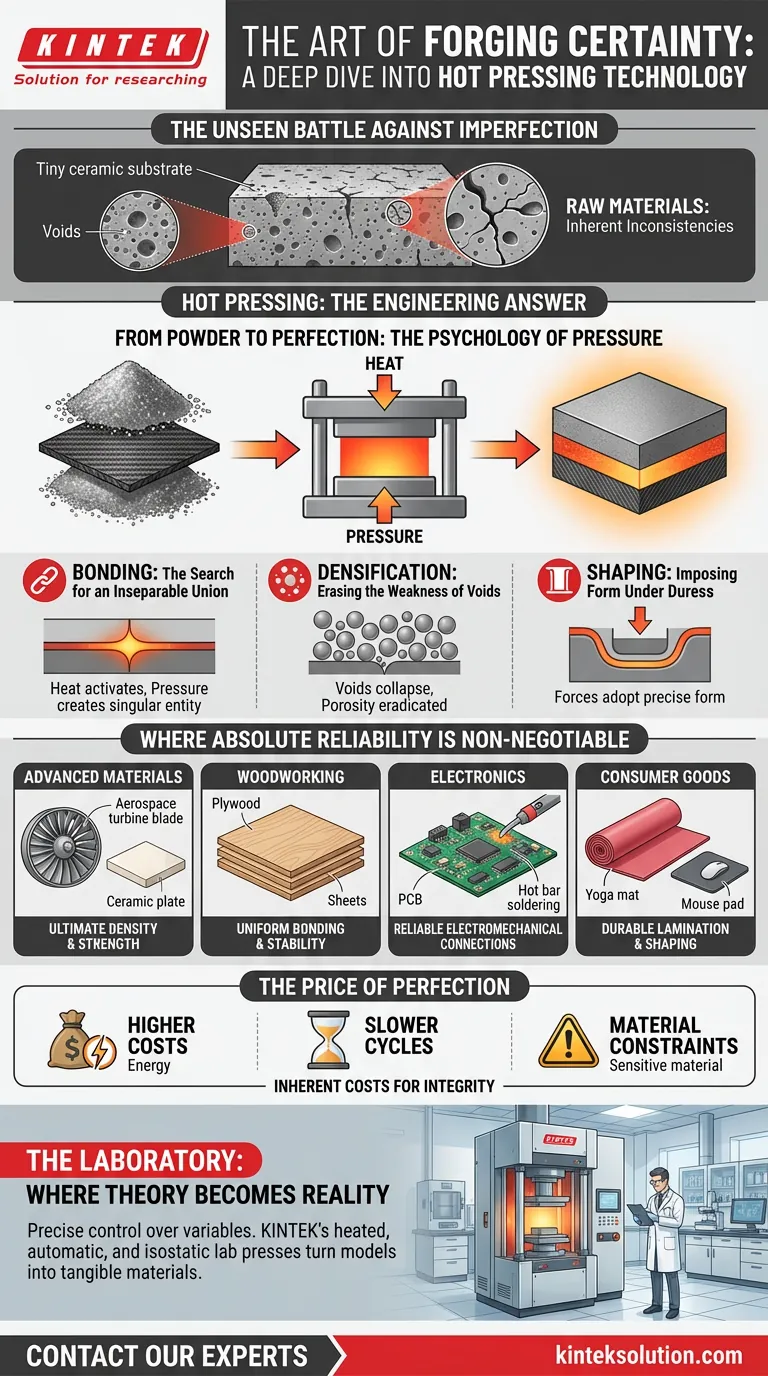
The Unseen Battle Against Imperfection
Imagine a critical component deep inside a satellite's avionics. It’s a tiny ceramic substrate, no bigger than a thumbnail, but the entire mission depends on its flawless performance. To the naked eye, it looks perfect. But at a microscopic level, it’s a landscape of tiny voids and potential fracture points—ghosts of its original powdered form.
This is the fundamental challenge in advanced manufacturing: raw materials are inherently imperfect. Whether it's a pile of metallic powder, layers of carbon fiber, or veneers of wood, they all contain inconsistencies that become liabilities under stress.
Hot pressing is the engineering answer to this problem. It’s a process, but it's also a philosophy: applying overwhelming force and heat to compel a material into its most ideal, unified state.
From Powder to Perfection: The Psychology of Pressure
At its core, hot pressing is a controlled, almost brutal, act of transformation. It doesn't just stick things together; it fundamentally restructures them by eliminating doubt—the empty spaces, the weak bonds, the potential for failure.
This is achieved through a few primary functions.
Bonding: The Search for an Inseparable Union
Heat activates an adhesive or the material itself. Pressure forces two surfaces into such intimate contact that they effectively become one. This isn't just gluing; it's creating a new, singular entity.
This is the principle that gives us everything from multi-layered composite armor to the humble, yet remarkably strong, sheet of plywood.
Densification: Erasing the Weakness of Voids
For materials starting as powders (like ceramics or superalloys), pressure collapses the voids between particles. Simultaneously, heat initiates sintering, fusing the particles at their boundaries.
The result is a dense, monolithic part, dramatically stronger than the sum of its raw ingredients. Porosity, the enemy of strength, is systematically eradicated.
Shaping: Imposing Form Under Duress
A material is heated until it becomes pliable and then pressed into a mold. The combination of heat and pressure forces it to adopt a new, precise form, which it retains upon cooling.
This is how we create everything from shaped decorative panels to intricate plastic components with perfect fidelity.
Where Absolute Reliability is Non-Negotiable
The applications for hot pressing are not defined by industry, but by the demand for certainty. Wherever failure is not an option, you will likely find this process at work.
Forging the Future: Advanced Materials
In aerospace, defense, and metallurgy, components must perform under unimaginable stress.
- Aerospace: Manufacturing turbine blades from superalloy powders.
- Ceramics: Creating ballistic plates or high-purity substrates for electronics.
- Composites: Fusing layers of carbon fiber for lightweight, ultra-strong structural parts.
In these fields, hot pressing isn't just a manufacturing step; it's a guarantee of performance.
Building with Certainty: Woodworking & Electronics
Even in more familiar industries, hot pressing provides a level of reliability that has become standard.
- Woodworking: Plywood, particle board, and laminated veneers all rely on heat and pressure to create stable, uniform, and strong engineered wood products.
- Electronics: A specialized process called hot bar soldering uses a heated press to create robust, permanent connections between flexible circuits and PCBs, ensuring the device works every single time.
The Hidden Craft in Everyday Objects
You interact with the results of hot pressing daily. The process is valued for creating durable bonds and textures in high-volume consumer goods. That perfectly bonded fabric on a mouse pad or the durable, non-slip surface of a yoga mat is often the result of this precise application of heat and pressure.
| Industry | Core Objective Achieved with Hot Pressing | Example Products |
|---|---|---|
| Advanced Materials | Ultimate Density & Strength | Ceramic armor, superalloy parts, composites |
| Woodworking | Uniform Bonding & Stability | Plywood, particle boards, decorative laminates |
| Electronics | Reliable Electromechanical Connections | PCB assemblies, flexible circuit bonds |
| Consumer Goods | Durable Lamination & Shaping | Mouse pads, yoga mats, insulation foam |
The Price of Perfection
Such a powerful process is not without its trade-offs. It is a deliberate, energy-intensive technique.
- Higher Costs: Hot press machines are specialized equipment, and the energy required to generate immense heat and pressure is significant.
- Slower Cycles: The process is methodical. It requires time to heat, press (dwell), and cool. This makes it less suitable for applications where speed is the only priority.
- Material Constraints: The process is reserved for materials that can endure its intensity. Thermally sensitive components require other methods.
These aren't so much "disadvantages" as they are the inherent costs of achieving near-perfect material integrity. You trade speed and economy for strength and reliability.
The Laboratory: Where Theory Becomes Reality
Every groundbreaking material developed for these industries—from a new ceramic composite for jet engines to a more durable laminate for furniture—begins its life in the laboratory. This is where the precise parameters of heat, pressure, and time are painstakingly tested and perfected.
To innovate, researchers and engineers need tools that offer absolute control over these variables. They need to replicate industrial conditions on a smaller, more precise scale to push the boundaries of what's possible.
This is where a dedicated laboratory press becomes the critical link between an idea and a breakthrough. For scientists pioneering the next generation of materials, the ability to meticulously control the hot pressing process is paramount. KINTEK's range of heated, automatic, and isostatic lab presses provides the precision and reliability needed to turn theoretical models into tangible, high-performance materials.
If you are working to eliminate imperfection and forge certainty in your materials, Contact Our Experts
Visual Guide
Related Products
- Automatic High Temperature Heated Hydraulic Press Machine with Heated Plates for Lab
- Heated Hydraulic Press Machine with Heated Plates for Vacuum Box Laboratory Hot Press
- Automatic Heated Hydraulic Press Machine with Hot Plates for Laboratory
- Heated Hydraulic Press Machine With Heated Plates For Vacuum Box Laboratory Hot Press
- Laboratory Split Manual Heated Hydraulic Press Machine with Hot Plates
Related Articles
- The Architecture of Slow: Why Physical Precision Dictates Chemical Destiny
- The Architecture of Certainty: Why the Laboratory Press is the Anchor of Material Science
- The Vanishing Boundary: The Hidden Thermodynamics of LTCC Lamination
- The Alchemy of 160°C: Why Precision Pressing is the Silent Backbone of Rubber Science
- The Invisible Forge: Why the Laboratory Press is the Soul of Nano-Composites



















