The Illusion of More is Better
In many engineering disciplines, the path to a better outcome seems simple: add more. More force, more speed, more power. We intuitively believe that maximizing every variable will yield the best result.
But in the world of advanced materials, particularly in Vacuum Hot Pressing (VHP), this logic fails.
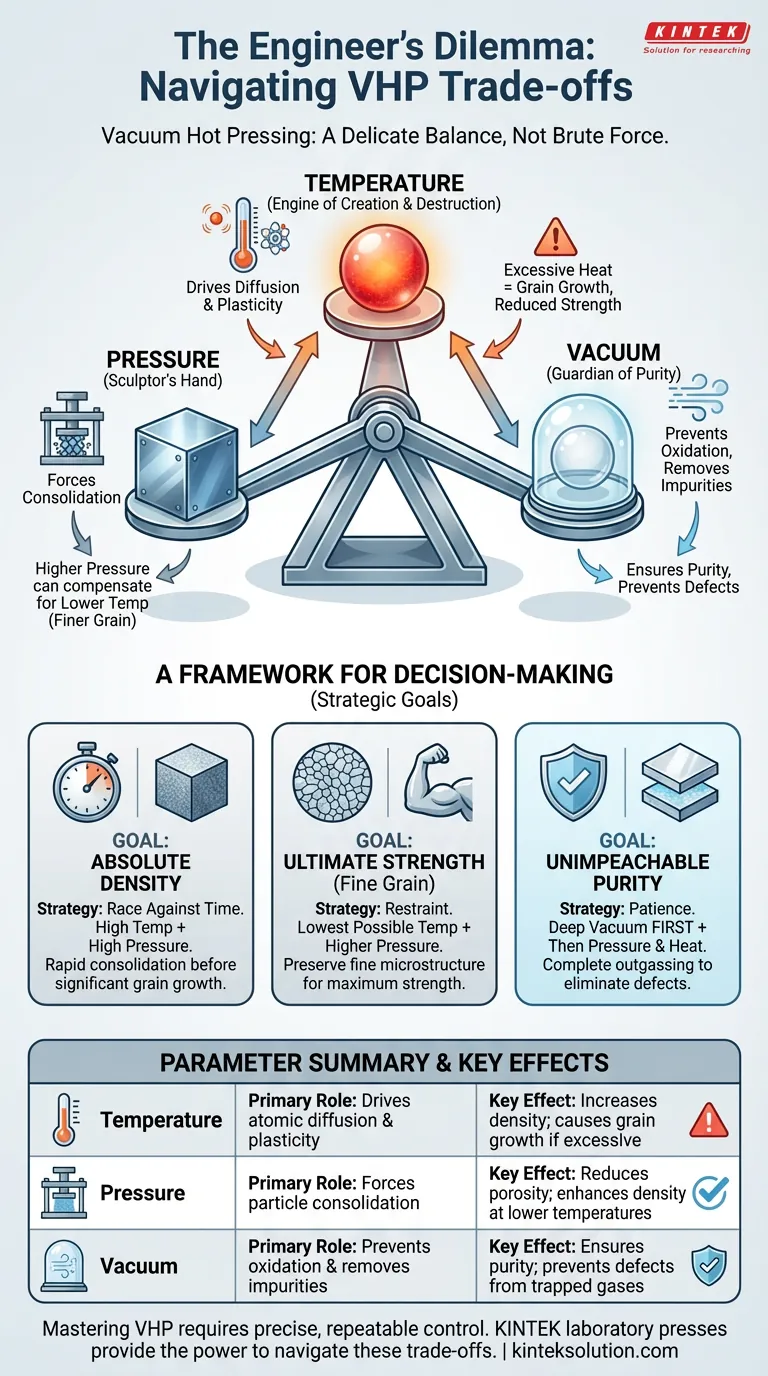
VHP is not a process of brute force; it is a delicate craft of deliberate control. Success hinges on understanding and manipulating the intricate relationship between three fundamental parameters: temperature, pressure, and vacuum. Pushing one too far can compromise the entire endeavor. It's a system where balance, not sheer power, forges perfection.
Temperature: The Engine of Creation and Destruction
Temperature is the primary catalyst in VHP. It provides the thermal energy that transforms loose powder into a dense, monolithic solid. Without it, nothing happens.
The Atomic Dance
Heat energizes the atoms within each particle, causing them to vibrate and move. This allows them to diffuse across particle boundaries, slowly filling the microscopic voids between them. Think of it as the music that encourages a crowded room of people to mingle and fill empty spaces. This atomic diffusion is the very heart of densification.
Softening for the Sculpt
As the material heats, it softens and becomes more plastic. Like clay warmed in a sculptor's hands, it becomes far more receptive to the applied pressure. This enhanced malleability is crucial for deforming particles and forcing them into a tightly packed structure.
The Hidden Cost of Heat
But temperature is a double-edged sword. While it drives consolidation, it also promotes grain growth. Given too much heat for too long, smaller crystal grains are consumed by larger ones. This coarsens the material's microstructure, which can severely degrade its mechanical properties like strength and toughness. The engine of creation can easily become an agent of destruction.
Pressure: The Sculptor's Hand
Pressure works in concert with temperature, providing the mechanical force to consolidate the material. It is the steady hand that guides the process.
Forging the First Bond
Initially, pressure's main job is to rearrange the loose powder, breaking down weak clusters and dramatically increasing the contact area between individual particles. This creates the essential "highways" upon which atomic diffusion can later occur efficiently.
The Final Squeeze
Once the material is heated and softened, pressure forces it to flow and deform, physically squeezing out the last remnants of porosity. This mechanical action is what pushes the material from a high density to one that approaches its theoretical maximum.
The Temperature-Pressure Bargain
Herein lies one of the most powerful strategies in VHP. An engineer can make a deliberate trade. For materials sensitive to grain growth, one can use a lower temperature and compensate with higher pressure to achieve the target density. You "buy" a finer, stronger microstructure by "spending" more on pressure.
Vacuum: The Guardian of Purity
The vacuum environment is what elevates VHP. It is a shield, protecting the material from contamination during its most vulnerable, high-temperature state.
A World Without Sabotage
At high temperatures, most advanced materials are incredibly reactive with oxygen. A vacuum removes the air, preventing the formation of brittle oxides at the grain boundaries. These oxides are internal saboteurs, creating weak points that can lead to catastrophic failure.
The Deep Cleanse
The combination of heat and low pressure also creates perfect conditions for outgassing. This process purges unwanted volatile substances—moisture, binders, or lubricants from previous steps—from the material. Without a vacuum, these impurities would become trapped as permanent defects. A flawed shield is no shield at all.
A Framework for Decision-Making
Mastering VHP is about mastering these trade-offs. Your strategy should not be fixed; it must be dictated by your end goal.
-
Goal: Absolute Density. The mindset is a race against time. You employ high temperature and high pressure for rapid consolidation but must carefully optimize the hold time to stop just before significant grain growth begins.
-
Goal: Ultimate Strength (Fine Grain). The mindset is one of restraint. You prioritize the lowest possible temperature that still allows for densification, relying on higher pressure to achieve the final density while preserving the delicate, fine-grained microstructure.
-
Goal: Unimpeachable Purity. The mindset is one of patience. The priority is establishing a deep, stable vacuum before applying full pressure and heat. This allows for complete outgassing, ensuring no impurities are sealed within the final part.
Executing these distinct strategies requires more than theoretical knowledge. It demands instrumentation capable of precise, repeatable control over this delicate balance.
| Parameter | Primary Role | Key Effect on Material Properties |
|---|---|---|
| Temperature | Drives atomic diffusion & plasticity | Increases density; can cause grain growth if excessive |
| Pressure | Forces particle consolidation | Reduces porosity; enhances density at lower temperatures |
| Vacuum | Prevents oxidation & removes impurities | Ensures purity; prevents defects from trapped gases |
Achieving this level of deliberate control turns a manufacturing process into a tool for materials engineering. KINTEK's suite of laboratory presses, including automatic and heated models, is designed to provide this exact capability—giving researchers the power to navigate these trade-offs with confidence and precision.
Transform your theoretical parameters into superior, high-performance materials. Contact Our Experts
Visual Guide
Related Products
- Heated Hydraulic Press Machine with Heated Plates for Vacuum Box Laboratory Hot Press
- Heated Hydraulic Press Machine With Heated Plates For Vacuum Box Laboratory Hot Press
- Automatic High Temperature Heated Hydraulic Press Machine with Heated Plates for Lab
- Automatic Heated Hydraulic Press Machine with Hot Plates for Laboratory
- Laboratory Manual Heated Hydraulic Press Machine with Hot Plates
Related Articles
- The Architecture of Slow: Why Physical Precision Dictates Chemical Destiny
- The Architecture of Certainty: Why the Laboratory Press is the Anchor of Material Science
- The Vanishing Boundary: The Hidden Thermodynamics of LTCC Lamination
- The Alchemy of 160°C: Why Precision Pressing is the Silent Backbone of Rubber Science
- The Invisible Forge: Why the Laboratory Press is the Soul of Nano-Composites



















