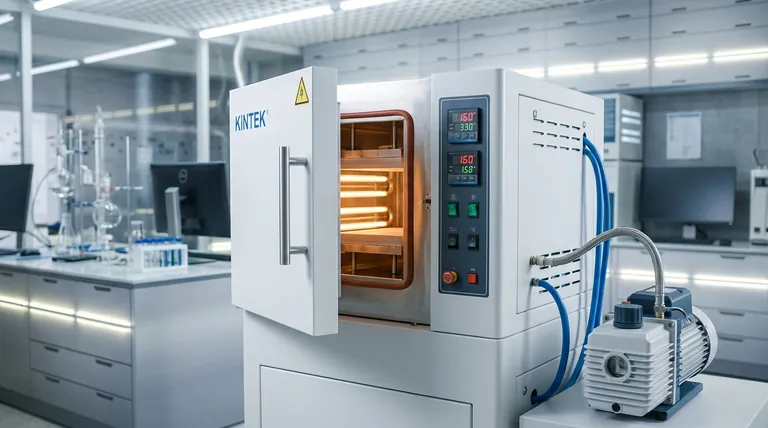
At its heart, the pursuit of materials science is a battle against entropy. It is the art of taking disordered powders and forging them into solids with predictable, extraordinary properties. The arena for this battle is often a vacuum hot press—a machine that looks like a simple oven but operates like a self-contained universe.
To understand it is to appreciate a symphony of opposing forces: immense heat held at bay by chilling water, crushing pressure applied in a near-perfect void. It’s not a single machine, but a deeply integrated system where every component's performance dictates the final outcome.
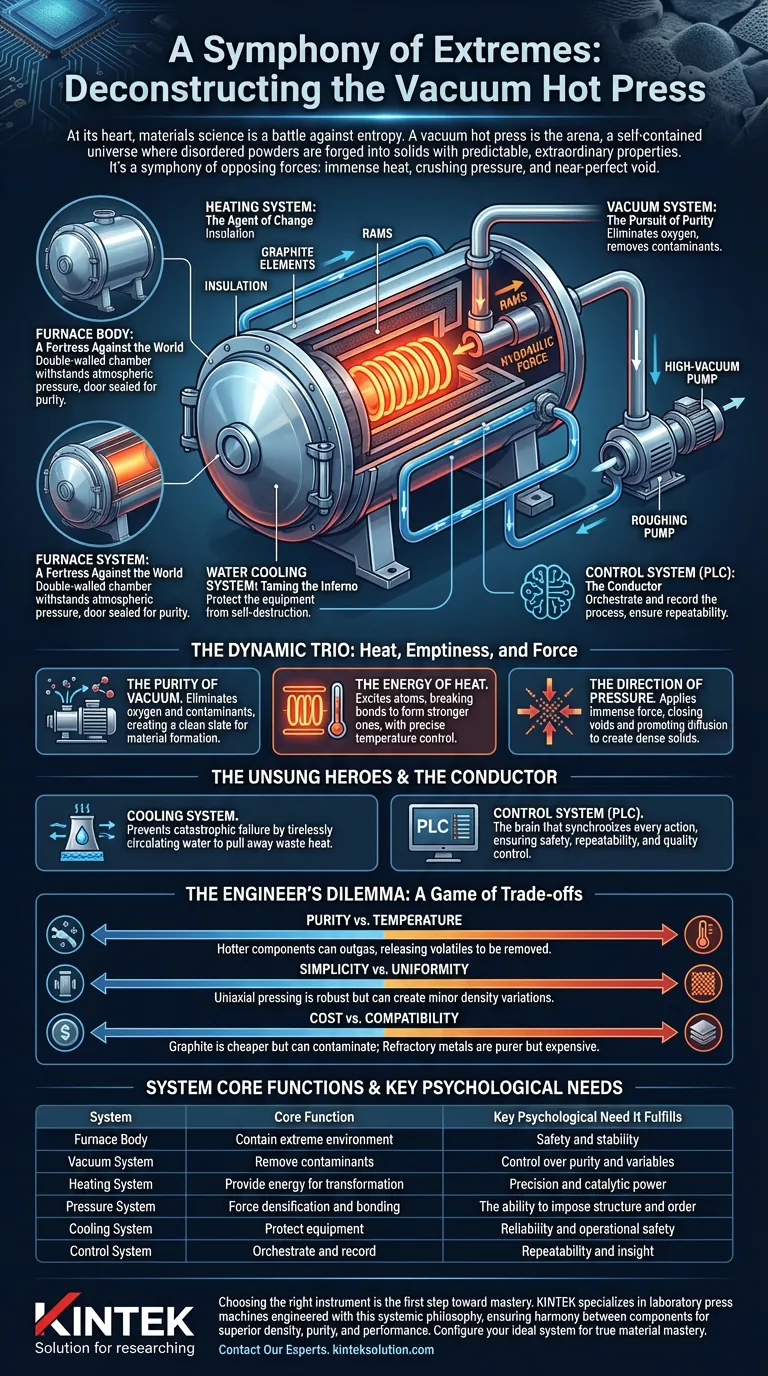
The Vessel: A Fortress Against the World
The entire process unfolds within the furnace body. This double-walled stainless steel chamber is more than a container; it's a fortress. When the vacuum system engages, this body withstands the crushing force of an entire atmosphere trying to get in.
The door, sealed with precision O-rings, is the gate to this fortress. Its integrity is the first line of defense in the quest for atmospheric purity. A minor flaw here compromises every subsequent step.
The Dynamic Trio: Heat, Emptiness, and Force
The transformation of material happens through the precise interplay of three active systems. Each must perform its role flawlessly.
The Pursuit of Purity: The Vacuum System
The most powerful actor in high-temperature processing is often the one that isn't there: oxygen. At 2000°C, stray oxygen molecules are agents of chaos, causing oxidation that can ruin a novel alloy or a sensitive ceramic.
The vacuum system is the instrument for creating a controlled emptiness. A roughing pump removes the bulk air, but the real work is done by a high-vacuum pump that hunts down the last remaining molecules. This isn't just about removing air; it's about eliminating a critical variable, giving the material a clean slate on which to form.
The Agent of Change: The Heating System
Heat is the energy that excites atoms, allowing them to break old bonds and form new, stronger ones. The heating system, typically composed of graphite or refractory metal elements, is the engine of this change.
But raw power is useless without control. Surrounding these elements is a thick blanket of insulation—graphite felt or ceramic fiberboard—that sculpts the thermal environment. It ensures temperature uniformity, preventing hot spots that could warp or crack the final component. The goal isn't just to get hot, but to get hot with absolute precision.
The Sculptor's Hand: The Pressure System
While heat provides the energy, pressure provides the direction. The pressure system acts as the sculptor's hand, applying immense uniaxial force through rams.
This force physically closes the voids between powder particles. It overcomes the material's natural reluctance to consolidate, promoting diffusion and bonding at a microscopic level. It is the final, insistent command that turns a loose aggregate into a dense, high-performance solid.
The Unsung Heroes: The Systems of Support
Behind the scenes, two systems work silently to make the entire process safe and repeatable. Their perfection is often invisible, noticed only in its absence.
Taming the Inferno: The Water Cooling System
A system generating thousands of degrees of heat would destroy itself in minutes without a guardian. The water cooling system is that guardian. It tirelessly circulates water through the furnace body, door, and power feedthroughs, pulling waste heat away from critical components.
This is not an optional accessory; it is the fundamental enabler of high-temperature operation. Its failure is catastrophic, yet its flawless performance is the quiet hum in the background of every successful run.
The Conductor: The Control System
The control system, managed by a PLC, is the brain that synchronizes the symphony. It translates the operator's intent—a specific temperature ramp, a pressure profile, a vacuum level—into precise, automated actions.
For a researcher, this system’s data logging provides the fingerprint of an experiment, ensuring repeatability. For a manufacturer, it is the bedrock of quality control. It is the bridge between human ambition and physical reality.
The Engineer's Dilemma: A Game of Trade-offs
Mastering a vacuum hot press is to understand its inherent compromises. Optimizing one parameter often constrains another.
- Purity vs. Temperature: The hotter the chamber, the more its internal components can "outgas," releasing volatiles that the vacuum pump must fight to remove.
- Simplicity vs. Uniformity: Uniaxial pressing is robust and direct, but applying pressure from a single direction can create minor density variations.
- Cost vs. Compatibility: Graphite heating elements are workhorses, but can contaminate certain metals. Refractory metals are purer but more expensive and fragile.
Understanding these trade-offs is the difference between simply operating a machine and truly mastering a material process.
| System | Core Function | Key Psychological Need It Fulfills |
|---|---|---|
| Furnace Body | Contain the extreme environment | Safety and stability |
| Vacuum System | Remove contaminants | Control over purity and variables |
| Heating System | Provide energy for transformation | Precision and catalytic power |
| Pressure System | Force densification and bonding | The ability to impose structure and order |
| Cooling System | Protect the equipment from self-destruction | Reliability and operational safety |
| Control System | Orchestrate and record the process | Repeatability and insight |
Choosing the right instrument is the first step toward mastery. For labs dedicated to pushing material boundaries, a system must be more than the sum of its parts; it must be a reliable, precise, and fully integrated tool. KINTEK specializes in laboratory press machines engineered with this systemic philosophy, ensuring that each component works in harmony to deliver superior density, purity, and performance.
If you are ready to move from simple operation to true material mastery, we can help you configure the ideal system for your goals. Contact Our Experts
Visual Guide
Related Products
- Heated Hydraulic Press Machine with Heated Plates for Vacuum Box Laboratory Hot Press
- Heated Hydraulic Press Machine With Heated Plates For Vacuum Box Laboratory Hot Press
- Automatic High Temperature Heated Hydraulic Press Machine with Heated Plates for Lab
- Automatic Heated Hydraulic Press Machine with Hot Plates for Laboratory
- Laboratory Manual Heated Hydraulic Press Machine with Hot Plates
Related Articles
- The Architecture of Slow: Why Physical Precision Dictates Chemical Destiny
- The Architecture of Certainty: Why the Laboratory Press is the Anchor of Material Science
- The Vanishing Boundary: The Hidden Thermodynamics of LTCC Lamination
- The Alchemy of 160°C: Why Precision Pressing is the Silent Backbone of Rubber Science
- The Invisible Forge: Why the Laboratory Press is the Soul of Nano-Composites



















