The Invisible Infrastructure of Energy
In battery research, we often obsess over chemistry. We talk about lithium-ion migration, electron flow, and chemical stability. But there is a silent, physical reality that dictates whether a battery thrives or dies: The Void.
Every micropore, every internal air pocket, and every loose interface in a solid-state electrolyte is a point of failure. These "whitespace" regions act as insulators, blocking ions and inviting lithium dendrites to pierce through.
The fabrication of hexagonal boron nitride (h-BN) reinforced composite electrolytes is not just a chemical process; it is a structural one. It is a battle against the gaps.
Force as a Structural Architect
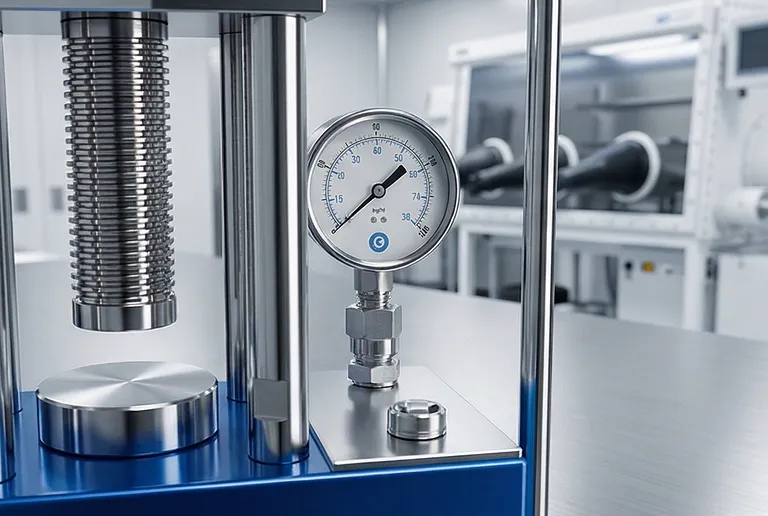
A high-pressure laboratory press is more than a tool for compaction. In the context of h-BN composites, it is a system for creating monolithic integrity.
When we apply several tons of uniform mechanical force, we are performing three critical engineering interventions:
1. Eliminating the "Dead Zones"
Micropores are the enemies of conductivity. High pressure forces h-BN particles and polymer chains to rearrange, squeezing out trapped air. This turns a porous mixture into a dense, continuous medium where ions can move without interruption.
2. The Atomic Handshake
For a composite to function, the h-BN reinforcement, the polymer matrix, and the lithium salts must be in intimate contact. Under high tonnage, these components are forced into an "atomic-level contact," reducing bulk resistance and ensuring the materials function as a single unit.
3. Creating a Physical Fortress
Lithium dendrites are persistent. They seek the path of least resistance. By maximizing material density, the press transforms the electrolyte into a formidable mechanical barrier, significantly reducing the risk of internal short circuits.
The Thermodynamic Dance: Heat Meets Pressure
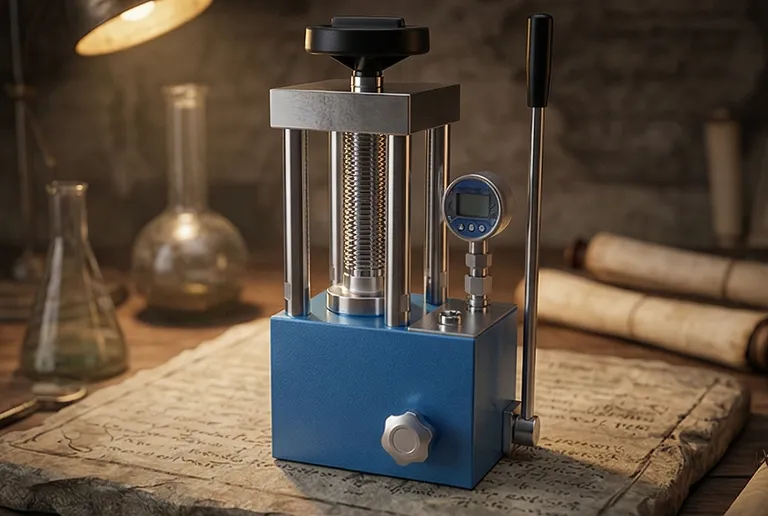
The most sophisticated fabrication workflows involve Hot Pressing. This is where the "Engineer’s Romanticism" meets practical efficiency.
| Feature | The Role of Heat + Pressure | The Performance Result |
|---|---|---|
| Material Softening | Heat reduces the viscosity of polymer matrices (like PEO). | Faster, more thorough encapsulation of h-BN particles. |
| Network Formation | Mechanical force shapes the softened polymer into a web. | A flexible, continuous network for superior ion transport. |
| Lower Thresholds | Heat allows for high densification at lower mechanical stress. | Protection of the delicate h-BN crystal structure from crushing. |
The Margin of Error
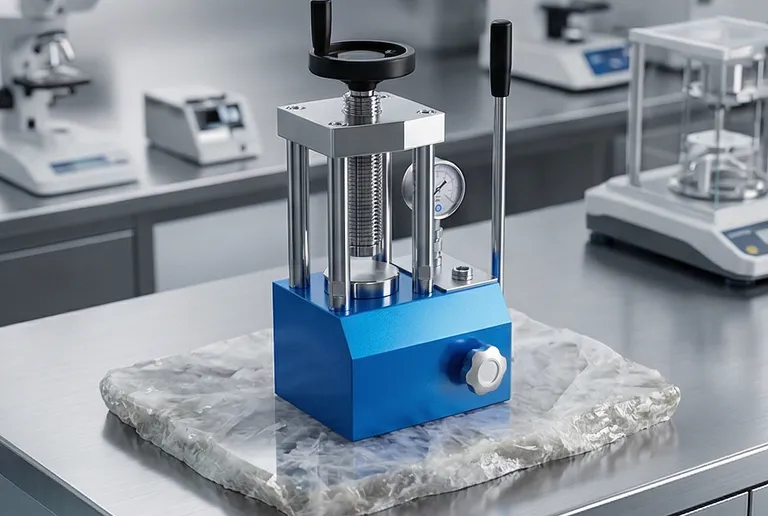
In engineering, there is a fine line between "compacted" and "crushed."
If a press lacks precision, two risks emerge:
- Over-Compression: Applying force beyond a material's threshold can lead to micro-cracking or the permanent deformation of h-BN crystals, ruining ionic mobility.
- Inconsistency: If the force is not perfectly uniform, "density gradients" form. These variations create uneven ion transport, leading to localized hot spots and accelerated degradation.
Precision, therefore, is not a luxury—it is the prerequisite for stability.
Choosing the Pathway to Performance

To master h-BN composite fabrication, your pressing strategy must align with your research goals:
- For Dendrite Suppression: Prioritize high-tonnage, uniform pressure to create the hardest possible physical barrier.
- For Optimal Conductivity: Utilize a heated press to ensure a seamless polymer-ceramic interface.
- For Batch Consistency: Use automated presses with digital controls to eliminate human error and ensure every sample is identical.
The success of next-generation solid-state batteries depends on our ability to control the physical environment at the micro-scale. We aren't just making pellets; we are building the architecture of future energy.
At KINTEK, we provide the precision instruments required for this level of structural control. From manual and automatic presses to glovebox-compatible and isostatic systems, our solutions are designed to eliminate the void and empower your innovation.
Related Products
- 24T 30T 60T Heated Hydraulic Lab Press Machine with Hot Plates for Laboratory
- Automatic High Temperature Heated Hydraulic Press Machine with Heated Plates for Lab
- Manual Heated Hydraulic Lab Press with Integrated Hot Plates Hydraulic Press Machine
- Automatic Heated Hydraulic Press Machine with Hot Plates for Laboratory
- Laboratory Split Manual Heated Hydraulic Press Machine with Hot Plates
Related Articles
- The Invisible Forge: Why the Laboratory Press is the Soul of Nano-Composites
- The Architecture of Slow: Why Physical Precision Dictates Chemical Destiny
- The Architecture of Density: Why Pressure is the Silent Architect of Solid-State Batteries
- The Physics of Transparency: Why Pressure is the Silent Architect of Spectroscopic Clarity
- The Architecture of Certainty: Why the Laboratory Press is the Anchor of Material Science



















