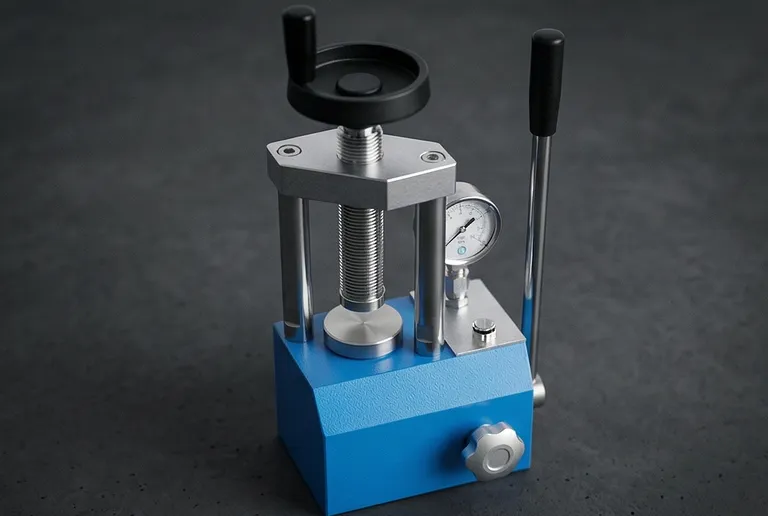
The Invisible Failure of the Perfect Design
In materials science, there is a recurring ghost in the machine: the perfect theoretical composite that fails in the real world.
On a blueprint, the fibers are aligned and the resin is uniform. But inside the hot press, a chaotic silent war occurs. If the pressure is too low, the material remains porous—a "honeycomb" of structural weaknesses. If it is too high, you crush the very fibers meant to provide strength.
Precision in hot-pressing is not about how hard you can squeeze; it is about knowing exactly when to stop.
The Matrix Paradox: Flow vs. Force
The goal of hot-pressing is to force a molten matrix—often a polymer or nanofiber—into the microscopic gaps of a reinforcement fabric. This is called impregnation.
Achieving the "Saturation Point"
For a composite to reach its peak mechanical properties, the matrix must reach every corner of the fiber bed.
- Thin-film sensors act as the "nervous system" of the press.
- They provide real-time feedback to ensure the pressure is high enough to drive flow.
- Without this data, engineers are simply guessing whether the resin has reached the core.
Protecting the Architecture
Fibers have a "crush point." When the pressure exceeds the structural limits of the primary fabric, the fibers misalign or snap. This destroys the geometric integrity of the component.
By utilizing precise control systems, such as those found in KINTEK’s automatic pressing solutions, researchers can maintain the delicate equilibrium where the resin flows but the skeleton remains intact.
The Hidden Debt of Internal Voids
In finance, hidden debt eventually bankrupts a company. In composites, internal voids—microscopic bubbles of trapped air or evaporated solvent—eventually bankrupt the structure.
Densification as a Cure
High pressure, synchronized perfectly with thermal peaks, forces these voids to collapse. This process of densification is what turns a loose collection of layers into a monolithic material.
| Feature | The Role of Precision Control | The "Engineer’s Romantic" Outcome |
|---|---|---|
| Matrix Flow | Monitors resin penetration in real-time | Total interlaminar bonding |
| Void Removal | Synchronizes heat with axial pressure | Zero-porosity structural integrity |
| Fiber Safety | Prevents "over-extrusion" of the matrix | Optimized tensile strength |
| Repeatability | Digital distribution analysis | Lab-to-factory scalability |
The Barrier Effect
For specialized applications like battery research or chemical targets, densification does more than provide strength. It creates a barrier. A dense, void-free material prevents oxygen and moisture from migrating through the layers, significantly extending the life of the final product.
The Psychological Leap from Lab to Industry
The greatest challenge in material science is not the first successful prototype; it is the ten-thousandth.
Laboratory-scale success often relies on the "intuition" of a skilled researcher. However, industrial scaling requires the removal of intuition in favor of digital certainty.
High-temperature thin-film sensors allow us to map the "pressure nip"—the instantaneous distribution of force. When this data is applied to high-performance hardware, like KINTEK Isostatic Presses, the result is a repeatable manufacturing standard that works as well on the factory floor as it did in the glovebox.
Engineering the Future of Composites
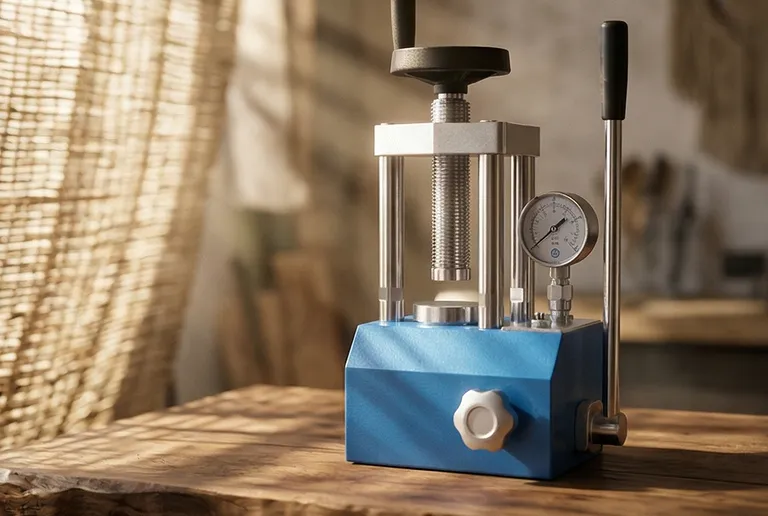
Whether you are developing the next generation of solid-state batteries or high-performance ceramic targets, the hardware you choose defines the limits of your material.
At KINTEK, we build the tools that turn the "game of estimation" into a science of precision. Our laboratory pressing solutions—ranging from manual and automatic heated presses to advanced isostatic systems—are designed to give you total control over the thermal-mechanical environment.
Don't let your research be limited by the uncertainty of the press.
Related Products
- Automatic High Temperature Heated Hydraulic Press Machine with Heated Plates for Lab
- Automatic Heated Hydraulic Press Machine with Hot Plates for Laboratory
- Heated Hydraulic Press Machine with Heated Plates for Vacuum Box Laboratory Hot Press
- Laboratory Manual Heated Hydraulic Press Machine with Hot Plates
- Laboratory Split Manual Heated Hydraulic Press Machine with Hot Plates
Related Articles
- The Architecture of Slow: Why Physical Precision Dictates Chemical Destiny
- The Architecture of Certainty: Why the Laboratory Press is the Anchor of Material Science
- The Vanishing Boundary: The Hidden Thermodynamics of LTCC Lamination
- The Alchemy of 160°C: Why Precision Pressing is the Silent Backbone of Rubber Science
- The Invisible Forge: Why the Laboratory Press is the Soul of Nano-Composites



















