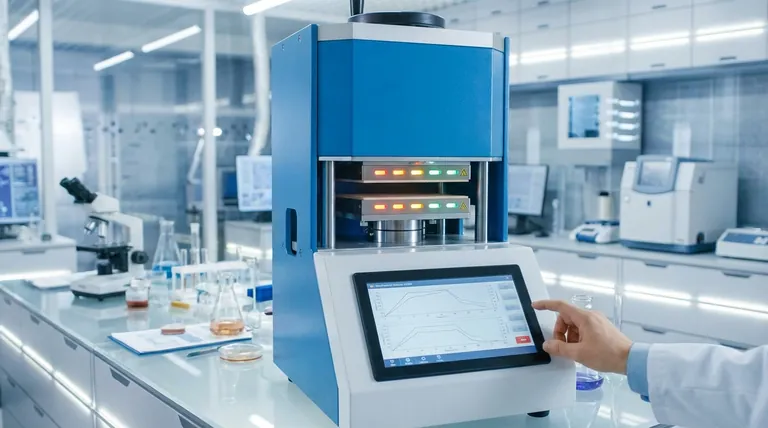
The Ghost in the Machine
A materials scientist is trying to cure a novel aerospace composite. The protocol is perfect, the materials are pristine, but the results are inconsistent. One sample delaminates; another shows micro-voids. The culprit isn't the chemistry; it's the equipment. The standard heated press, a workhorse of the lab, delivers heat unevenly across the platen, creating thermal gradients that sabotage the curing process.
This scenario isn't a failure of research. It's a failure of the tool.
We often accept the limitations of off-the-shelf equipment as an unchangeable law of the lab. We work around them, adjust our processes, and explain away inconsistencies. But in doing so, we fall into a precision trap—mistaking a general-purpose tool for the specific instrument we actually need.
The Subtle Tyranny of "Good Enough"
The appeal of a standard lab press is its availability and familiarity. It’s designed to do many things adequately. But adequacy is the enemy of a breakthrough. When your work involves novel materials, demanding quality control, or a process that operates at the edge of what's possible, "good enough" is a ceiling on your potential.
A standard press creates limitations. A custom-engineered press creates possibilities.
The decision to move beyond a standard model is a psychological shift. It’s the recognition that your equipment should conform to your research, not the other way around. It’s an investment in certainty, repeatability, and data you can trust.
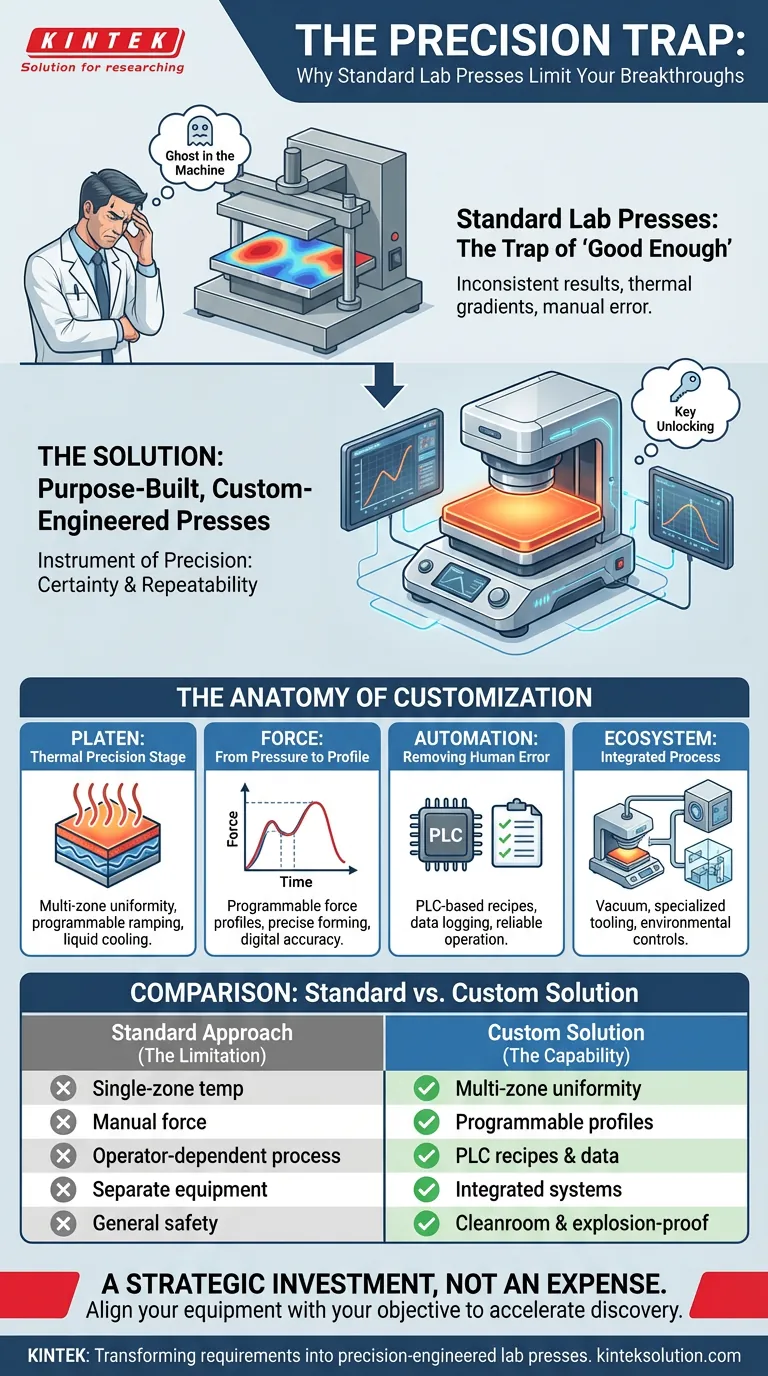
The Anatomy of a Purpose-Built Press
Customization isn't about adding features; it's about engineering intent into the machine. The process transforms a press from a brute-force tool into an instrument of precision. The dialogue with an engineer centers on a few critical subsystems.
H3: The Platen: A Stage for Thermal Precision
The platens are where the action happens, but a simple heated block is rarely sufficient for advanced applications.
- Uniformity: Multi-zone heating elements eliminate hot and cold spots across large surfaces, ensuring consistent curing or consolidation.
- Speed: Programmable heating and cooling rates (thermal ramping) allow you to mimic precise production cycles or study material behavior under specific thermal stress.
- Control: Integrated channels for liquid cooling can achieve rapid temperature drops, essential for "freezing" a material's state at a specific point in its processing.
H3: Force as a Language: From Pressure to Profile
Tonnage is just a number. The true variable is how that force is applied over time. A standard press applies force; a custom press speaks the language of your material.
This involves programmable force profiles, where the control system can be instructed to ramp up, hold, and ramp down pressure with digital accuracy. This is crucial for applications like compaction studies or forming delicate components where the rate of force application is as important as the peak force itself.
H3: Automation: Removing the Variable of Human Error
In a quality control or pilot production environment, repeatability is paramount. Automation turns a manual process into a reliable, recipe-driven operation.
Customization here is transformative:
- PLC-Based Recipes: Store and execute multi-step processes for temperature, pressure, and time, ensuring every sample is made under identical conditions.
- Data Logging: Integrate sensors and software to record every critical parameter of the process. This turns each press cycle into a rich dataset for analysis and validation.
H3: Building an Ecosystem, Not Just a Press
Often, the press is the heart of a larger process. A custom build can integrate ancillary systems directly, creating a seamless workflow.
- Vacuum Chambers: For curing composites or molding materials that are sensitive to air, an integrated vacuum chamber is essential.
- Specialized Tooling: Fixtures for tensile or flexural testing can be built-in, allowing for immediate post-formation analysis.
- Environmental Controls: For cleanroom use, the press can be built with stainless steel surfaces and non-shedding components. For volatile materials, explosion-proof (ATEX-rated) components provide critical safety.
A Strategic Investment, Not an Expense
Customization involves clear trade-offs. The upfront cost is higher, and the lead time is longer than for an off-the-shelf unit. But it's crucial to view this through the lens of total cost and return on investment. How much time and material is wasted on inconsistent results? What is the value of a single, validated breakthrough?
| Customization Area | Standard Approach (The Limitation) | Custom Solution (The Capability) |
|---|---|---|
| Temperature Control | Single-zone, slow response | Multi-zone uniformity, rapid thermal ramping, liquid cooling |
| Force Control | Manual or basic digital control | Programmable force profiles for precise material forming |
| Process Control | Operator-dependent, manual logs | PLC recipes, automated data logging, enhanced repeatability |
| Ancillary Systems | Separate, disconnected equipment | Integrated vacuum, specialized molds, in-situ testing |
| Safety & Environment | General-purpose guarding | Cleanroom compatibility, explosion-proof systems, light curtains |
Choosing to customize is about aligning your equipment directly with your objective. For advanced R&D, you prioritize flexibility and data. For quality control, you prioritize automation and repeatability.
Your unique challenge requires a purpose-built solution. At KINTEK, we specialize in transforming your specific requirements into precision-engineered lab presses that remove limitations and accelerate discovery. To discuss the specific needs of your project, Contact Our Experts.
Visual Guide
Related Products
- 24T 30T 60T Heated Hydraulic Lab Press Machine with Hot Plates for Laboratory
- Manual Heated Hydraulic Lab Press with Integrated Hot Plates Hydraulic Press Machine
- Laboratory Hydraulic Pellet Press for XRF KBR FTIR Lab Press
- Lab Infrared Press Mold for Laboratory Applications
- Laboratory Hydraulic Press Lab Pellet Press Machine for Glove Box
Related Articles
- The Invisible Forge: Why the Laboratory Press is the Soul of Nano-Composites
- The Architecture of Slow: Why Physical Precision Dictates Chemical Destiny
- The Architecture of Density: Why Pressure is the Silent Architect of Solid-State Batteries
- The Physics of Transparency: Why Pressure is the Silent Architect of Spectroscopic Clarity
- The Architecture of Certainty: Why the Laboratory Press is the Anchor of Material Science



















