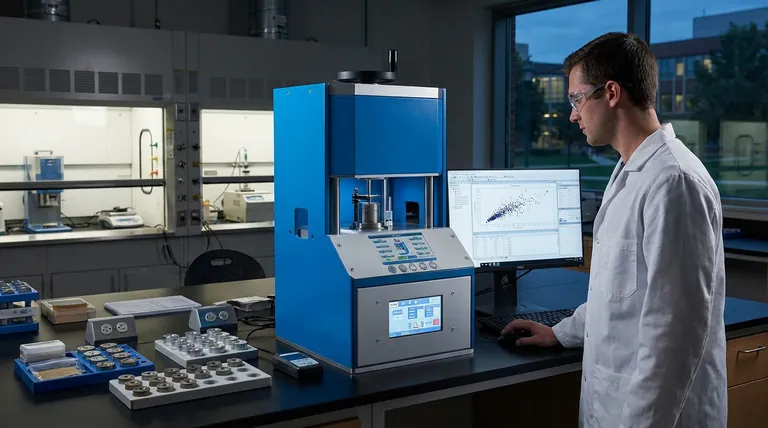
The Ghost in the Machine is You
Picture a researcher, late at night, staring at a scatter plot. The data points should form a clean line, but instead, they look like a shotgun blast. The chemistry is sound. The materials are pure. Yet, the results are stubbornly, maddeningly inconsistent.
The source of this chaos is often not in the formula, but in the formation. The manual press, operated with practiced "feel," delivered a slightly different pressure each time. The stopwatch was clicked a fraction of a second late. The unseen variable wasn't a flaw in the experiment; it was the inherent, unavoidable inconsistency of human touch.
This is the psychological barrier that modern laboratory presses are designed to break. The goal is no longer to simply apply force, but to remove the operator as a variable from the equation entirely.
From Brute Force to Intelligent Process
The crucial philosophical shift in sample preparation is from applying force to managing a process. An advanced lab press is not a stronger hand; it's a tireless, flawless partner that executes a complex thermal and mechanical recipe with perfect fidelity, every single time.
This isn't about luxury. It's about control. It's about the scientific necessity of eliminating variables to generate reliable, defensible data. This control rests on three pillars: pressure, temperature, and time.
Pressure: From Guesswork to Guarantee
A manual press with a simple gauge gives you a target, but achieving and holding that target is a constant, manual effort. It introduces cognitive load and physical variance.
Modern presses replace this art with an algorithm.
- Digital Feedback: A real-time digital display provides immediate, unambiguous feedback, removing the guesswork of an analog needle.
- Programmable Control: The true leap is programming a target force—say, 10 tons—and having the machine's hydraulic system automatically achieve and maintain it. The press doesn't get tired or distracted. It holds the line.
This frees the researcher from performing the task to designing the task, ensuring unparalleled consistency from one sample to the next.
Temperature: The Silent Architect of Microstructure
For materials like polymers or composites, heat isn't just about making things malleable; it is an active ingredient in the final microstructure. Uneven or incorrect temperature creates internal stresses and inconsistent properties.
Advanced heated lab presses, like those engineered by KINTEK, integrate this thermal control directly into the process.
- Uniform Heating: Platens with integrated dual heaters and sensors ensure the sample experiences a consistent temperature across its entire surface, often up to 250°C or higher.
- Active Regulation: A programmable digital controller doesn't just heat the platen; it actively monitors and adjusts to maintain a precise thermal setpoint. This is critical for achieving consistent melt flow, curing, or crystallization.
Automation: Escaping the Tyranny of the Stopwatch
Human timing is fallible. A multi-step process—heat for 5 minutes, press for 2, hold for 10, cool—is a minefield of potential micro-errors when performed manually.
Full process automation solves this. A programmable, multi-step routine allows you to define the entire sequence once. The press then executes the heating, pressing, holding, and cooling stages automatically. It’s the ultimate expression of “set it and forget it,” ensuring the time variable is perfectly controlled for every run.
Data as Your Alibi: The Power of Traceability
If you can't prove how a sample was made, can you truly trust the data it generates? For quality control, process validation, and academic publication, the answer is no.
This is where data logging becomes indispensable. High-end presses record the exact pressure, temperature, and time parameters for every cycle. This creates an indelible digital record—an alibi for your process. It allows you to:
- Validate results for quality audits or peer review.
- Troubleshoot failed experiments with hard data.
- Ensure compliance with industry standards like ISO or ASTM.
The Fundamental Choice: Artisan vs. Algorithm
The choice between a manual and an automated press is a choice between two philosophies.
-
The Artisan (Manual Press): Simple, cost-effective, and provides direct tactile feedback. It's excellent for basic prep work or when absolute precision is secondary to speed. However, its greatest weakness is its reliance on operator skill, making true reproducibility a significant challenge.
-
The Algorithm (Automated Press): Designed to eliminate operator variability. While a higher initial investment, the return is in the currency of certainty. Automated presses from specialists like KINTEK are the standard for R&D and QC because they guarantee that every sample is a faithful reproduction of the intended process.
Feature Summary for Process Control
| Feature | Impact on Your Work |
|---|---|
| Programmable Multi-Step Cycles | Automates complex sequences of heating, pressing, and cooling for perfect consistency. |
| Digital Pressure Control | Provides real-time feedback and programmable settings to maintain exact force. |
| Active Temperature Regulation | Uses dual heaters and digital controllers for uniform, precise heating. |
| Integrated Timers & Alarms | Ensures exact cycle durations, eliminating human timing errors. |
| Data Logging Capabilities | Records all process parameters for traceability, analysis, and quality assurance. |
Ultimately, moving to a press with advanced controls is an investment in the integrity of your work. It's about having absolute confidence that your results are a reflection of your science, not an artifact of an imperfect process.
If you are ready to eliminate the unseen variables in your laboratory, our team is here to help you configure the right solution. Contact Our Experts
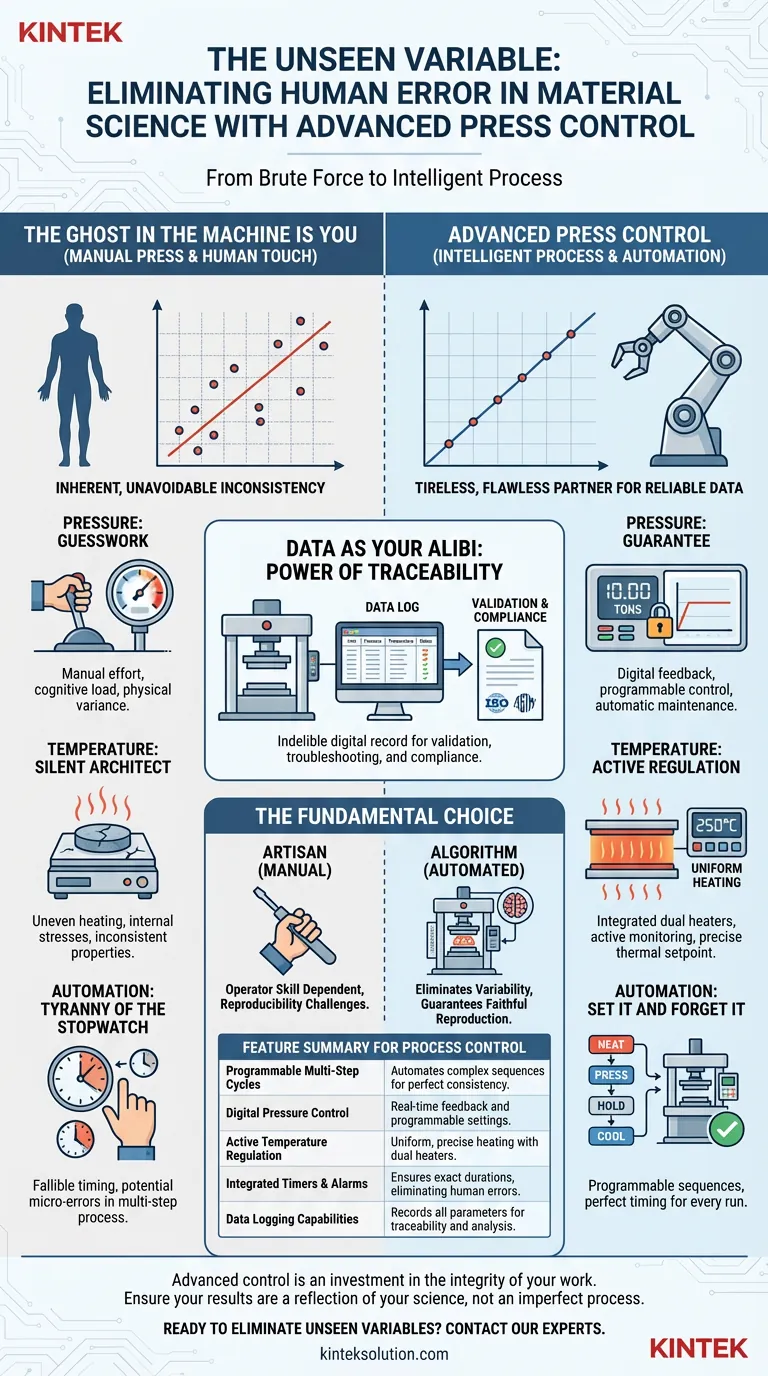
Visual Guide
Related Products
- 24T 30T 60T Heated Hydraulic Lab Press Machine with Hot Plates for Laboratory
- Manual Heated Hydraulic Lab Press with Integrated Hot Plates Hydraulic Press Machine
- Laboratory Hydraulic Pellet Press for XRF KBR FTIR Lab Press
- Lab Infrared Press Mold for Laboratory Applications
- Laboratory Hydraulic Press Lab Pellet Press Machine for Glove Box
Related Articles
- The Invisible Forge: Why the Laboratory Press is the Soul of Nano-Composites
- The Architecture of Slow: Why Physical Precision Dictates Chemical Destiny
- The Architecture of Density: Why Pressure is the Silent Architect of Solid-State Batteries
- The Physics of Transparency: Why Pressure is the Silent Architect of Spectroscopic Clarity
- The Architecture of Certainty: Why the Laboratory Press is the Anchor of Material Science



















