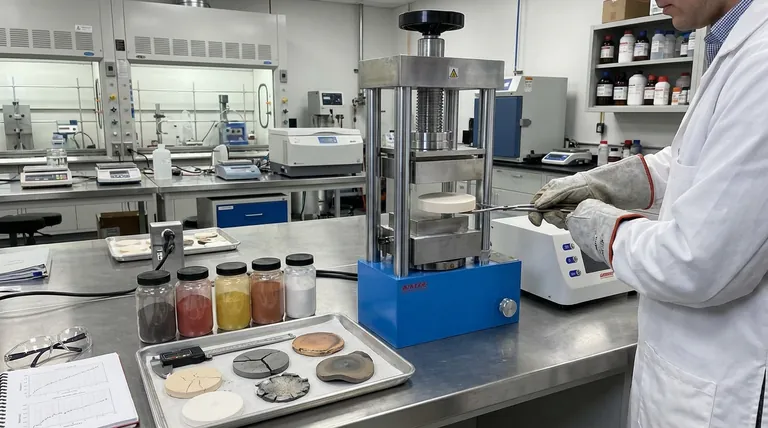
You’ve done it. After weeks of work, you pull the sample from the press. It’s perfect. The density is uniform, it’s free of cracks, and it passes every performance test. You’ve finally cracked the code for your new advanced ceramic or composite material.
Then, you try to make another one.
Following the exact same recipe, the second sample cracks. The third has voids. The fourth looks good but fails the strength test. Suddenly, your breakthrough feels like a fluke. The pressure is on, expensive raw materials are being wasted, and your project deadline is looming. If this sounds familiar, you’re not alone.
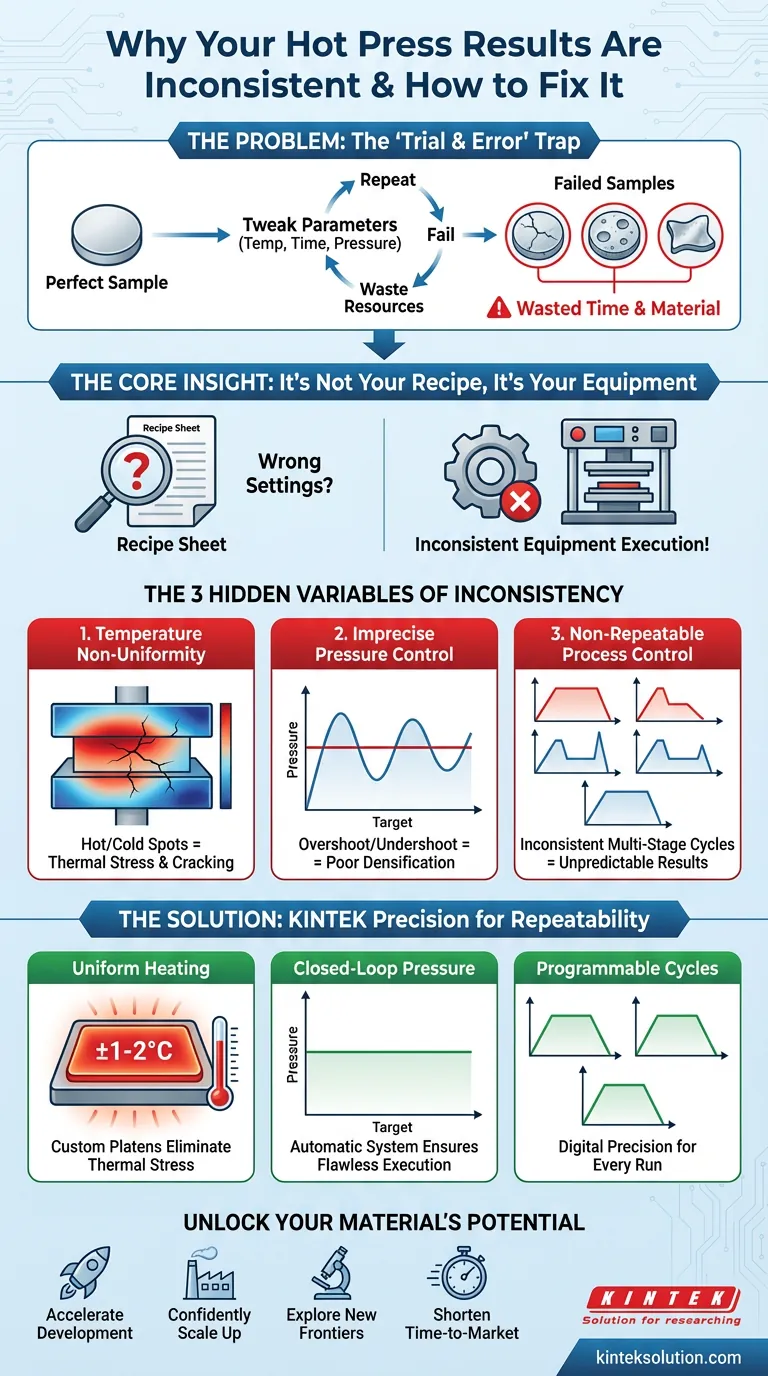
The Vicious Cycle of 'Trial and Error'
In materials science labs around the world, this exact scenario plays out every day. When faced with inconsistent results from a hot press, the response is almost always the same: a frustrating and costly cycle of trial and error.
Engineers and scientists start tweaking the parameters:
- "Let's increase the temperature by 10°C."
- "Maybe we need to add five more minutes of dwell time."
- "Let's try ramping up the pressure more slowly."
- "Could it be a bad batch of powder?"
Each attempt consumes valuable time, and worse, it consumes expensive materials—whether it's advanced ceramic powders, carbon fiber pre-pregs, or proprietary polymer blends. The business consequences are severe. A project that should take weeks stretches into months. Promising new products are delayed, giving competitors an edge. In the worst cases, the inability to produce consistent results can lead to a promising R&D project being canceled altogether.
The core problem with this approach is that it assumes one of your settings is wrong. But what if the problem isn't your recipe at all?
It’s Not Your Recipe, It’s Your Equipment: The Hidden Variable in Hot Pressing
Here is the truth that turns the problem on its head: Your inconsistency isn't caused by the wrong parameters, but by your equipment's inability to execute those parameters precisely and repeatably.
Hot pressing isn't just about smashing something hot. It's a delicate process governed by fundamental physics. Three critical, often-overlooked variables determine success or failure:
1. Temperature Uniformity
When a press has hot and cold spots across its heating surfaces (platens), it creates massive internal stress in your sample. One part of the material expands or sinters faster than another. This thermal stress is a primary cause of the micro-cracks and warping that ruin your components. A generic press might reach the target temperature in one spot, but fail to hold it evenly across the entire sample.
2. Pressure Control
Achieving a target pressure isn't enough. The way that pressure is applied and maintained is critical. A system with imprecise pressure control can overshoot the target, causing cracks, or undershoot it, leading to poor densification and porosity. Without a closed-loop feedback system, the actual pressure applied can fluctuate, making each run different even with the same settings.
3. Repeatable Process Control
Your "recipe" isn't just a final temperature and pressure. It's the entire thermal and mechanical journey: the heating rate, the cooling rate, the pressure ramp-up, the dwell time, and the pressure release. If your equipment cannot execute this entire multi-stage cycle with machine precision every single time, your results will never be truly repeatable.
This is why endlessly tweaking your parameters fails. You're trying to correct a recipe when the real problem is that your "oven" is unpredictable. You're trying to draw a straight line with a wobbly ruler.
From Brute Force to Precision Control: The Tool Designed for Repeatability
To escape the cycle of trial and error, you don't need a more complicated recipe. You need an instrument that guarantees control. You need a tool engineered from the ground up not just to apply heat and pressure, but to master the process of doing so.
This is precisely why KINTEK's laboratory presses are designed as precision instruments for materials R&D. They are built on a deep understanding of what causes failure and engineered to eliminate those root causes.
-
To solve Temperature Non-Uniformity: Our presses feature custom-engineered heating platens that ensure exceptional temperature uniformity (often within ±1-2°C) across the entire surface. This eliminates the internal stresses that cause cracking and ensures your entire sample experiences the exact same thermal profile.
-
To solve Inconsistent Pressure: We utilize fully automatic, closed-loop hydraulic or servo-electric systems. You program the exact pressure profile you need, and the machine executes it flawlessly, maintaining the target force without fluctuation and ensuring consistent densification run after run.
-
To solve Lack of Repeatability: KINTEK presses are equipped with advanced programmable controllers. You can design, save, and execute complex multi-stage cycles with the push of a button. Every ramp, dwell, and cooling stage is performed with digital precision, guaranteeing that the 1st and 100th sample undergo the identical process.
Our machines aren't just powerful; they are predictable. They transform hot pressing from a black art into a repeatable science.
Beyond Troubleshooting: Unlocking the True Potential of Your Material Science
When you are no longer fighting your equipment, you are free to do what you do best: innovate.
Resolving the core problem of inconsistency unlocks incredible new potential. Instead of spending your time troubleshooting, you can now:
- Accelerate Development: Systematically test different material compositions and process parameters with confidence, knowing that any change in the result is due to your deliberate modification, not random machine error.
- Confidently Scale Up: Move from a single successful sample to a pilot batch for investors or customers, knowing you can reproduce your results on demand.
- Explore New Frontiers: Push the boundaries of your materials. With precise control, you can explore more complex curing cycles or sinter highly sensitive materials that would be impossible with less-capable equipment.
- Shorten Time-to-Market: By drastically reducing the R&D cycle time, you get your innovative products out of the lab and into the market faster, securing your competitive advantage.
Stop letting inconsistent equipment dictate the pace of your innovation. It's time to move from guesswork to guaranteed control and unlock the true potential of your research. If you're ready to make inconsistent results a thing of the past, our team is here to help you configure the right solution for your specific material challenges. Contact Our Experts.
Visual Guide
Related Products
- Automatic High Temperature Heated Hydraulic Press Machine with Heated Plates for Lab
- Heated Hydraulic Press Machine with Heated Plates for Vacuum Box Laboratory Hot Press
- Automatic Heated Hydraulic Press Machine with Hot Plates for Laboratory
- Heated Hydraulic Press Machine With Heated Plates For Vacuum Box Laboratory Hot Press
- Laboratory Split Manual Heated Hydraulic Press Machine with Hot Plates
Related Articles
- The Architecture of Slow: Why Physical Precision Dictates Chemical Destiny
- The Architecture of Certainty: Why the Laboratory Press is the Anchor of Material Science
- The Vanishing Boundary: The Hidden Thermodynamics of LTCC Lamination
- The Alchemy of 160°C: Why Precision Pressing is the Silent Backbone of Rubber Science
- The Invisible Forge: Why the Laboratory Press is the Soul of Nano-Composites



















