
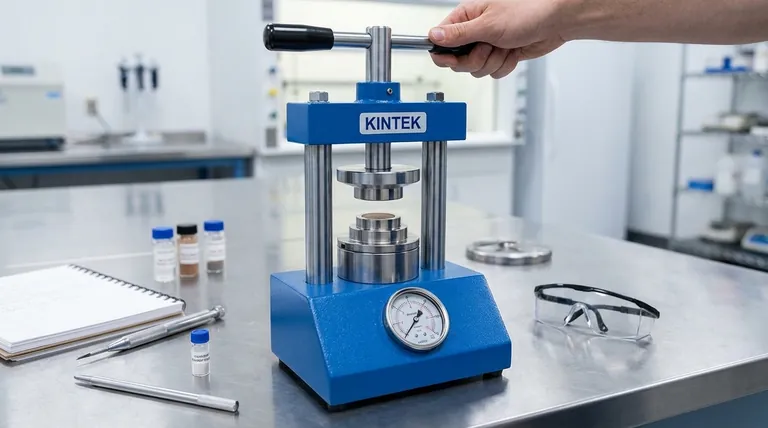
At their core, manual hydraulic presses are simple, robust machines that use a hand-operated lever to generate significant compressive force. By pumping the lever, the operator pressurizes hydraulic oil in a cylinder, which drives a piston to compact a material. The key features center on this direct manual control, a visible pressure gauge for monitoring, and built-in safety mechanisms.
The defining characteristic of a manual hydraulic press is its simplicity and direct user control. While this makes it cost-effective and ideal for certain applications, it also introduces trade-offs in terms of physical effort and the repeatability of results compared to automated systems.
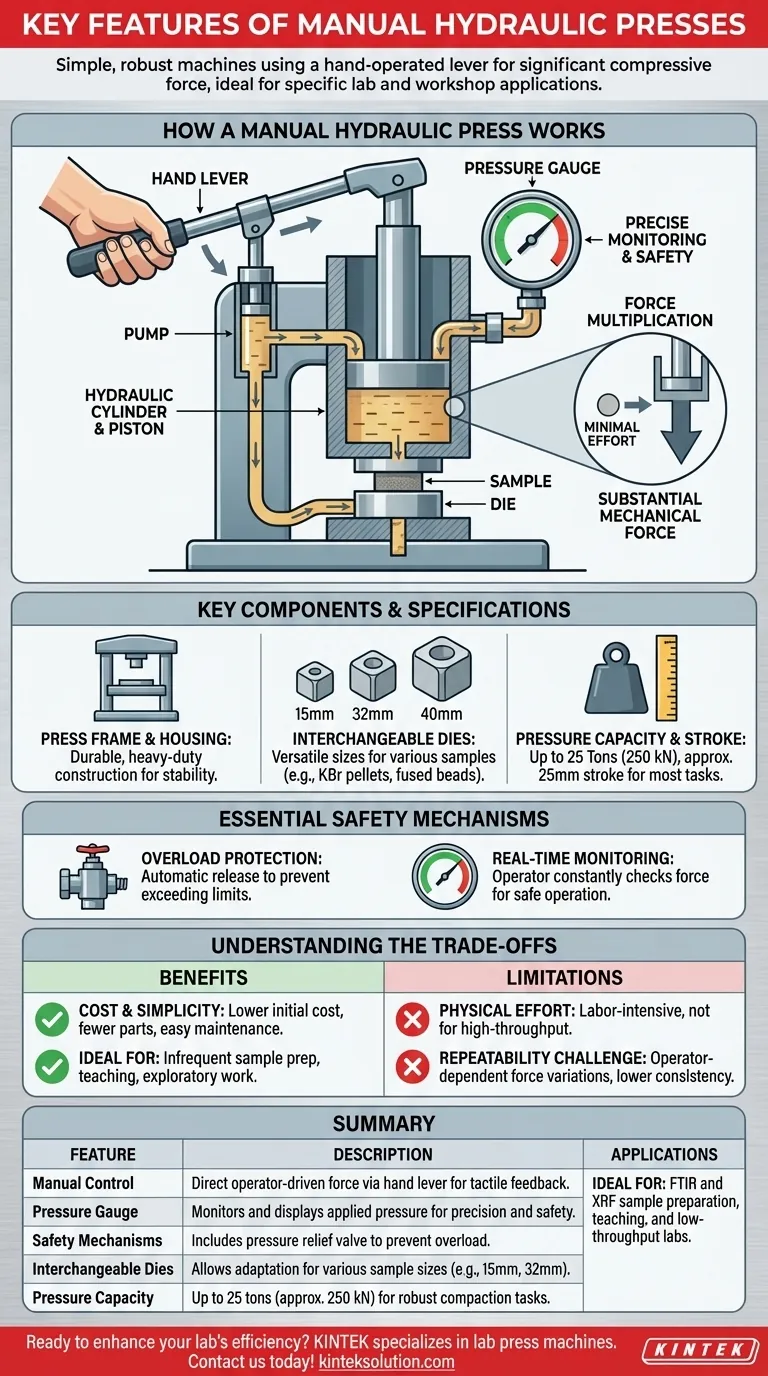
How a Manual Hydraulic Press Works
A manual press translates minimal human effort into substantial mechanical force through the principle of hydraulic multiplication. Understanding this mechanism is key to using the tool effectively and safely.
The Core Hydraulic Principle
The system consists of a cylinder filled with incompressible hydraulic oil. Pumping the hand lever pressurizes this oil.
This pressure acts on a large-diameter piston, multiplying the initial force applied by the operator to generate a powerful compressive load on the sample.
Operator-Driven Force Application
The amount of force is directly controlled by the operator's actions on the lever. More pumping increases the pressure, while releasing a valve decreases it.
This provides direct, tactile feedback and control over the compaction process, which is useful for delicate or exploratory work.
Monitoring with the Pressure Gauge
An integrated and accurate pressure gauge is a critical feature. It is the operator's primary source of feedback.
This display allows for the precise application of a desired load and ensures that the pressure stays within the safe operational limits of both the sample and the press itself.
Key Components and Specifications
While the core principle is simple, several components define the press's versatility and capacity for different laboratory and workshop tasks.
The Press Frame and Housing
Manual presses are built with a durable, heavy-duty frame. This ensures stability during high-pressure operation and provides a long service life.
Interchangeable Pressing Dies
Most units support interchangeable pressing dies of various diameters (e.g., 15 mm, 32 mm, 40 mm). This allows the press to be adapted for creating different sized sample pellets, such as KBr pellets for FTIR or fused beads for XRF analysis.
Pressure Capacity and Stroke
These presses are available in a range of force capacities, with common models reaching up to 25 tons (approximately 250 kN).
The piston stroke, or the distance the piston can travel, is typically limited, often up to around 25 mm, which is sufficient for most sample compaction tasks.
Understanding the Trade-offs
The simplicity of a manual press is its greatest strength and also the source of its primary limitations. Choosing one requires understanding these trade-offs.
The Benefit: Cost and Simplicity
Manual presses have a significantly lower initial cost than their automatic counterparts. With fewer moving parts, they are also easier and cheaper to maintain.
The Drawback: Physical Effort
Because the force is generated manually, operation is labor-intensive. This makes manual presses less suitable for high-throughput environments where many samples must be prepared frequently.
The Challenge: Repeatability
The final applied pressure is entirely dependent on the operator. This can lead to variations between samples and between different users, making it more challenging to achieve high levels of consistency across large batches compared to a programmed automatic press.
Essential Safety Mechanisms
Operating any high-pressure equipment demands a focus on safety. Manual presses incorporate fundamental features to protect both the operator and the instrument.
Overload Protection: The Pressure Relief Valve
A key safety feature is an automatic pressure relief valve. If the operator attempts to exceed the machine's maximum rated pressure, this valve will automatically engage to release excess pressure and prevent catastrophic failure.
Real-Time Monitoring: The Pressure Display
The clear pressure gauge is not just for operational accuracy; it's a safety tool. It allows the operator to constantly monitor the force being applied and ensure it remains within a safe range, preventing over-pressurization.
Is a Manual Press Right for Your Lab?
Your final decision should be based on a clear assessment of your primary goals, budget, and throughput requirements.
- If your primary focus is cost-effectiveness and infrequent sample prep: A manual press is an excellent, reliable choice for tasks like creating pellets for FTIR or XRF analysis.
- If your primary focus is high throughput or absolute consistency across batches: You should consider an automatic press to eliminate operator-induced variability and reduce physical labor.
- If your primary focus is teaching or hands-on process development: The direct feedback and control of a manual press provide an invaluable learning experience.
Understanding these core features and trade-offs empowers you to select the right tool for your specific scientific or industrial goal.
Summary Table:
| Feature | Description |
|---|---|
| Manual Control | Direct operator-driven force via hand lever for tactile feedback. |
| Pressure Gauge | Monitors and displays applied pressure for precision and safety. |
| Safety Mechanisms | Includes pressure relief valve to prevent overload and ensure operator protection. |
| Interchangeable Dies | Allows adaptation for various sample sizes (e.g., 15mm, 32mm). |
| Pressure Capacity | Up to 25 tons (approx. 250 kN) for robust compaction tasks. |
| Applications | Ideal for FTIR and XRF sample preparation, teaching, and low-throughput labs. |
Ready to enhance your lab's efficiency with reliable manual hydraulic presses? KINTEK specializes in lab press machines, including manual hydraulic presses, automatic lab presses, isostatic presses, and heated lab presses, designed to meet your laboratory needs for precise sample preparation, cost savings, and durable performance. Contact us today to discuss your requirements and discover how our solutions can benefit your workflow! Get in touch now
Visual Guide
Related Products
- Manual Heated Hydraulic Lab Press with Integrated Hot Plates Hydraulic Press Machine
- Manual Laboratory Hydraulic Press Lab Pellet Press
- Laboratory Manual Heated Hydraulic Press Machine with Hot Plates
- Manual Laboratory Hydraulic Pellet Press Lab Hydraulic Press
- Laboratory Split Manual Heated Hydraulic Press Machine with Hot Plates
People Also Ask
- Why is a laboratory hydraulic press with heating plates required for PLA/TEC films? Achieve Precise Sample Integrity
- Why is a manual hydraulic heated lab press essential for compleximer materials? Unlock Advanced Material Synthesis
- Function of a Laboratory Hydraulic Press with Heated Platens in SSE? Enhance Battery Density & Conductivity
- What role does a lab manual hydraulic press play in Li9B19S33 ionic conductivity? Optimize Pellet Characterization
- What are the main benefits of performing proper maintenance on a heated lab press? Ensure Accuracy & Safety



















