
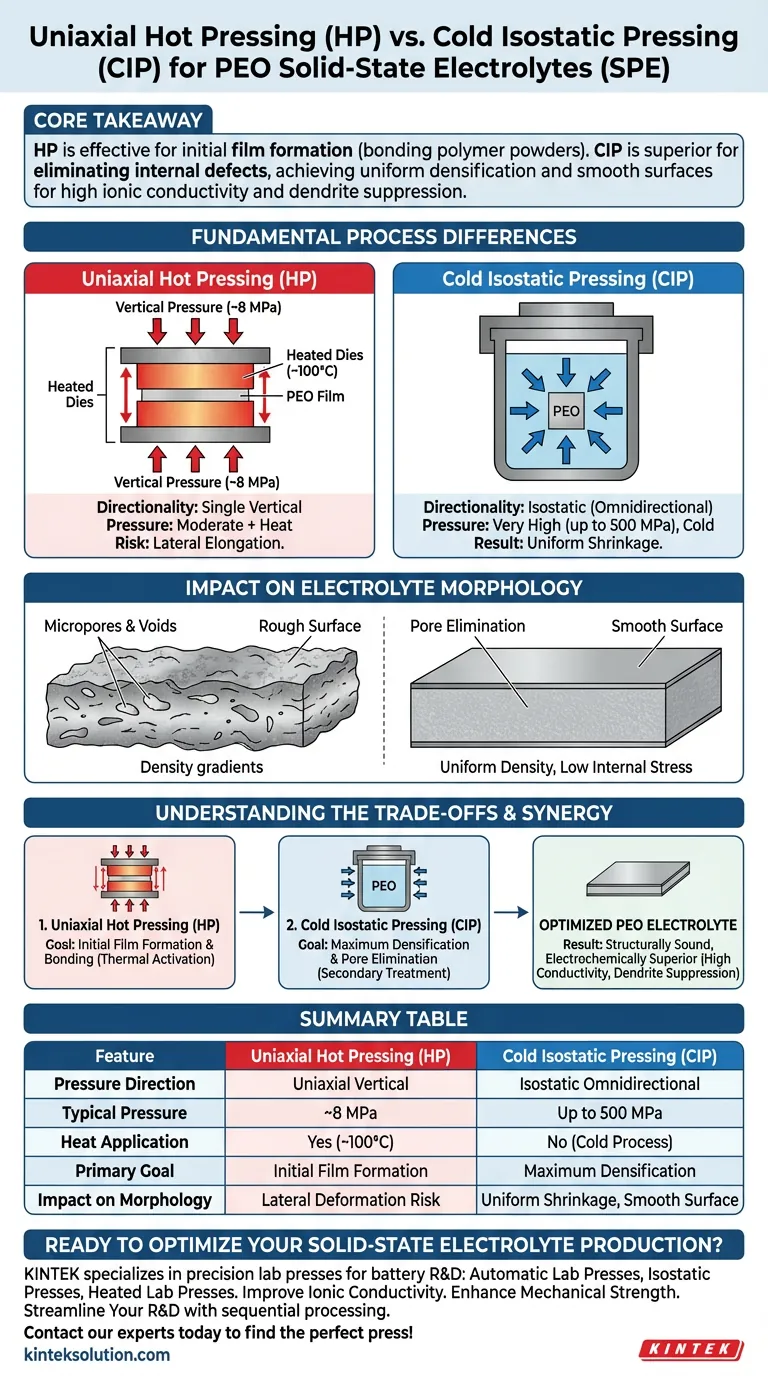
Uniaxial hot pressing (HP) and cold isostatic pressing (CIP) differ fundamentally in the direction of applied force and the magnitude of pressure achieved. HP utilizes heated mechanical dies to apply moderate vertical pressure for initial film formation, while CIP employs a fluid medium to exert ultra-high, omnidirectional pressure to maximize density without distorting the sample's shape.
Core Takeaway: While uniaxial hot pressing is effective for bonding polymer powders into a cohesive preliminary shape, cold isostatic pressing is superior for eliminating internal defects. CIP achieves uniform densification and surface smoothness, which are critical for high ionic conductivity and dendrite suppression in solid-state batteries.
Fundamental Process Differences
Directionality of Pressure
Uniaxial hot pressing applies force in a single vertical direction using upper and lower dies. This directional nature can lead to uneven stress distribution.
Cold isostatic pressing utilizes a liquid medium to apply pressure from all directions simultaneously. This results in "isotropic" pressure, ensuring that force is exerted equally on every surface of the electrolyte.
Pressure Magnitude and Medium
HP typically operates at moderate pressures (e.g., around 8 MPa) combined with heat (e.g., 100°C). The heat is necessary to soften the PEO polymer to facilitate particle bonding.
CIP is capable of exerting significantly higher pressures (e.g., up to 500 MPa). Because it uses a fluid medium rather than rigid dies, it can achieve these levels without crushing the sample macroscopically.
Impact on Electrolyte Morphology
Macroscopic Deformation vs. Densification
Because HP squeezes the material vertically, excessive pressure can cause lateral elongation. This flattens the polymer film and changes its dimensions, potentially leading to inconsistent thickness.
CIP avoids this issue completely. It densifies the material by shrinking it uniformly, maintaining the original geometric proportions without causing macroscopic deformation.
Pore Elimination and Surface Quality
The primary morphological benefit of CIP is the elimination of internal micropores. The high, uniform pressure forces the material to fill voids that HP cannot reach.
This results in an electrolyte with a significantly smoother surface and a more uniform interior structure.
Homogeneity and Stress Distribution
HP can introduce internal stress and density gradients due to friction between the sample and the die.
CIP yields components with uniform density distribution and lower internal stress. This homogeneity minimizes micro-cracks and improves the mechanical reliability of the electrolyte.
Understanding the Trade-offs
The Necessity of Heat vs. Pressure
HP is not purely about density; it is about thermal activation. It uses heat to soften the PEO and lithium salt mixture, allowing for the initial bonding of particles that would not occur under cold pressure alone.
However, HP is limited in its ability to fully densify the material without deforming it. It establishes the "foundation," but often leaves microscopic voids.
Sequential Processing
The most effective approach is often synergistic rather than mutually exclusive. HP is frequently used first to form the initial film structure.
CIP is then applied as a secondary treatment to the hot-pressed film. This "post-treatment" boosts mechanical strength and ionic conductivity by closing the pores left behind by the initial hot press.
Making the Right Choice for Your Goal
To optimize PEO solid-state electrolytes, you must select the method that aligns with your specific processing stage:
- If your primary focus is initial film formation: Use Uniaxial Hot Pressing to leverage heat for softening the polymer and bonding the powder into a cohesive, preliminary disc.
- If your primary focus is maximizing electrochemical performance: Apply Cold Isostatic Pressing as a secondary step to eliminate micropores, enhance ionic conductivity, and suppress lithium dendrite growth.
By combining the thermal forming capabilities of hot pressing with the densification power of isostatic pressing, you achieve an electrolyte that is both structurally sound and electrochemically superior.
Summary Table:
| Feature | Uniaxial Hot Pressing (HP) | Cold Isostatic Pressing (CIP) |
|---|---|---|
| Pressure Direction | Uniaxial (Vertical) | Isostatic (Omnidirectional) |
| Typical Pressure | Moderate (~8 MPa) | Very High (up to 500 MPa) |
| Heat Application | Yes (e.g., 100°C) | No (Cold Process) |
| Primary Goal | Initial Film Formation & Bonding | Maximum Densification & Pore Elimination |
| Impact on Morphology | Risk of Lateral Deformation | Uniform Shrinkage, Smooth Surface |
| Best Use Case | Creating a preliminary cohesive film | Enhancing density and conductivity of a pre-formed film |
Ready to Optimize Your Solid-State Electrolyte Production?
The right lab press is critical for developing high-performance PEO-based electrolytes. KINTEK specializes in precision lab press machines – including automatic lab presses, isostatic presses, and heated lab presses – designed to meet the exacting demands of battery research and development.
Let us help you achieve superior results:
- Improve Ionic Conductivity: Achieve the uniform density and smooth surfaces necessary for high ion transport.
- Enhance Mechanical Strength: Produce robust electrolytes that effectively suppress dendrite growth.
- Streamline Your R&D: Our equipment enables the precise sequential processing (HP followed by CIP) highlighted in this article.
Don't let processing limitations hinder your battery's potential. Contact our experts today to find the perfect press for your laboratory's needs!
Visual Guide
References
- Benoît Denis Louis Campéon, Naoaki Yabuuchi. Virtues of Cold Isostatic Pressing for Preparation of All‐Solid‐State‐Batteries with Poly(Ethylene Oxide). DOI: 10.1002/cssc.202301054
This article is also based on technical information from Kintek Solution Knowledge Base .
Related Products
- Split Automatic Heated Hydraulic Press Machine with Heated Plates
- Laboratory Manual Heated Hydraulic Press Machine with Hot Plates
- Automatic High Temperature Heated Hydraulic Press Machine with Heated Plates for Lab
- Automatic Heated Hydraulic Press Machine with Hot Plates for Laboratory
- Manual Heated Hydraulic Lab Press with Integrated Hot Plates Hydraulic Press Machine
People Also Ask
- What are the requirements for electrode pressing with high-viscosity ionic liquids like EMIM TFSI? Optimize Performance
- How does a laboratory heated hydraulic press facilitate PBN sample prep for WAXS? Achieve Precise X-Ray Scattering
- What are the industrial applications of heated hydraulic presses? Master Heat & Force for Precision Manufacturing
- Why is a laboratory hydraulic press with heating plates required for PLA/TEC films? Achieve Precise Sample Integrity
- Function of a Laboratory Hydraulic Press with Heated Platens in SSE? Enhance Battery Density & Conductivity
















