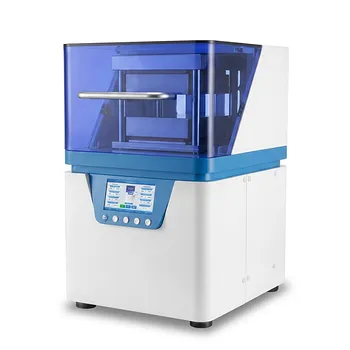
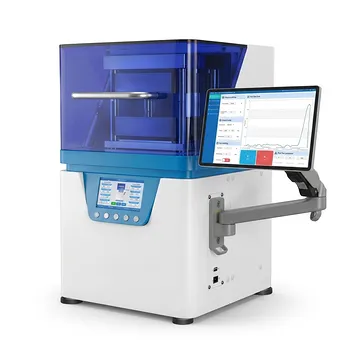
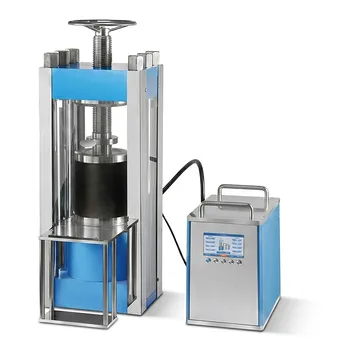
The heated press functions as the primary control mechanism for the thermal compression cycle, simultaneously applying heat and pressure to consolidate multilayer prepregs. It facilitates the flow of epoxy resin into flax fiber gaps, eliminates internal air pockets, and initiates the chemical cross-linking required to transform raw materials into a dense, high-performance composite.
The core purpose of a heated press is to manage the interaction between heat and pressure to ensure optimal resin infiltration and structural uniformity. By controlling these variables, the press removes defects like porosity and residual stress while defining the final physical dimensions and fiber-to-resin ratio of the composite.
Achieving Structural Integrity through Consolidation
Facilitating Resin Infiltration and Wetting
The primary role of the heated plates is to reduce the viscosity of the epoxy resin, allowing it to become fluid enough to penetrate the flax fiber bundles. This wetting process ensures that every fiber is fully encapsulated by the matrix, which is essential for efficient load transfer within the finished material.
Elimination of Internal Voids and Porosity
As the press applies constant pressure (often around 0.7 MPa to 5 MPa), it forces residual air and volatiles out of the laminated structure. Discharging this air is critical, as interlaminar voids act as stress concentrators that can lead to premature structural failure or delamination.
Maximizing Interlaminar Adhesion
The simultaneous application of heat and pressure ensures that multiple layers of prepreg or fabric bond tightly together. This creates a homogeneous structure with high interlaminar shear strength, preventing the layers from separating under mechanical load.
Precision Control of the Thermal Cycle
Managing the Cross-linking Reaction
The heated press provides the stable high temperatures (such as 130°C) necessary to trigger the chemical cross-linking of the epoxy resin. Precise control over isothermal holding times ensures the resin cures completely and uniformly throughout the entire thickness of the plate.
Maintaining Thermal Uniformity
High-quality presses utilize upper and lower heating platens to provide a uniform thermal field. This prevents localized under-curing or over-curing, which can result in inconsistent mechanical properties across the composite surface.
Reducing Internal Residual Stresses
By controlling the heating and cooling rates, the press manages the thermal expansion and contraction of the different materials. This careful modulation helps minimize internal residual stresses that could otherwise cause the composite to warp or crack after it is removed from the mold.
Geometric and Material Precision
Controlling Thickness and Dimensional Stability
The press acts as a mechanical stop that ensures the final composite plate has a uniform thickness and stable geometric dimensions. This precision is vital for meeting industrial standards and ensuring the material fits perfectly into its intended application.
Optimizing the Fiber-to-Resin Mass Ratio
As the press consolidates the material, it extrudes excess resin from the mold. This allows manufacturers to achieve a preset fiber volume content, which is the primary factor in determining the strength-to-weight ratio of the flax-reinforced composite.
Rearrangement of Fiber Layers
The mechanical pressure encourages the tight bonding and rearrangement of multi-layer fabrics. This optimization of the internal architecture results in a denser, more robust material with fewer structural "soft spots."
Understanding the Trade-offs
Risk of Fiber Damage
While high pressure is necessary for consolidation, excessive force can crush or damage the natural flax fibers. This degradation of the reinforcement phase can lead to a significant reduction in the overall tensile strength of the composite.
Thermal Degradation of Natural Fibers
Natural fibers like flax are more sensitive to heat than synthetic fibers like glass or carbon. If the press temperature is too high or the holding time is too long, the flax fibers may undergo thermal degradation, weakening the bond between the fiber and the matrix.
Resin Starvation
Applying too much pressure too quickly can squeeze out excessive amounts of resin before it has a chance to properly wet the fibers. This results in resin starvation, where the lack of matrix material leaves the fibers unsupported and prone to buckling or fraying.
How to Apply This to Your Project
Making the Right Choice for Your Goal
- If your primary focus is maximizing mechanical strength: Prioritize precise pressure control and optimal fiber-to-resin ratios to ensure the highest possible fiber volume fraction without damaging the flax.
- If your primary focus is reducing weight and thickness: Focus on the press's ability to extrude excess resin and maintain strict dimensional tolerances through stable hydraulic pressure.
- If your primary focus is eliminating structural defects: Ensure the press provides a highly uniform thermal field and a multi-stage pressure cycle to effectively vent air and volatiles.
By mastering the balance of heat and pressure within the press, you transform a stack of raw fibers and resin into a high-performance, predictable engineering material.
Summary Table:
| Key Function | Impact on Composite | Benefit for Manufacturers |
|---|---|---|
| Resin Infiltration | Ensures full fiber encapsulation | Efficient load transfer & durability |
| Void Elimination | Removes trapped air/volatiles | Prevents delamination & structural failure |
| Thermal Control | Triggers chemical cross-linking | Ensures uniform curing & material stability |
| Dimensional Control | Maintains thickness & fiber ratio | Achieves high strength-to-weight precision |
| Stress Management | Reduces internal residual stress | Prevents warping or cracking post-molding |
Elevate Your Material Research with KINTEK’s Precision Pressing Solutions
Achieving the perfect balance of heat and pressure is critical for the development of high-performance composites and next-generation battery technologies. KINTEK specializes in comprehensive laboratory pressing solutions tailored to your specific research needs.
our extensive range includes:
- Manual & Automatic Heated Presses for precise thermal cycles.
- Multifunctional & Glovebox-Compatible Models for sensitive environments.
- Cold and Warm Isostatic Presses (CIP/WIP) widely applied in advanced battery research.
Whether you are optimizing fiber-to-resin ratios or ensuring thermal uniformity to eliminate defects, KINTEK provides the reliability and control your lab demands.
Contact our experts today to find the ideal solution for your project!
References
- Constantin Stochioiu, Benoît Piezel. Mechanical Response of Epoxy Resin—Flax Fiber Composites Subjected to Repeated Loading and Creep Recovery Tests. DOI: 10.3390/polym15030766
This article is also based on technical information from Kintek Solution Knowledge Base .
Related Products
- Heated Hydraulic Press Machine with Heated Plates for Vacuum Box Laboratory Hot Press
- Automatic Hydraulic Heat Press Machine with Multi Stage Programmable Control and Integrated Water Cooling Plate Size 180x180mm
- Automatic Hydraulic Hot Press with Large Plate and Precision Temperature Control for Advanced Material Sample Preparation and Industrial Research
- Automatic High Temperature Heated Hydraulic Press Machine with Heated Plates for Lab
- Heated Hydraulic Press Machine With Heated Plates For Vacuum Box Laboratory Hot Press
People Also Ask
- How are heated hydraulic presses utilized in the preparation of thin films? Key Mechanisms and Applications
- How does a laboratory heated hydraulic press facilitate PBN sample prep for WAXS? Achieve Precise X-Ray Scattering
- What industrial applications does a heated hydraulic press have beyond laboratories? Powering Manufacturing from Aerospace to Consumer Goods
- What are the requirements for electrode pressing with high-viscosity ionic liquids like EMIM TFSI? Optimize Performance
- What role do heated hydraulic presses play in manufacturing composite materials? Enhance Strength and Precision in Production