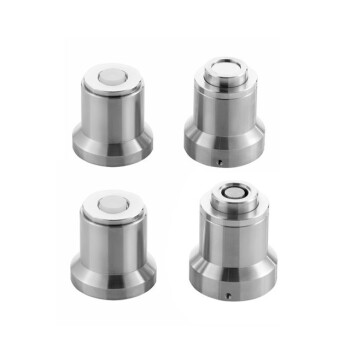
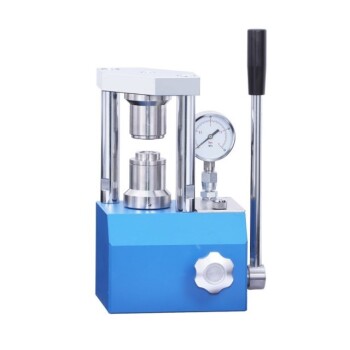
The primary function of hot pressing equipment in solid-state battery assembly is to minimize interfacial resistance by creating intimate physical contact between material layers. By applying simultaneous heat and pressure, the equipment forces the solid electrolyte and electrodes to fuse at a microscopic level. This process compensates for the lack of liquid "wetting," ensuring that lithium ions can move smoothly across the interface during operation.
The fundamental challenge in solid-state batteries is that solid interfaces do not naturally adhere to one another like liquid electrolytes do. Hot pressing mechanically bridges this gap, eliminating voids to establish the continuous ion transport channels required for high performance and extended cycle life.
The Challenge of Solid-Solid Interfaces
Overcoming the Lack of Wetting
In traditional batteries, liquid electrolytes naturally flow into the porous structure of electrodes, creating instant contact. Solid-state electrolytes are rigid and lack this inherent wetting capability. Without external intervention, the contact between the electrode and electrolyte remains poor, resulting in high impedance that blocks ion flow.
Eliminating Microscopic Voids
When solid layers are simply stacked, microscopic gaps and voids remain between the particles. These voids act as barriers to lithium-ion transport. Hot pressing equipment applies precise force to collapse these voids, significantly increasing the effective contact area between the active materials.
Mechanisms of Improvement
Promoting Atomic-Level Contact
The simultaneous application of thermal and pressure fields does more than just squeeze materials together; it changes their physical interaction. Heat softens the materials, while pressure forces them into an "atomic-level" contact. This ensures that the interface is not just touching, but physically interlocked.
Facilitating Co-Sintering and Interlocking
For hard, rigid materials like oxide electrolytes, establishing contact via cold pressing is often impossible. Hot pressing (e.g., at 375 MPa and 550 °C) promotes co-sintering. This physical interlocking creates a robust bond between the electrolyte and electrode layers without requiring the extreme temperatures that might damage the materials.
Enhancing Polymer Penetration
In systems using polymer electrolytes, the heat allows the polymer network to undergo microscopic adjustment and deformation. The pressure then forces this softened polymer to penetrate the pores of the cathode material. This molecular-level fusion creates a continuous path for ions to travel from the anode to the cathode.
Understanding the Trade-offs
Balancing Temperature and Material Integrity
A critical advantage of hot pressing is its ability to bond materials at lower temperatures than traditional sintering requires. Prolonged exposure to high heat can cause element diffusion and the formation of impurity phases, which degrade battery performance.
Precision vs. Degradation
Hot pressing mitigates this risk by substituting some of the thermal energy requirements with mechanical pressure. However, the process requires extreme precision. The equipment must apply pressure uniformly; uneven pressure can lead to structural defects or inconsistent ion transport, rendering the cell unstable for electrochemical measurements.
Making the Right Choice for Your Goal
Depending on the specific chemistry and objectives of your assembly process, the role of the hot press shifts slightly.
- If your primary focus is Oxide/Ceramic Electrolytes: Prioritize high-pressure capabilities to force rigid particles into physical interlocking and promote co-sintering at manageable temperatures.
- If your primary focus is Polymer Electrolytes: Focus on precise temperature control to soften the polymer network sufficiently for pore penetration without degrading the material.
- If your primary focus is Research and Standardization: Ensure the equipment delivers highly uniform stack pressure to eliminate variables when investigating phenomena like lithium dendrite suppression.
Success in solid-state assembly relies not just on the materials used, but on the mechanical precision with which they are fused together.
Summary Table:
| Mechanism | Impact on Battery Performance | Key Process Parameters |
|---|---|---|
| Void Elimination | Reduces impedance by closing microscopic gaps | Uniform stack pressure |
| Atomic-Level Contact | Facilitates smooth ion transport across interfaces | Simultaneous heat & pressure |
| Co-Sintering | Creates robust physical interlocking of layers | High pressure (e.g., 375 MPa) |
| Polymer Penetration | Ensures continuous paths in composite cathodes | Precise temperature control |
Optimize Your Battery Research with KINTEK Pressing Solutions
Unlock the full potential of your solid-state battery assembly with KINTEK’s industry-leading laboratory pressing equipment. Whether you are working with rigid oxide electrolytes or flexible polymer systems, our solutions are designed to deliver the mechanical precision required to eliminate interfacial resistance and prevent material degradation.
Why choose KINTEK?
- Comprehensive Range: Choose from manual, automatic, heated, and multifunctional models.
- Specialized Capability: Glovebox-compatible designs and advanced cold/warm isostatic presses.
- Research Focused: High-uniformity pressure application perfect for lithium dendrite suppression studies.
Contact KINTEK Today to Enhance Your Lab's Efficiency
References
- Worku Tamire, Tsiye Hailemariam. Advancements in Solid-State Batteries Overcoming Challenges in Energy Density and Safety - Review. DOI: 10.11648/j.ajac.20251302.12
This article is also based on technical information from Kintek Solution Knowledge Base .
Related Products
- Warm Isostatic Press for Solid State Battery Research Warm Isostatic Press
- Automatic Heated Hydraulic Press Machine with Hot Plates for Laboratory
- Lab Button Battery Tablet Press Sealing Mold
- Automatic High Temperature Heated Hydraulic Press Machine with Heated Plates for Lab
- Laboratory Manual Heated Hydraulic Press Machine with Hot Plates
People Also Ask
- Why must composite cathodes be sealed in vacuum lamination bags for WIP? Ensure Battery Stability and Density
- What is the function of elastic molds in warm isostatic pressing? Achieve Uniform Density in Composite Particles
- How do sacrificial volume materials (SVM) maintain microchannels in isostatic pressing? Ensure Structural Integrity
- What is the significance of temperature control in Warm Isostatic Pressing? Unlock Uniform Densification and Process Stability
- What is the function of hydraulic pressure in warm isostatic pressing? Achieve Uniform Material Density