
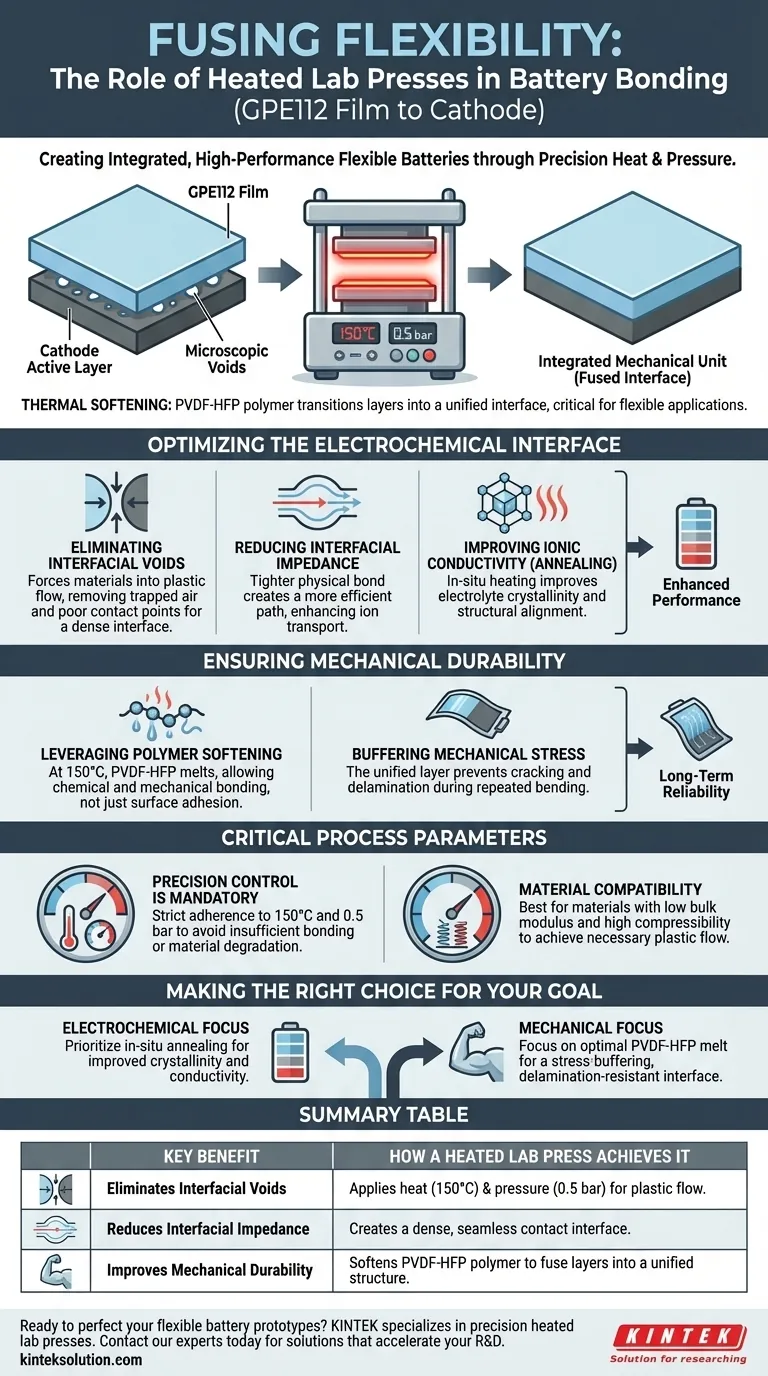
The primary function of a heated lab press in this context is to fuse the GPE112 film and the cathode active layer into a single, integrated mechanical unit. By applying controlled heat (typically 150°C) and pressure (around 0.5 bar), you induce a phase change in the binder materials that eliminates microscopic voids and ensures structural integrity.
The process utilizes the thermal softening properties of the PVDF-HFP polymer to transition two separate layers into a unified interface. This seamless bonding is critical for flexible applications, as it significantly lowers impedance and prevents delamination during repeated bending.
Optimizing the Electrochemical Interface
Eliminating Interfacial Voids
The most immediate benefit of hot pressing is the removal of gaps between layers. Simply stacking a GPE112 film onto a cathode results in poor contact points and trapped air, which creates high resistance.
Applying pressure forces the materials into a plastic flow, ensuring a dense, seamless contact interface. This physical merging is essential for efficient battery operation.
Reducing Interfacial Impedance
By eliminating voids, you directly address the issue of interfacial impedance. A tighter physical bond translates to a more efficient path for electrochemical reactions.
This results in significantly enhanced ion transport efficiency, allowing the battery to charge and discharge more effectively without energy loss at the layer boundaries.
Improving Ionic Conductivity via Annealing
The heating element of the press does more than just melt the binder; it acts as an in-situ annealing treatment.
For composite electrodes, this gentle heating can improve the electrolyte’s crystallinity. This structural alignment further enhances the overall ionic conductivity within the composite electrode.
Ensuring Mechanical Durability
Leveraging Polymer Softening
The success of this process relies on the specific properties of the PVDF-HFP polymer present in both the GPE112 film and the cathode binder.
At 150°C, this polymer softens and physically melts. This allows the two layers to chemically and mechanically bond, rather than just adhering at the surface.
Buffering Mechanical Stress
For flexible battery applications, rigid components are a failure point. The integrated structure created by the press effectively buffers mechanical stress.
This unified layer prevents the active material from cracking or delaminating when the battery is bent, ensuring long-term reliability in flexible devices.
Critical Process Parameters
Precision Control is Mandatory
The effectiveness of this technique relies entirely on staying within specific parameters, such as 150°C and 0.5 bar.
Deviating from these settings can lead to insufficient bonding (too cool/light) or material degradation (too hot/heavy).
Material Compatibility
This method is specifically advantageous for materials with low bulk modulus and high compressibility.
The technique exploits these physical characteristics to achieve the plastic flow necessary for a dense interface, meaning it may not be suitable for all material types.
Making the Right Choice for Your Goal
To maximize the effectiveness of your flexible battery fabrication, align your pressing parameters with your specific performance targets.
- If your primary focus is Electrochemical Performance: Prioritize the in-situ annealing effect to improve crystallinity and maximize ionic conductivity.
- If your primary focus is Mechanical Durability: Focus on achieving the optimal melt of the PVDF-HFP polymer to create a stress-buffering interface that resists delamination.
By controlling the interface at the microscopic level, you transform a stack of loose layers into a robust, high-performance energy storage unit.
Summary Table:
| Key Benefit | How a Heated Lab Press Achieves It |
|---|---|
| Eliminates Interfacial Voids | Applies heat (150°C) and pressure (0.5 bar) to force materials into plastic flow, removing microscopic gaps. |
| Reduces Interfacial Impedance | Creates a dense, seamless contact interface for enhanced ion transport and efficient battery operation. |
| Improves Mechanical Durability | Softens the PVDF-HFP polymer to fuse layers, creating a unified structure that buffers stress from bending. |
Ready to perfect your flexible battery prototypes? KINTEK specializes in lab press machines, including precision heated lab presses, to help you achieve the seamless layer bonding and robust mechanical integrity critical for your R&D. Our equipment provides the exact temperature and pressure control you need to eliminate interfacial voids and enhance performance. Contact our experts today to discuss how our solutions can accelerate your development of reliable, high-performance flexible energy storage devices.
Visual Guide
Related Products
- 24T 30T 60T Heated Hydraulic Lab Press Machine with Hot Plates for Laboratory
- Manual Heated Hydraulic Lab Press with Integrated Hot Plates Hydraulic Press Machine
- Automatic High Temperature Heated Hydraulic Press Machine with Heated Plates for Lab
- Automatic Heated Hydraulic Press Machine with Hot Plates for Laboratory
- Heated Hydraulic Press Machine with Heated Plates for Vacuum Box Laboratory Hot Press
People Also Ask
- Function of a Laboratory Hydraulic Press with Heated Platens in SSE? Enhance Battery Density & Conductivity
- Why is a laboratory hydraulic press with heating plates required for PLA/TEC films? Achieve Precise Sample Integrity
- What role does a laboratory heated hydraulic press play in LTCC? Essential for High-Density Ceramic Lamination
- What is the primary function of a laboratory heated hydraulic press? Mastering Thermoplastic Carbon Fiber Composites
- What is the critical role of a laboratory heated hydraulic press? Mastering PVC Sample Prep for Testing



















