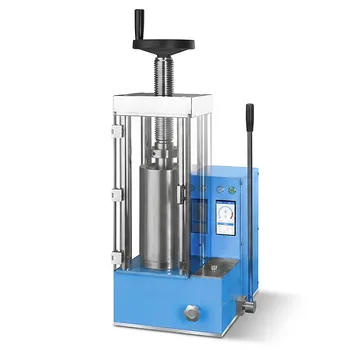
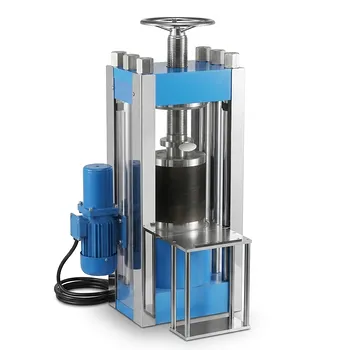
Cold isostatic pressing (CIP) serves as the primary molding mechanism for Bi2212 superconducting tubular substrates, providing the isotropic pressure necessary to transform loose oxide powders into high-density "green" bodies. By applying uniform force from all directions, CIP ensures that cylindrical or conical substrates achieve a consistent internal density that is impossible to reach with traditional uniaxial pressing. This high-precision compaction is the foundational step required to minimize structural defects and ensure the mechanical integrity of the material during the final sintering process.
Core Takeaway: CIP is essential for fabricating Bi2212 tubular substrates because it eliminates internal density gradients and voids, directly preventing structural distortion and cracking while significantly enhancing the material's final current-carrying capacity.
Achieving Uniform Densification in Complex Shapes
The Role of Isotropic Pressure
In the preparation of Bi2212 tubes, CIP utilizes a fluid medium to transmit omnidirectional pressure to oxide powders contained within flexible molds. This ensures that every part of the tubular or conical structure receives equal force, regardless of its geometric complexity.
This method is superior to standard pressing because it overcomes the aspect ratio limitations inherent in mechanical dies. It allows for the production of elongated rod-shaped or tubular preforms that maintain a constant density across their entire length.
Elimination of Internal Voids
The primary goal during the molding stage is to force the elimination of voids between powder particles. High-pressure compaction (often reaching 0.3 GPa to 2 GPa) packs the superconducting particles into a tightly coherent structure.
By maximizing the initial "green" density, CIP provides the structural consistency needed for subsequent processing. This dense packing is critical for creating a continuous superconducting path once the material undergoes heat treatment.
Impact on Sintering and Performance
Mitigating Structural Defects
Bi2212 materials are prone to cracking and distortion during high-temperature sintering if the initial compact is uneven. CIP significantly reduces internal density gradients, which prevents the substrate from warping or developing severe fractures as it shrinks during the heating cycle.
Furthermore, high-density compaction helps suppress retrograde densification. This refers to the tendency of the material to expand or form gas bubbles during partial-melt heat treatment, which can otherwise interrupt the superconducting filaments.
Enhancing Current-Carrying Capacity
The densification achieved through CIP directly influences the critical current density ($J_c$). By ensuring better particle connectivity and a more uniform core architecture, the process allows for a higher volume of current to flow through the finished substrate.
In composite structures, CIP also densifies the interface between the superconducting oxide and metallic stabilizers (like silver). This improved interface facilitates better thermal and electrical stability in high-field applications.
Understanding the Trade-offs
Equipment and Tooling Requirements
While CIP offers superior uniformity, it requires specialized flexible molds (often made of rubber or elastomer) rather than hardened steel dies. These molds must be precisely designed to account for the uniform shrinkage that occurs under high pressure.
Processing Time and Cost
Compared to high-speed uniaxial pressing, CIP is a batch process that involves sealing samples, pressurizing a fluid chamber, and decompression. This makes it a more time-consuming and technically demanding stage in the manufacturing workflow, though it is indispensable for high-performance superconducting components.
How to Apply CIP to Your Project
Recommendations for Fabrication
If your project requires high-performance Bi2212 tubular substrates, the application of CIP should be tailored to your specific performance requirements:
- If your primary focus is Maximum Current Density ($J_c$): Utilize higher pressures (up to 2 GPa) during the CIP stage to eliminate the smallest voids and suppress gas bubble expansion during melting.
- If your primary focus is Structural Integrity of Large Tubes: Prioritize the uniformity of the isotropic pressure to prevent internal density gradients that lead to cracking during the sintering-forging process.
- If your primary focus is Complex Geometry (Conical/Large Scale): Use CIP specifically to overcome the friction and pressure-loss limitations found in traditional mechanical pressing.
By integrating cold isostatic pressing into the molding phase, you ensure the production of Bi2212 substrates that are both mechanically robust and electromagnetically superior.
Summary Table:
| Feature | Role of CIP in Bi2212 Fabrication | Impact on Final Substrate |
|---|---|---|
| Pressure Type | Isotropic (omnidirectional) fluid pressure | Ensures uniform density in complex tubular/conical shapes |
| Compaction | High-pressure powder packing (up to 2 GPa) | Eliminates internal voids and creates a dense "green" body |
| Structural Integrity | Reduction of internal density gradients | Prevents warping, cracking, and distortion during sintering |
| Electrical Performance | Enhanced particle connectivity | Significantly increases critical current density ($J_c$) |
| Geometric Flexibility | Flexible molding technology | Overcomes aspect ratio limits of traditional mechanical dies |
Elevate Your Material Research with KINTEK Precision
Unlock the full potential of your superconducting materials with KINTEK’s industry-leading pressing technology. KINTEK specializes in comprehensive laboratory pressing solutions, offering manual, automatic, heated, multifunctional, and glovebox-compatible models, as well as cold and warm isostatic presses widely applied in battery research and advanced material science.
Whether you are fabricating Bi2212 tubular substrates or engineering high-performance ceramics, our systems provide the uniform isotropic pressure necessary to eliminate defects and maximize critical current density.
Ready to optimize your fabrication process? Contact us today to find the perfect pressing solution for your lab!
References
- Jun Ohkubo, T. Mito. Bi2212 HTS bulk tubes prepared by the diffusion process for current lead application. DOI: 10.1016/j.fusengdes.2006.07.078
This article is also based on technical information from Kintek Solution Knowledge Base .
Related Products
- Automatic Lab Cold Isostatic Pressing CIP Machine
- Manual Cold Isostatic Pressing CIP Machine Pellet Press
- Electric Split Lab Cold Isostatic Pressing CIP Machine
- Electric Lab Cold Isostatic Press CIP Machine
- Lab Isostatic Pressing Molds for Isostatic Molding
People Also Ask
- What are the key features of automated laboratory Cold Isostatic Press (CIP) systems? Achieve Precise, High-Pressure Powder Consolidation
- Why is an Isostatic Press (CIP) Necessary After Uniaxial Pressing? Achieve Transparency in Nd:Y2O3 Ceramics
- What is the primary function of a Cold Isostatic Press (CIP) in NASICON preparation? Achieve 96% Theoretical Density
- How does a Cold Isostatic Press (CIP) increase Bi-2223/Ag current density? Boost Superconductivity with Uniform Pressure
- How does a Cold Isostatic Press (CIP) facilitate the preparation of CaO-doped silicon carbide (SiC) green bodies?