
In its most direct role, Hot Isostatic Pressing (HIP) is a post-processing method that uses a combination of high inert gas pressure and elevated temperature to eliminate internal defects within a component. This process collapses internal voids, such as porosity from casting or additive manufacturing, and diffusionally bonds the material back together, creating a fully dense, structurally sound part.
Hot Isostatic Pressing is more than a simple repair process; it is a transformative step that fundamentally improves a material's internal integrity. By healing defects at a microscopic level, HIP elevates a component's performance and reliability to meet the demands of the most critical applications.
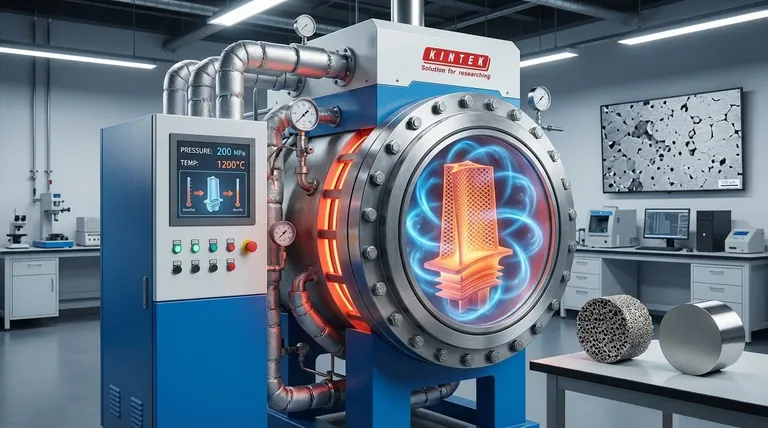
How HIP Heals Internal Defects
HIP is not merely a surface treatment; it is a thermomechanical process that re-engineers a part from the inside out. Its effectiveness comes from the precise application of fundamental physical principles.
The Fundamental Mechanism: Pressure and Temperature
The process places a component inside a high-pressure vessel. The vessel is heated to a temperature below the material's melting point and simultaneously pressurized with an inert gas, like argon.
The high temperature softens the material, making it pliable enough for plastic deformation. The high, uniform pressure acts on all surfaces, causing internal voids and pores to collapse under the force.
At these elevated temperatures, atoms can migrate across the collapsed void boundaries, creating strong metallurgical bonds in a process known as diffusion bonding. This permanently heals the defect.
Eliminating Porosity and Voids
Porosity is a common issue in parts made through casting, sintering, or additive manufacturing (3D printing). These microscopic voids act as stress concentrators, becoming initiation points for cracks and material failure.
HIP directly targets this porosity. The isostatic (uniform) pressure ensures that the part is squeezed from all directions, effectively closing these internal gaps without distorting the component's external geometry.
Achieving Near-Perfect Density
The ultimate goal of defect remediation is to create a homogenous material. By eliminating internal voids, HIP can increase a part's density to nearly 100% of its theoretical maximum.
This densification is directly linked to a dramatic improvement in the material's properties, turning a standard component into a high-performance one.
The Impact on Material Properties
Eliminating defects is the mechanism, but the true value of HIP lies in the significant enhancement of the final component's performance and reliability.
Enhanced Mechanical Performance
A fully dense part is inherently stronger. By removing internal defects, HIP significantly improves a component's ductility, fracture toughness, and fatigue life. This is critical for parts subjected to cyclical loading, like engine components or turbine blades.
A More Uniform Microstructure
The HIP process not only closes voids but also helps homogenize the material's internal grain structure. This leads to more consistent and predictable mechanical properties throughout the entire component, reducing the risk of unexpected failures.
Reduced Scrap and Material Loss
For high-value components, especially in industries like aerospace, a part with internal porosity would typically be scrapped. HIP provides a reliable method to salvage these parts, dramatically improving manufacturing yields and reducing costly waste.
Understanding the Trade-offs and Limitations
While powerful, HIP is not a universal solution. Understanding its limitations is key to applying it correctly.
Only Internal Defects are Healed
This is the most critical limitation. HIP relies on a "gas-tight" outer skin to work. If a defect or pore is connected to the component's surface, the high-pressure gas will simply fill the void instead of collapsing it.
Material and Temperature Constraints
The HIP cycle's temperature must be carefully selected. It needs to be high enough to allow for material diffusion but low enough to avoid melting, grain growth, or otherwise degrading the material's desired microstructure.
An Additional Manufacturing Step
HIP is a batch process that adds both time and cost to the overall production cycle. Its use must be justified by the need for enhanced performance, reliability, or the high value of the component being treated.
Making the Right Choice for Your Goal
Deciding whether to use HIP requires balancing its benefits against its cost and process constraints.
- If your primary focus is salvaging high-value cast or 3D-printed parts: HIP is an extremely effective method for healing internal porosity and significantly reducing scrap rates.
- If your primary focus is maximizing performance for critical applications: HIP should be considered a required post-processing step to achieve full density and unlock superior mechanical properties like fatigue resistance.
- If your primary focus is non-critical components with lower performance demands: The added expense and cycle time of HIP may not be justified if minor internal porosity does not compromise the part's function.
Ultimately, Hot Isostatic Pressing transforms a component from the inside out, ensuring its internal structure is as sound as its external design.
Summary Table:
| Aspect | Key Details |
|---|---|
| Primary Role | Eliminates internal defects like porosity in cast or 3D-printed parts using high pressure and temperature. |
| Key Benefits | Increases density to near 100%, improves mechanical properties (e.g., fatigue life, toughness), and reduces material waste. |
| Limitations | Only heals internal defects with a gas-tight surface; adds cost and time; requires precise temperature control. |
| Ideal Use Cases | Salvaging high-value parts, maximizing performance in critical applications (e.g., aerospace, medical). |
Unlock the full potential of your lab with KINTEK's advanced lab press machines! Whether you're working with automatic lab presses, isostatic presses, or heated lab presses, our solutions deliver precise defect remediation, enhanced material density, and improved reliability for your critical components. Don't let internal defects hold you back—contact us today to discuss how we can optimize your laboratory processes and boost your research outcomes!
Visual Guide

Related Products
- Warm Isostatic Press for Solid State Battery Research Warm Isostatic Press
- Electric Lab Cold Isostatic Press CIP Machine
- Electric Split Lab Cold Isostatic Pressing CIP Machine
- Lab Isostatic Pressing Molds for Isostatic Molding
- Manual Cold Isostatic Pressing CIP Machine Pellet Press
People Also Ask
- Why must composite cathodes be sealed in vacuum lamination bags for WIP? Ensure Battery Stability and Density
- How do sacrificial volume materials (SVM) maintain microchannels in isostatic pressing? Ensure Structural Integrity
- What is the function of elastic molds in warm isostatic pressing? Achieve Uniform Density in Composite Particles
- How does Warm Isostatic Pressing differ from traditional pressing methods? Unlock Uniform Density for Complex Parts
- What are the advantages of using a Warm Isostatic Press (WIP) for batteries? Achieve Superior Interface Contact



















