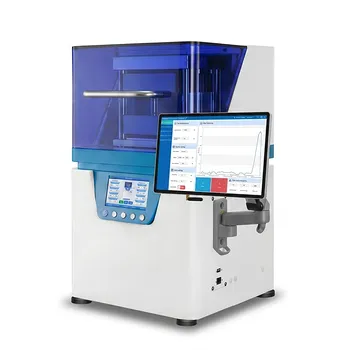
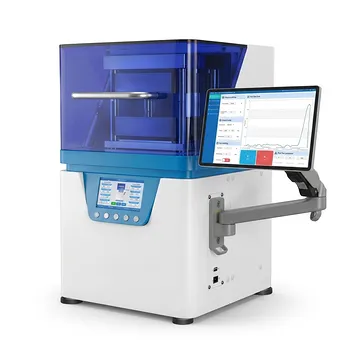
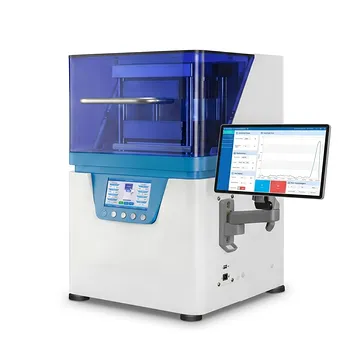
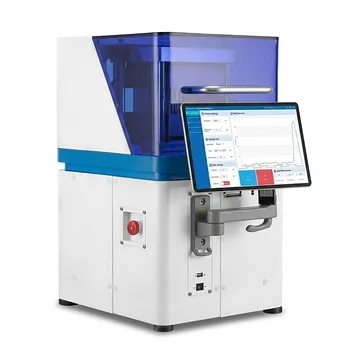
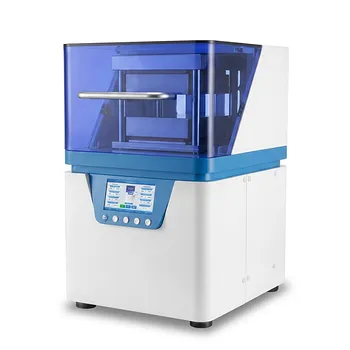
The requirement for a high-performance oil-heated laboratory hydraulic press is driven by the specific thermal and mechanical energy needed to cure oxidized starch-lignin (OSTL) bio-adhesives. Specifically, these presses provide the stable high-temperature environment (up to 200°C) and consistent pressure (up to 25 bar) necessary to trigger the complex chemical cross-linking between urea, oxidized starch, and modified lignin. Without this precise control, the bio-adhesive cannot form the dense molecular network required for structural integrity, resulting in boards with poor mechanical strength and low dimensional stability.
A high-performance hydraulic press acts as a chemical reactor as much as a mechanical tool. It ensures the OSTL resin undergoes a complete phase transition and chemical reorganization, transforming a loose mixture of sawdust and bio-glue into a dense, high-strength composite.
The Chemical Imperative: Cross-Linking OSTL Resins
Activation of the Triple-Network Structure
The OSTL adhesive system relies on the formation of a complex network structure involving urea, oxidized starch, and modified lignin. A high-performance press provides the thermal energy required to break and reform chemical bonds, allowing these three components to cross-link effectively.
Overcoming the Thermal Threshold for Curing
OSTL resins often require temperatures near 200°C to achieve rapid and complete curing. High-performance oil-heated systems maintain this temperature with high precision, ensuring that the resin reaches its curing point consistently throughout the board's core.
Facilitating Lignin Plasticization
Beyond the adhesive itself, the high-temperature environment induces the softening and plasticization of the natural lignin within the wood particles. This allows for chemical reorganization and self-bonding, which supplements the OSTL adhesive to create a more robust internal structure.
Physical Consolidation and Structural Integrity
Eliminating Internal Voids and Air Pockets
Stable pressure, often reaching 25 bar or higher, is essential to force wood fibers into close alignment. This high-pressure environment expels trapped air and ensures the molten OSTL resin completely coats the filler surfaces, eliminating microscopic defects.
Achieving Uniform Density and Thickness
Precision hydraulic control allows researchers to manage unit pressure accurately, which dictates the density profile of the board. This control ensures the maximum density zones are correctly positioned—usually near the surface—to enhance the board’s load-bearing capacity and surface hardness.
Promoting Physical Interlocking
The application of uniform pressure forces the wood fibers into a state of physical interlocking. This mechanical bond works in tandem with the chemical bonds of the OSTL resin to create a "defect-free" composite that resists warping and thickness swelling.
Understanding the Trade-offs
Thermal Inertia and Response Time
While oil-heated presses offer superior thermal stability and uniformity compared to electric heating, they often have higher thermal inertia. This means they take longer to reach the target temperature and longer to cool down, which can slow down rapid prototyping cycles.
Maintenance and Operational Complexity
High-performance oil systems require more intensive maintenance, including monitoring oil degradation and potential leaks. The complexity of maintaining a stable 25-bar pressure environment with high-temperature fluid necessitates more robust seals and safety protocols than standard pneumatic or simple electric presses.
Energy Consumption vs. Precision
Achieving the high-precision environment required for OSTL research involves significant energy expenditure. While this is necessary for repeatable scientific results, it may represent a higher operational cost compared to less precise industrial pressing methods.
Optimizing Your Pressing Parameters
How to Apply This to Your Project
To achieve the best results with OSTL bio-adhesives, your pressing strategy should be tailored to the specific density and strength requirements of your application.
- If your primary focus is Maximum Mechanical Strength: Prioritize higher temperatures (180°C–200°C) and sustained pressure to ensure the OSTL triple-network is fully cross-linked.
- If your primary focus is Surface Hardness: Use high-precision pressure control to accelerate the press closing time, which shifts the high-density zone toward the board's surfaces.
- If your primary focus is Dimensional Stability: Focus on the cooling phase under pressure to ensure that the chemical bonds set firmly before the board is released from the mold.
The integration of precise thermal and mechanical control is the fundamental requirement for transforming sustainable bio-adhesives into high-performance industrial materials.
Summary Table:
| Feature | Requirement for OSTL Curing | Key Benefit |
|---|---|---|
| Temperature | Up to 200°C (High Precision) | Triggers triple-network cross-linking of starch and lignin. |
| Pressure | Consistent 25 bar or higher | Eliminates internal voids and ensures high-density consolidation. |
| Heating System | Oil-heated Platen | Provides superior thermal uniformity and stability for resin curing. |
| Material Effect | Thermal & Mechanical Energy | Induces lignin plasticization for robust internal wood bonding. |
Elevate Your Material Research with KINTEK Precision
Achieve flawless chemical cross-linking and structural integrity in your composite research with KINTEK’s comprehensive laboratory pressing solutions. Whether you are developing sustainable OSTL bio-adhesives or advancing battery research, our range of manual, automatic, heated, multifunctional, and glovebox-compatible models—including high-performance cold and warm isostatic presses—delivers the exact thermal and mechanical control your project demands.
Ready to optimize your pressing parameters? Contact our technical experts today to find the perfect high-performance solution for your laboratory.
References
- Hamed Younesi-Kordkheili, A. Pizzi. Wood Bio-Adhesives Made by Polymerizing Oxidized Starch with Deep Eutectic Solvent-Modified Lignin. DOI: 10.3390/polym17223023
This article is also based on technical information from Kintek Solution Knowledge Base .
Related Products
- 24T 30T 60T Heated Hydraulic Lab Press Machine with Hot Plates for Laboratory
- Automatic Heated Hydraulic Press Machine with Heated Plates for Laboratory
- Automatic Heated Hydraulic Press Machine with Hot Plates for Laboratory
- Automatic Heated Hydraulic Lab Press 120x120mm Plate Fully Automated Material Research Press
- Automatic High Temperature Heated Hydraulic Press Machine with Heated Plates for Lab
People Also Ask
- Function of a Laboratory Hydraulic Press with Heated Platens in SSE? Enhance Battery Density & Conductivity
- Why is a laboratory hydraulic press with heating plates required for PLA/TEC films? Achieve Precise Sample Integrity
- What role does a laboratory heated hydraulic press play in LTCC? Essential for High-Density Ceramic Lamination
- Why reduce load when applying composite strengthening tabs? Protect Specimen Integrity and Data Accuracy
- Why is a laboratory heated hydraulic press utilized during the lamination stage of NASICON green tapes?