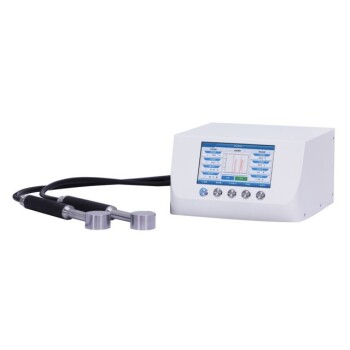
A high-precision annealing furnace is a critical requirement for the successful multi-pass drawing of Nickel-Titanium (NiTi) and Silver (Ag) composites. Its primary function is to perform intermediate electrolytic annealing—specifically at controlled parameters like 750°C for 20 seconds—to eliminate work hardening and restore plasticity. Crucially, this equipment ensures that the material is softened enough for further deformation without exposing the NiTi alloy to prolonged heat that would degrade its phase transformation behavior.
Core Takeaway Success in drawing NiTi/Ag composites relies on a delicate thermal trade-off: you must apply enough heat to restore malleability, yet limit exposure time strictly to preserve the alloy's functional properties. Only high-precision equipment can maintain this narrow operational window.
The Mechanics of Work Hardening
The Consequence of Cold Drawing
As NiTi/Ag composites undergo multi-pass drawing, the material structure naturally hardens. This phenomenon, known as work hardening, significantly reduces the material's ductility.
The Risk of Fracture
Without intervention, the accumulated internal stress makes the material brittle. Continued drawing of a work-hardened composite will inevitably lead to fracture, halting the manufacturing process and wasting valuable material.
Restoring Plasticity
Intermediate annealing acts as a "reset" button for the material's mechanical state. It restores the plasticity of both the NiTi matrix and the Ag components, allowing them to tolerate subsequent large-deformation drawing steps.
Why Precision is Non-Negotiable
Protecting Phase Transformation
NiTi alloys are prized for their unique phase transformation behavior (shape memory and superelasticity). This behavior is highly sensitive to thermal history.
The Danger of Prolonged Exposure
Standard annealing methods often involve longer heating cycles. Prolonged high-temperature exposure can alter the NiTi microstructure, negatively affecting its ability to transform between phases effectively.
Achieving the "Sweet Spot"
High-precision furnaces enable exact control over time and temperature, such as the requisite 750°C for 20 seconds. This rapid, electrolytic approach ensures the material is heated just enough to soften, but not long enough to degrade its functional properties.
Common Pitfalls to Avoid
Under-Annealing
If the furnace cannot maintain stable high temperatures, the material may not fully recrystallize. This leaves residual internal stresses, resulting in wire breakage during the next drawing pass.
Over-Annealing
Conversely, if temperature control lags or the duration is extended, the NiTi grain structure may grow excessively. This leads to a composite that draws easily but lacks the superelastic or shape-memory characteristics required for the end application.
Making the Right Choice for Your Process
To ensure the production of high-quality NiTi/Ag composites, align your equipment capabilities with your specific processing goals:
- If your primary focus is Manufacturability: Ensure your furnace can reach 750°C rapidly to fully eliminate work hardening and prevent drawing fractures.
- If your primary focus is Material Performance: Prioritize equipment with precise timing controls (down to the second) to prevent phase transformation degradation in the NiTi alloy.
Precision in thermal processing is the bridge between a raw composite and a functional, high-performance material.
Summary Table:
| Parameter | Requirement | Purpose |
|---|---|---|
| Temperature | 750°C | Restores plasticity and eliminates work hardening |
| Time Control | ~20 Seconds | Prevents degradation of NiTi phase transformation |
| Cooling Method | Electrolytic/Rapid | Minimizes grain growth and maintains material integrity |
| Process Risk | Over/Under-annealing | Leads to wire breakage or loss of superelasticity |
Elevate Your Material Research with KINTEK
Precision is the difference between a high-performance composite and a fractured material. KINTEK specializes in comprehensive laboratory pressing and thermal solutions, offering a versatile range of manual, automatic, and multifunctional furnaces designed for the rigorous demands of battery research and advanced metallurgy.
Whether you need to maintain a strict 20-second annealing window or require cold/warm isostatic presses for your next breakthrough, our equipment delivers the accuracy you need to protect sensitive NiTi phase transformations.
Ready to optimize your drawing process? Contact KINTEK today to find your perfect laboratory solution!
References
- Shijie Hao, Yang Ren. A novel multifunctional NiTi/Ag hierarchical composite. DOI: 10.1038/srep05267
This article is also based on technical information from Kintek Solution Knowledge Base .
Related Products
- Automatic High Temperature Heated Hydraulic Press Machine with Heated Plates for Lab
- Lab Double Plate Heating Mold for Laboratory Use
- Warm Isostatic Press for Solid State Battery Research Warm Isostatic Press
- Infrared Heating Quantitative Flat Plate Mold for Precise Temperature Control
- Split Automatic Heated Hydraulic Press Machine with Heated Plates
People Also Ask
- Function of a Laboratory Hydraulic Press with Heated Platens in SSE? Enhance Battery Density & Conductivity
- What are the requirements for electrode pressing with high-viscosity ionic liquids like EMIM TFSI? Optimize Performance
- How does a laboratory heated hydraulic press facilitate PBN sample prep for WAXS? Achieve Precise X-Ray Scattering
- What are the industrial applications of heated hydraulic presses? Master Heat & Force for Precision Manufacturing
- Why is a laboratory hydraulic press with heating plates required for PLA/TEC films? Achieve Precise Sample Integrity