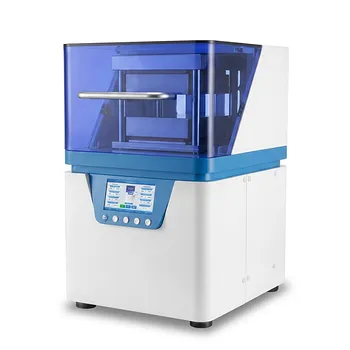
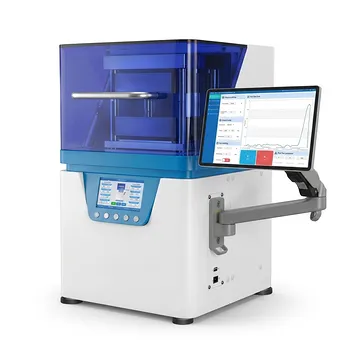
Flexible pressure control is essential because every polymer base possesses distinct thermal and mechanical properties that dictate its reaction to compressive force. Specifically, materials like PVDF-HFP or PDDA-TFSI have unique glass transition temperatures (Tg) and mechanical strengths, requiring a hydraulic press that can adjust between 10 bar and 100 bar to prevent material failure or insufficient density.
Core Takeaway: Precise pressure modulation allows researchers to tailor the molding process to the specific rheological and structural needs of a polymer, ensuring maximum material density without inducing surface cracks or structural deformation.
The Impact of Material Properties on Pressure Requirements
Diversity in Glass Transition and Mechanical Strength
Each polymer base reacts differently to stress based on its molecular structure. Flexible pressure control accommodates these variations, ensuring that the force applied does not exceed the material's mechanical limits or fall short of the energy required for deformation.
Prevention of Surface Cracking in Brittle Systems
Certain polymer systems, such as PBA-based membranes, are inherently brittle or prone to cracking under high stress. A laboratory press must provide lower and stable pressures to maintain the integrity of these delicate "green bodies" during the molding and demolding phases.
Managing High Ceramic Content in Composites
When membranes are infused with inorganic fillers, the requirement for pressure increases significantly. High-pressure settings are necessary to overcome the resistance of ceramic particles, ensuring the material achieves the initial density required for structural stability.
Optimizing Micro-Structural Integrity and Performance
Forced Particle Rearrangement
A hydraulic press facilitates the rearrangement of particles within a mixture of precursor materials. By applying a specific, optimal molding pressure, the press eliminates internal air voids and increases packing density, which is critical for consistent performance.
Inducing Micro-Rearrangement of Polymer Chains
In composite membranes like PVDF-HFP/LLZTO, the simultaneous application of temperature and pressure induces a micro-rearrangement of polymer chains. This process fills microscopic gaps between inorganic fillers and the polymer matrix, significantly enhancing mechanical strength.
Reducing Porosity and Preventing Micro-Cracks
Precise control ensures a uniform internal density, which is vital for materials that undergo later thermal processing. In magnetoelectric composites, uniform density prevents uneven shrinkage or the formation of micro-cracks during high-temperature sintering.
Improving Interface and Thermal Conductivity
Enhancing Interface Contact Performance
The use of a laboratory press optimizes the interface contact between the electrolyte membrane and the electrodes. This tight bonding is essential for reducing impedance and facilitating efficient charge transfer in battery systems.
Consistency in Thermal Conductivity
For Composite Phase Change Materials (CPCM), eliminating internal voids through precise pressing is mandatory. This structural integrity ensures that thermal conductivity remains consistent across the entire battery thermal management system.
Understanding the Trade-offs and Pitfalls
The Risk of Excessive Pressure
Applying pressure beyond the recommended 100 bar limit for a specific polymer base can lead to "over-compaction." This may cause the polymer chains to fracture or the membrane to become too thin, compromising its role as a physical separator.
Consequences of Insufficient Pressure
If the pressure is too low, the membrane will suffer from high porosity and low density. This results in poor mechanical integrity, making the specimen liable to break during demolding or fail during the strain transfer required in functional composites.
Thermal-Pressure Synchronization
Failure to coordinate pressure with the correct processing temperature (such as 80 °C for PVDF-HFP) can lead to incomplete chain rearrangement. Without this synchronization, the interface between the polymer matrix and inorganic fillers remains weak.
How to Apply Pressure Control to Your Process
When configuring your hydraulic press for membrane processing, evaluate your material's specific composition to determine the starting parameters.
- If your primary focus is brittle or crack-prone polymers: Set the press to the lower end of the spectrum (near 10 bar) and focus on maintaining extreme pressure stability to prevent surface defects.
- If your primary focus is high-density ceramic composites: Utilize higher pressures (up to 100 bar) to ensure the particles are sufficiently packed to withstand subsequent high-temperature sintering.
- If your primary focus is optimizing interface contact (e.g., PVDF-HFP): Integrate hot-pressing at specific temperatures like 80 °C with moderate pressure (approx. 3 MPa) to induce the necessary micro-rearrangement of polymer chains.
Mastering flexible pressure control transforms a hydraulic press from a simple weight into a precision instrument for material engineering.
Summary Table:
| Material/Application | Pressure Requirement | Key Benefit |
|---|---|---|
| Brittle Polymers (e.g., PBA) | Low & Stable (approx. 10 bar) | Prevents surface cracking and deformation |
| High Ceramic Composites | High Pressure (up to 100 bar) | Overcomes particle resistance for high density |
| PVDF-HFP / LLZTO | Synchronized Heat & Pressure | Induces polymer chain rearrangement for strength |
| Composite Phase Change Materials | Precise Void Elimination | Ensures consistent thermal conductivity |
| Battery Electrode Interfaces | Optimized Tight Bonding | Reduces impedance and improves charge transfer |
Elevate Your Material Research with KINTEK
Precision is non-negotiable in battery research and membrane fabrication. KINTEK specializes in comprehensive laboratory pressing solutions, offering manual, automatic, heated, multifunctional, and glovebox-compatible models, as well as cold and warm isostatic presses.
Whether you are processing delicate polymer bases like PVDF-HFP or high-density ceramic composites, our equipment provides the flexible pressure control (10 bar to 100 bar+) required to eliminate voids and prevent structural failure.
Ready to optimize your sample density and structural integrity? Contact our experts today to find the perfect press for your laboratory.
References
- Kevin Vattappara, Andriy Kvasha. Ceramic-Rich Composite Separators for High-Voltage Solid-State Batteries. DOI: 10.3390/batteries11020042
This article is also based on technical information from Kintek Solution Knowledge Base .
Related Products
- Automatic Hydraulic Hot Press with Large Plate and Precision Temperature Control for Advanced Material Sample Preparation and Industrial Research
- Automatic Hydraulic Heat Press Machine with Multi Stage Programmable Control and Integrated Water Cooling Plate Size 180x180mm
- Automatic Heated Hydraulic Lab Press with Programmable Touch Screen Controls and Precision Temperature Regulation
- Manual Heated Hydraulic Lab Press with Integrated Hot Plates Hydraulic Press Machine
- Automatic High Temperature Heated Hydraulic Press Machine with Heated Plates for Lab
People Also Ask
- What are the specific features and applications of hydraulic hot press machines? Precision Solutions for Modern Labs
- How does an automatic hydraulic press operate? Achieve Precision and Consistency in Lab Pelleting
- What are the advantages and common applications of an automatic hydraulic press? Elevate Your Lab's Precision
- What is the technical significance of setting a precise dwell time? Achieve Peak Material Density and Stability
- When is an automatic hydraulic press more suitable than a manual press? Scale Your Lab with Precision & Speed