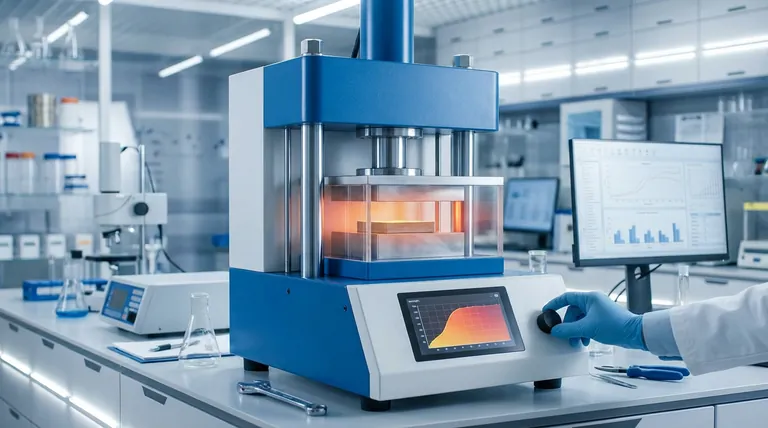
The Unseen Alliance of Heat and Pressure
Imagine a materials scientist attempting to bond two dissimilar polymers. Or an engineer prototyping a new composite material. The goal seems simple: apply heat and pressure.
But the reality is far more nuanced. Anyone can apply brute force. The real challenge—the difference between a crude lamination and a perfectly integrated, void-free component—lies in the how. How is the heat generated? How is it controlled? How is it delivered to the exact location where it's needed?
This isn't just a question of machine specifications. It’s a fundamental question of controlling matter at a microscopic level. The method used to generate heat dictates the entire outcome. It is the invisible architecture of your final product.
Three Philosophies of Thermal Control
At the heart of every modern laboratory press is a specific philosophy for applying thermal energy. Understanding these distinct approaches is crucial because each one is a solution to a different kind of problem.
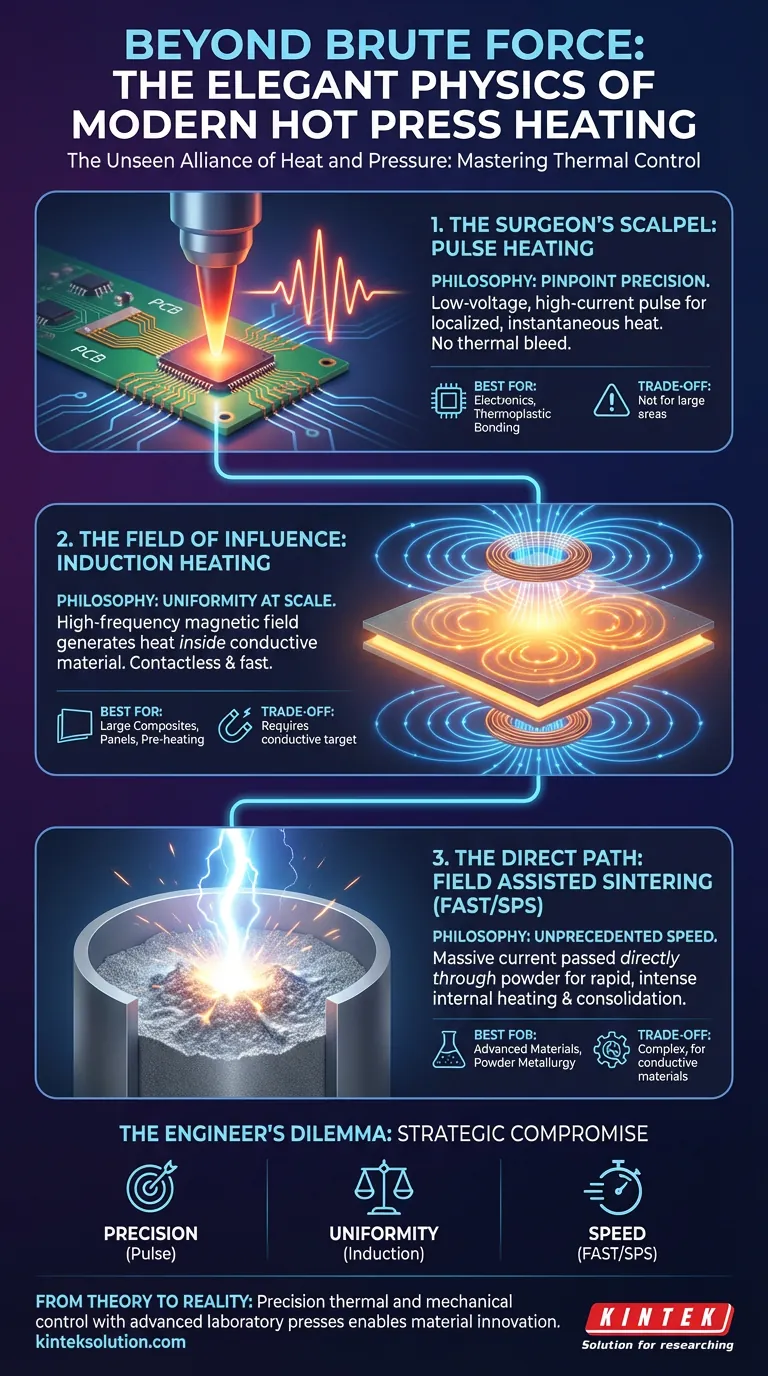
The Surgeon's Scalpel: Pulse Heating
Consider the task of soldering a delicate flexible circuit to a PCB. Heat must be applied to a tiny area, for a fraction of a second, without damaging the surrounding sensitive components. Any thermal bleed is a failure.
This scenario calls for a surgeon's precision.
Pulse Heating, a form of indirect resistance heating, is that scalpel. A low-voltage, high-current pulse is sent through a specialized indenter (or head). The head's electrical resistance causes it to heat up almost instantly. This intense, localized heat is transferred by conduction directly to the workpiece. Just as quickly, the current stops, and the head cools.
This method is the embodiment of control. It’s chosen when the primary psychological driver is the elimination of variables and the mitigation of risk to surrounding materials.
The Field of Influence: Induction Heating
Now, imagine the challenge is to create a large, perfectly uniform composite panel for an aerospace application. The heat must permeate the entire surface evenly and simultaneously. A single hot spot or cool zone would compromise the structural integrity of the entire piece.
This problem isn't about pinpoint precision; it's about massive, uniform influence.
Induction Heating provides this. It uses a high-frequency alternating magnetic field to generate eddy currents within a conductive platen or the workpiece itself. Heat isn't applied to the material; it is generated inside it. This contactless method is remarkably fast and efficient for achieving consistent temperature across large areas. It’s the ideal philosophy when uniformity and scale are non-negotiable.
The Direct Path: Field Assisted Sintering (FAST)
Finally, picture a researcher creating a novel metal alloy from powder. The goal is to fuse the particles together at extreme temperatures but to do it so quickly that the material's crystalline grains don't have time to grow too large, which would weaken the final product.
This requires a method that is both incredibly powerful and overwhelmingly fast.
Field Assisted Sintering Technique (FAST), also known as Spark Plasma Sintering (SPS), is the most direct approach imaginable. A massive electrical current is passed directly through the conductive powder itself. The result is intense, rapid, and uniform internal heating that consolidates the material in minutes, not hours. It's an audacious strategy chosen when the goal is to push the boundaries of material science, where speed is a critical element of the final properties.
The Engineer's Dilemma: Choosing Your Trade-offs
Selecting a heating method is an act of strategic compromise. There is no single "best" solution—only the optimal choice for a specific goal. Every engineer and scientist must weigh the trade-offs.
| Heating Method | Core Philosophy | Best For... | The Trade-Off |
|---|---|---|---|
| Pulse Heating | Absolute Local Control | Precision electronics, thermoplastic bonding | Not suitable for large surface areas |
| Induction Heating | Uniformity at Scale | Large composites, wood panels, pre-heating | Requires a conductive target (platen or part) |
| FAST / SPS | Unprecedented Speed | Advanced materials, powder metallurgy | Complex, specialized, for conductive materials |
This decision matrix isn't just technical; it's psychological. It forces you to clarify your primary objective:
- Is your priority repeatable precision on a small scale?
- Is it flawless uniformity across a large one?
- Or is it the creation of novel properties where speed is paramount?
From Theory to the Laboratory Bench
Understanding these physical principles is the first step. The second is having an instrument capable of executing your chosen strategy with unwavering reliability.
A well-designed laboratory press is more than a simple machine; it's a platform for precise thermal and mechanical control. This is where the theoretical meets the practical. For researchers and engineers, the ability to control temperature ramps, hold times, and pressure profiles is essential for developing new materials and processes.
KINTEK's heated lab presses, for example, are engineered to provide this exact layer of control. Whether using advanced resistance heating for uniform platen temperature or specialized configurations for targeted applications, these systems are designed to turn your theoretical model into a reproducible, physical reality. An automatic lab press ensures that pressure and heating cycles are repeated perfectly every time, removing human error and producing reliable data.
The choice of heating method is the soul of the process. Having the right tool to bring it to life is what enables innovation. If your work demands precise control over heat and pressure, it’s critical to work with an instrument built for that purpose.
Visual Guide
Related Products
- Automatic High Temperature Heated Hydraulic Press Machine with Heated Plates for Lab
- Heated Hydraulic Press Machine with Heated Plates for Vacuum Box Laboratory Hot Press
- Automatic Heated Hydraulic Press Machine with Hot Plates for Laboratory
- Heated Hydraulic Press Machine With Heated Plates For Vacuum Box Laboratory Hot Press
- Laboratory Split Manual Heated Hydraulic Press Machine with Hot Plates
Related Articles
- The Architecture of Slow: Why Physical Precision Dictates Chemical Destiny
- The Architecture of Certainty: Why the Laboratory Press is the Anchor of Material Science
- The Vanishing Boundary: The Hidden Thermodynamics of LTCC Lamination
- The Alchemy of 160°C: Why Precision Pressing is the Silent Backbone of Rubber Science
- The Invisible Forge: Why the Laboratory Press is the Soul of Nano-Composites



















