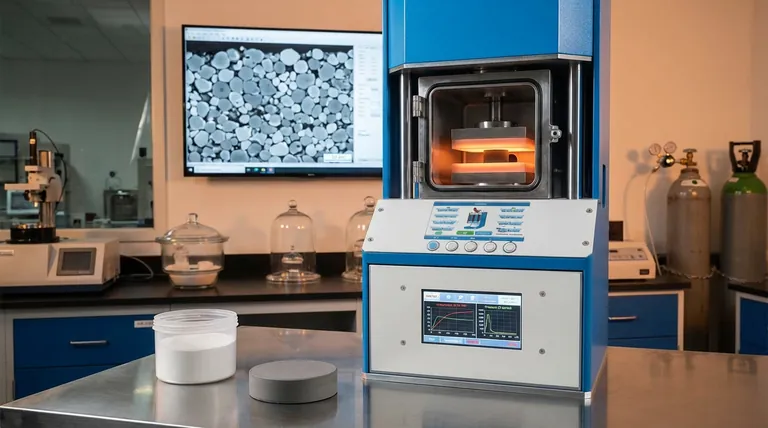
The Illusion of Solidity
We tend to see solid objects as monolithic. A block of metal, a ceramic component—they appear whole, complete. But this is a psychological shortcut.
At a microscopic level, most materials are more like a densely packed collection of grains. The space between those grains, the tiny, invisible voids of porosity, are the hidden architects of failure. They are where stress concentrates and where cracks are born.
The ultimate goal of high-performance material science isn't just to create a shape, but to eliminate that empty space.
From Powder to Performance: A Systemic Approach
Imagine trying to build a strong wall with perfectly spherical stones. No matter how you stack them, there will always be gaps. Conventional manufacturing processes, like sintering, face a similar problem. They heat a powdered material, encouraging the particles to fuse, but often leave behind residual porosity.
This is not a minor flaw; it's a systemic vulnerability.
Hot pressing addresses this problem at its root. By applying intense pressure while the material is heated, it does more than just fuse particles together. It fundamentally re-engineers the material's internal structure. It is a process of consolidation, not just fabrication.
Harnessing Controlled Synergy
The magic of hot pressing lies in the simultaneous application of heat and pressure. This synergy unlocks capabilities that neither force could achieve alone.
Engineering Density, Not Just Shape
Heat makes the material particles pliable. Pressure forces them into intimate contact, closing the microscopic gaps between them.
The result is a component with near-theoretical density. This isn't an abstract metric; it translates directly into superior mechanical properties. A denser material is a stronger, harder, and more fracture-resistant material.
The Architect of the Microstructure
True control goes deeper than density. The precise, automated regulation of temperature, pressure, and time allows engineers to act as architects of the material's internal grain structure.
You can dictate the grain size, ensure uniformity, and even trigger beneficial phase transformations. This level of control ensures that performance is not just high, but also predictable and repeatable—the foundation of all reliable engineering.
A Sanctuary from Contamination
Many advanced materials are vulnerable to oxidation at high temperatures. Exposing them to air during processing is like inviting a corrupting influence.
Modern hot pressing systems, like those found in advanced labs, operate under a vacuum or in an inert gas atmosphere. This creates a pristine sanctuary where the material can be formed without degradation. The result is higher purity, a better surface finish, and fewer internal defects.
The Practical Realities: Where Precision Matters Most
Hot pressing is not a universal solution. Its power is in its precision, which involves certain trade-offs. Understanding them reveals when it becomes the only logical choice.
| Consideration | The Psychological Reframe | Best Application Scenario |
|---|---|---|
| Cycle Time | Not slowness, but a deliberate pace for uncompromising quality. It's the difference between mass production and craftsmanship. | When material performance is the primary goal and cannot be compromised for speed. |
| Tooling & Cost | Not an expense, but an investment in predictability and control. You are paying for certainty. | For critical components where the cost of failure far exceeds the investment in tooling. |
| Complexity | A constraint that focuses the process on creating robust, high-integrity shapes rather than intricate, weaker ones. | Large-diameter components or near-net shapes where internal strength is paramount. |
The decision to use hot pressing is a decision to prioritize internal integrity over all else. It's for applications where you cannot afford the hidden risks of porosity.
When Performance is Non-Negotiable
You should choose hot pressing when your primary objective aligns with its core strengths:
- Maximum Material Performance: Your goal is to achieve the highest possible density, strength, and hardness for a critical component.
- Difficult-to-Process Materials: You are working with advanced ceramics, composites, or other powders that resist densification through conventional methods.
- Large, High-Purity Components: You need exceptional temperature uniformity and an oxygen-free environment to produce large, defect-free parts.
For laboratories and R&D teams aiming to pioneer new materials, this level of control is not a luxury; it's a necessity. A high-quality heated lab press isn't just a tool—it's the crucible where theoretical potential becomes tangible performance.
KINTEK's range of heated and automatic lab presses are engineered to provide this exact level of precision and control. To transform your material concepts into high-performance realities, Contact Our Experts.
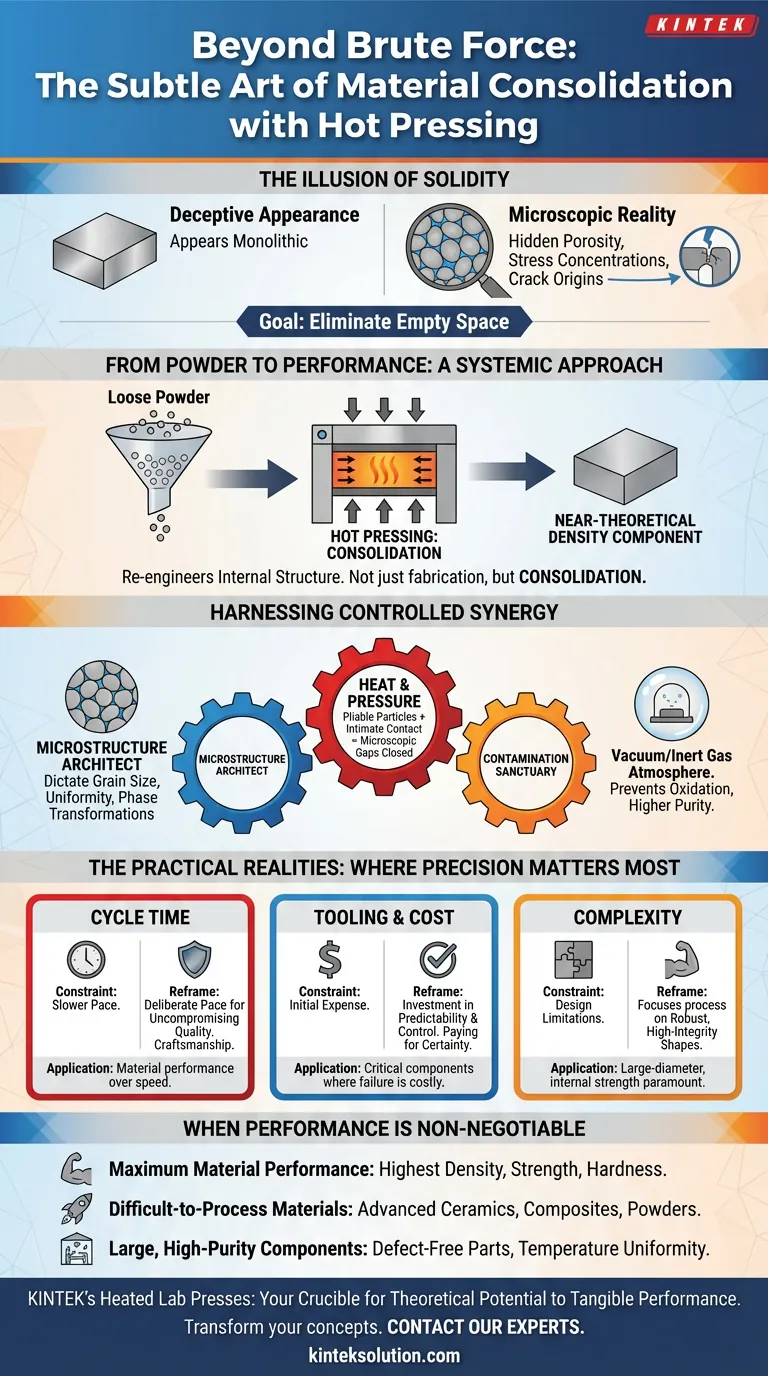
Visual Guide
Related Products
- Automatic High Temperature Heated Hydraulic Press Machine with Heated Plates for Lab
- Heated Hydraulic Press Machine with Heated Plates for Vacuum Box Laboratory Hot Press
- Heated Hydraulic Press Machine With Heated Plates For Vacuum Box Laboratory Hot Press
- Automatic Heated Hydraulic Press Machine with Hot Plates for Laboratory
- Laboratory Manual Heated Hydraulic Press Machine with Hot Plates
Related Articles
- The Architecture of Slow: Why Physical Precision Dictates Chemical Destiny
- The Architecture of Certainty: Why the Laboratory Press is the Anchor of Material Science
- The Vanishing Boundary: The Hidden Thermodynamics of LTCC Lamination
- The Alchemy of 160°C: Why Precision Pressing is the Silent Backbone of Rubber Science
- The Invisible Forge: Why the Laboratory Press is the Soul of Nano-Composites



















