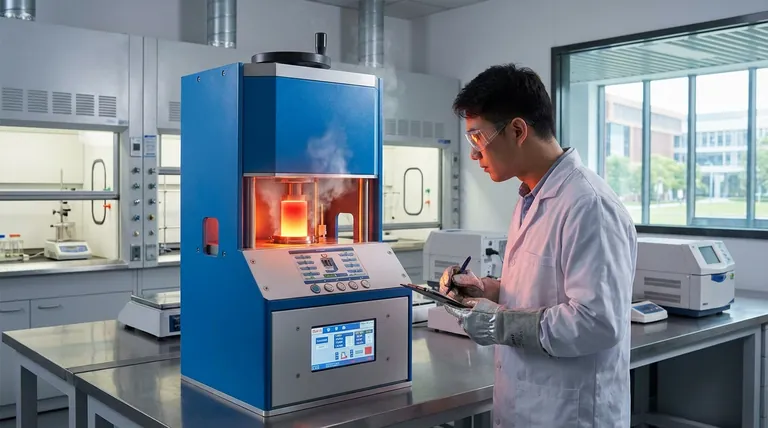
The Promise and the Problem of Powder
Powder metallurgy holds an incredible promise: to build solid, intricate objects from the ground up, starting with nothing more than fine powder. It’s a process of creation at its most fundamental level.
But within this promise lies a hidden enemy, an antagonist present in nearly every granular system: empty space. Porosity.
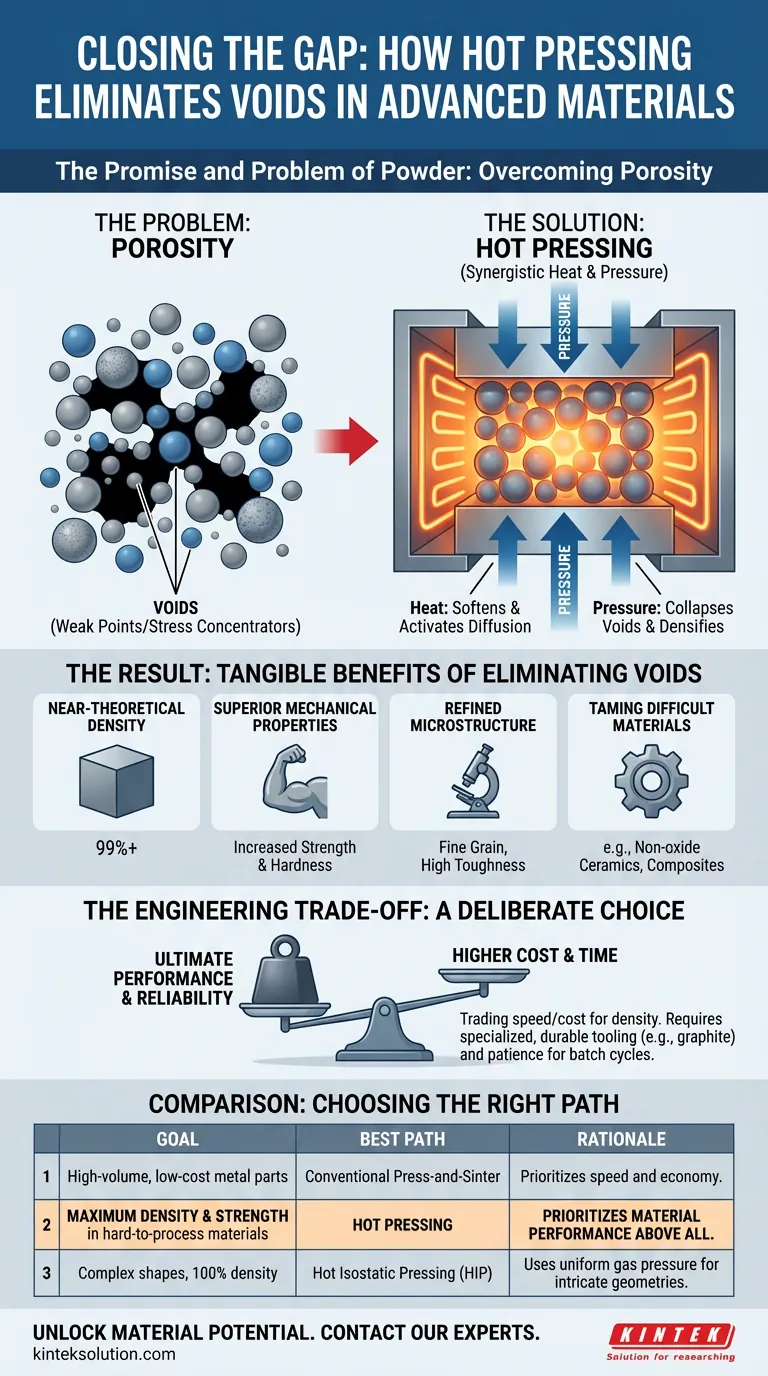
No matter how small, every void between particles is a built-in flaw. It’s a microscopic crack waiting to happen, a stress concentrator that undermines the material’s integrity. Porosity is the gap between a material's theoretical strength on paper and its actual, often disappointing, performance in the real world.
The Limits of Brute Force
The intuitive solution is to simply press harder. If we apply enough mechanical force, surely we can squeeze out every last pocket of air.
But materials science often defies brute force. For many advanced ceramics, composites, and alloys, cold pressing is like trying to build a perfectly solid wall out of jagged, unyielding stones. You can push them together, but tiny gaps will always remain. The particles resist deformation, and the final part is left brittle and porous, a shadow of its potential self.
This reveals a fundamental engineering truth: sometimes, force alone is not the answer. You need a more elegant approach.
The Synergistic Dance of Heat and Pressure
Hot pressing is that elegant approach. Instead of treating heat and pressure as separate steps (press then sinter), it combines them into a single, powerful, and synergistic dance.
The Role of Heat: An Invitation to Change
Elevating the temperature does not melt the material. Instead, it serves as an invitation. The heat softens the individual particles, lowering their yield strength and making them more malleable. Critically, it also activates atomic diffusion—the fundamental mechanism that allows separate particles to truly bond and become one.
The Role of Pressure: A Guiding Hand
While the material is in this receptive, softened state, pressure is applied. This external force acts as a guiding hand. It mechanically pushes the particles into intimate contact, collapses the remaining voids, and encourages the material to creep and flow into a dense, solid mass.
The true genius is how they work together. Because heat makes the material willing to change, the amount of pressure needed is dramatically lower than in a cold press. And because pressure is actively helping to eliminate pores, the temperature and time required are far less than in conventional sintering. It is a perfect fusion of energy and force.
The Tangible Results of Eliminating Voids
By closing the microscopic gap, hot pressing delivers a cascade of tangible benefits, allowing a material to finally live up to its full potential.
- Near-Theoretical Density: The primary achievement is a density often exceeding 99% of the material's theoretical maximum. This isn't just an impressive number; it's the foundation of reliability. You are building on solid ground.
- Superior Mechanical Properties: With voids eliminated, the material’s true strength emerges. Hot-pressed parts exhibit vastly improved hardness, wear resistance, and strength compared to their porous counterparts.
- A Refined Microstructure: The shorter cycles and lower temperatures help prevent excessive grain growth. Maintaining a fine-grained structure is crucial for achieving a combination of high strength and toughness.
- Taming Difficult Materials: This process is indispensable for materials that simply refuse to cooperate under normal conditions, such as non-oxide ceramics (e.g., silicon carbide), intermetallics, and metal matrix composites.
The Psychology of Engineering: Embracing the Trade-Off
Hot pressing is not a universal solution. It is a deliberate choice, and understanding its adoption requires a look into the psychology of engineering trade-offs.
Choosing hot pressing is a statement of priorities. You are consciously trading manufacturing speed and lower costs for ultimate performance and reliability.
- The Price of Durability: The die that holds the powder must withstand extreme heat and pressure simultaneously, requiring expensive materials like high-purity graphite that have a finite life.
- The Virtue of Patience: It is a batch process. Each part requires a full heating, pressing, and cooling cycle, making it slower and less suitable for high-volume commodity production.
- The Constraints of Simplicity: The uniaxial (single-direction) pressure generally limits the geometric complexity of parts that can be produced with uniform density.
This isn't a list of failures, but a ledger of costs. You are "buying" near-perfect density and strength with investments in time, tooling, and process simplicity.
The Laboratory: Where Potential Becomes Reality
This critical balancing act—weighing performance against cost and speed—is the daily work of materials scientists and R&D engineers. The laboratory is the arena where a material's potential is unlocked, and the decision to use a process like hot pressing is validated.
To navigate these trade-offs effectively, you need equipment that offers precision, control, and reliability. Lab-scale heated presses are the essential instruments for this exploration, allowing researchers to perfect formulations and prove that the investment in performance is worthwhile.
Choosing the right consolidation method depends entirely on your project's core values.
| If Your Primary Goal Is... | Your Best Path Is... | The Rationale |
|---|---|---|
| High-volume, low-cost metal parts | Conventional Press-and-Sinter | Prioritizes speed and economy over ultimate density. |
| Maximum density & strength in hard-to-process materials | Hot Pressing | Prioritizes material performance and integrity above all. |
| Complex shapes requiring 100% density | Hot Isostatic Pressing (HIP) | Uses uniform gas pressure for intricate geometries. |
At its heart, hot pressing is more than a manufacturing technique; it's a commitment to material integrity. It’s an engineer's bet on perfection. Whether you are developing next-generation ceramics or pioneering new composite materials, having precise control over heat and pressure is paramount. Contact Our Experts
Visual Guide
Related Products
- Heated Hydraulic Press Machine with Heated Plates for Vacuum Box Laboratory Hot Press
- Automatic High Temperature Heated Hydraulic Press Machine with Heated Plates for Lab
- Automatic Heated Hydraulic Press Machine with Hot Plates for Laboratory
- Laboratory Split Manual Heated Hydraulic Press Machine with Hot Plates
- Laboratory Manual Heated Hydraulic Press Machine with Hot Plates
Related Articles
- The Architecture of Slow: Why Physical Precision Dictates Chemical Destiny
- The Architecture of Certainty: Why the Laboratory Press is the Anchor of Material Science
- The Vanishing Boundary: The Hidden Thermodynamics of LTCC Lamination
- The Alchemy of 160°C: Why Precision Pressing is the Silent Backbone of Rubber Science
- The Invisible Forge: Why the Laboratory Press is the Soul of Nano-Composites



















