The Illusion of Solidity
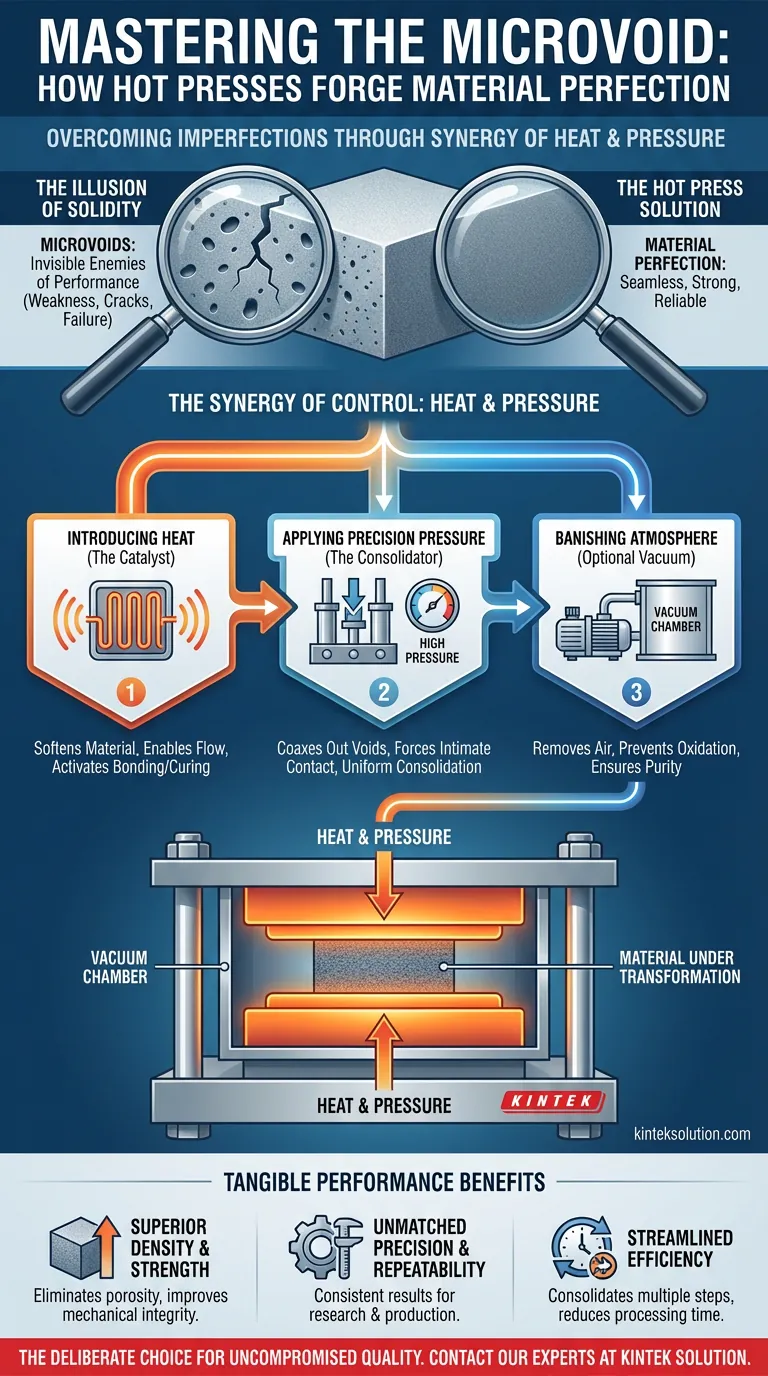
We live in a world we perceive as solid. We trust the steel beam, the ceramic plate, the carbon fiber frame. Yet, on a microscopic level, most engineered materials are a landscape of imperfections—a universe of tiny voids, air pockets, and incomplete bonds.
These microvoids are the invisible enemies of performance. They are the starting points for cracks, the pathways for corrosion, and the hidden weaknesses that lead to catastrophic failure under stress. The fundamental challenge in materials science isn't just shaping an object; it's conquering this internal, unseen chaos.
The Brute Force Fallacy: Why Pressure Isn't Enough
The intuitive solution is to apply immense pressure. Squeeze the material until the gaps close. This is the principle behind cold pressing, and it works, to a point.
But cold pressure is often a blunt instrument. It compacts the material, reducing the size of the largest voids, but it rarely heals the material's internal structure. It forces particles closer together but doesn't fundamentally convince them to bond into a seamless, monolithic whole. The memory of the voids remains, a latent weakness waiting for the right conditions to emerge.
The Catalyst for Transformation: Introducing Heat
Heat changes everything. It is the great facilitator.
When applied to a polymer, ceramic, or metal powder, heat acts as a catalyst for transformation. It softens the material, granting it a temporary state of grace—a moment of fluidity on a molecular level. In this state, the rigid boundaries between individual particles begin to blur. The material becomes receptive to change.
Heat doesn't just soften; it activates. For thermoset composites, it initiates the chemical reaction (curing) that creates a powerful, cross-linked polymer network. For bonding applications, it melts adhesives, preparing them to form an unbreakable connection.
The Synergy of Control: How a Hot Press Works
A hot press is not merely a machine that gets hot and squeezes. It is an environment for total thermo-mechanical control. Its genius lies in applying these two forces—heat and pressure—simultaneously and with extreme precision.
A Two-Part Command: Heat to Enable, Pressure to Consolidate
The process is a carefully choreographed sequence. Heated platens bring the material to the exact temperature needed for transformation. As it reaches this state of readiness, a hydraulic or pneumatic system applies a precise, uniform pressure.
This pressure is no longer a blunt instrument. Acting on a softened, pliable material, it gently but firmly coaxes out the remaining air and voids. It ensures the material flows into every crevice of a mold and forces disparate layers into intimate, permanent contact. The hot press doesn't just shape a material; it persuades it to become its best possible self.
Banishing the Atmosphere: The Role of Vacuum
For the most sensitive and high-performance materials, even air is an enemy. At high temperatures, oxygen can cause oxidation, degrading the material's integrity. Advanced hot presses operate within a vacuum chamber, removing the atmosphere to create a pure, controlled environment. This is essential for processing reactive metals or fabricating aerospace-grade composites where purity is non-negotiable.
From Theoretical Purity to Tangible Performance
This obsession with control isn't academic. It translates directly into superior, reliable material properties.
- Superior Density and Strength: By eliminating porosity, the final component is significantly denser and stronger. It behaves less like a compressed powder and more like a solid, continuous material, improving its ability to withstand mechanical stress.
- Unmatched Precision and Repeatability: Tightly controlling temperature, pressure, and time yields incredibly consistent results. For researchers and engineers, this repeatability is gold. It means the properties of sample #1 will be identical to sample #1000.
- Streamlined Efficiency: In many workflows, hot pressing consolidates heating, forming, curing, and bonding into a single, efficient step, reducing overall processing time.
This level of precision is the cornerstone of modern material development. In the laboratory, where every sample represents a step toward a breakthrough, this control is not a luxury—it's a necessity. It’s here that KINTEK's heated lab presses provide the industrial-grade control required to turn theoretical models into tangible, high-performance realities.
The Deliberate Choice for Uncompromised Quality
A hot press represents a significant investment in both cost and complexity. The process cycle can be longer than simpler methods. This is not a weakness but a reflection of its purpose.
You don't choose a hot press for speed or low cost. You choose it when "good enough" is the enemy of progress. You choose it when the final performance of the material cannot be compromised. It is a deliberate choice for when the integrity of the component, whether a jet engine turbine blade or a novel research sample, is paramount.
The quest for better materials is a quest to command matter at its most fundamental level. To achieve this, you need more than just force; you need control.
If your work demands materials that are not just formed but fundamentally perfected, the principles of hot pressing are your guide. To put these principles into practice, Contact Our Experts.
Visual Guide
Related Products
- Automatic High Temperature Heated Hydraulic Press Machine with Heated Plates for Lab
- Heated Hydraulic Press Machine with Heated Plates for Vacuum Box Laboratory Hot Press
- Automatic Heated Hydraulic Press Machine with Hot Plates for Laboratory
- Heated Hydraulic Press Machine With Heated Plates For Vacuum Box Laboratory Hot Press
- Laboratory Split Manual Heated Hydraulic Press Machine with Hot Plates
Related Articles
- The Architecture of Slow: Why Physical Precision Dictates Chemical Destiny
- The Architecture of Certainty: Why the Laboratory Press is the Anchor of Material Science
- The Vanishing Boundary: The Hidden Thermodynamics of LTCC Lamination
- The Alchemy of 160°C: Why Precision Pressing is the Silent Backbone of Rubber Science
- The Invisible Forge: Why the Laboratory Press is the Soul of Nano-Composites



















