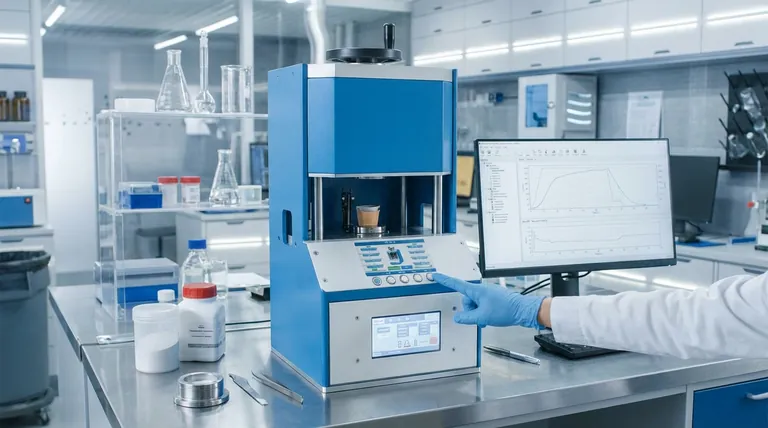
The Hidden Battle in Every Powder
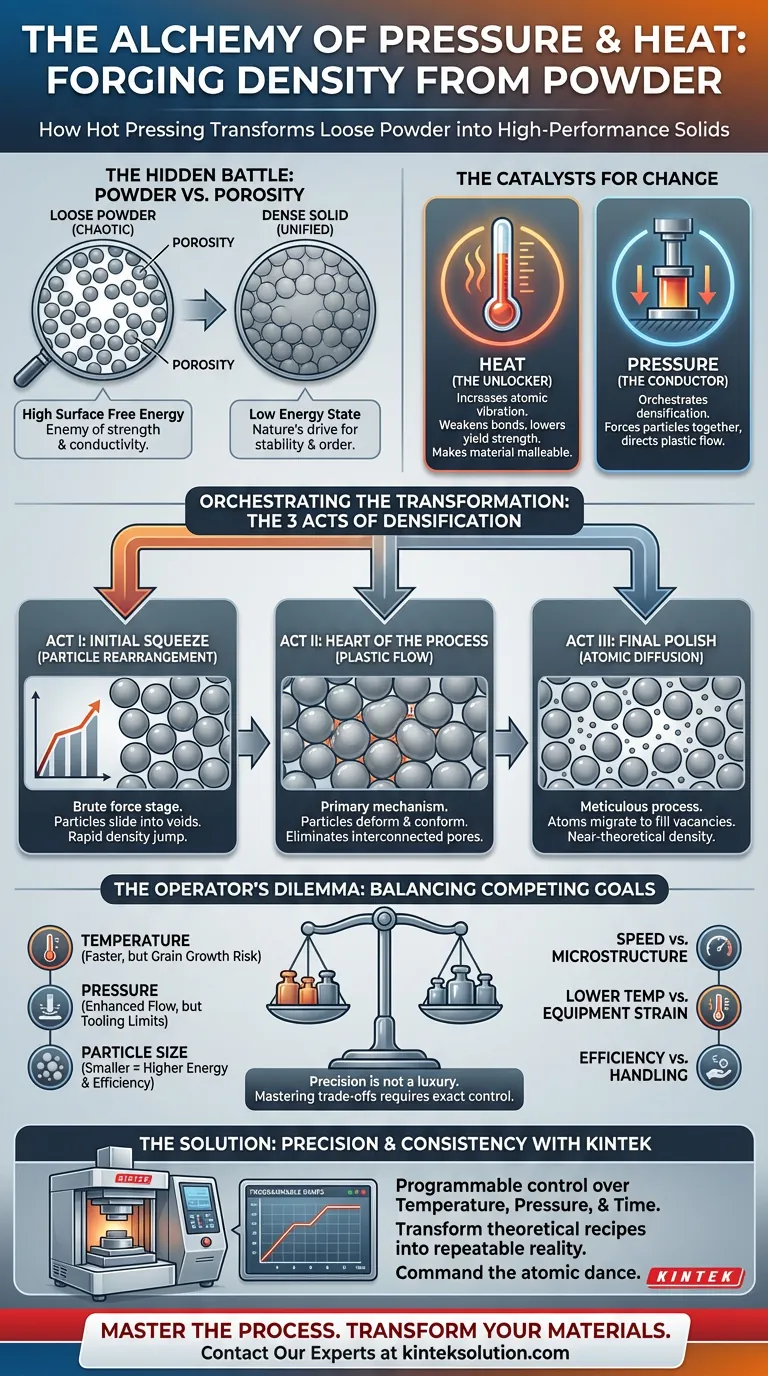
Imagine a container of loose powder. To our eyes, it's a uniform substance. But at the microscopic level, it's a chaotic landscape of individual particles separated by vast expanses of empty space—or porosity. This porosity is the enemy of strength, conductivity, and performance.
Turning this powder into a solid, high-performance component is a fundamental challenge in materials science. It’s not just about compression. It’s about convincing billions of individual particles to surrender their autonomy and fuse into a single, unified whole. This is the art and science of hot pressing.
The Inherent Drive for Order
A pile of powder is, in a physical sense, a high-stress system. The immense collective surface area of all its particles holds a tremendous amount of "surface free energy."
Nature abhors this kind of high-energy state. Just as a ball rolls downhill to a lower potential energy, a powder system wants to reduce its total energy. It can achieve this by eliminating the high-energy surfaces of individual particles and replacing them with lower-energy internal connections, known as grain boundaries.
Heat: The Catalyst for Change
This natural drive for stability is not enough on its own. The particles are locked in place, held back by their own rigidity.
Temperature is the key that unlocks this potential. As heat is applied, atoms within the particles vibrate with increasing energy. This weakens the bonds holding them in a rigid structure, dramatically lowering the material's yield strength. The material doesn't melt, but it becomes malleable and ready for transformation.
Orchestrating the Transformation: The Mechanics of Densification
With the material softened by heat, external pressure becomes the conductor, orchestrating the step-by-step process of densification. This is not a single event, but a carefully sequenced progression.
Act I: The Initial Squeeze
As pressure is first applied, the most straightforward change occurs: particle rearrangement. Particles slide past one another, falling into the voids between their neighbors. Any loose structures or "bridges" collapse. This is the brute-force stage, responsible for a quick and significant initial jump in density.
Act II: The Heart of the Process - Plastic Flow
This is where the true alchemy happens. At the now-softened contact points between particles, the relentless external pressure forces the material to deform and flatten. This plastic flow is the primary mechanism in hot pressing.
Instead of merely touching at single points, the particles begin to conform to one another, drastically increasing their contact area. As they flatten and spread, the pores trapped between them are squeezed out of existence.
Act III: The Final Polish
In the final stage, most of the porosity is gone. Only small, isolated voids remain. These are too deep to be eliminated by mechanical force alone.
Here, a slower, more patient mechanism takes over: diffusion. Individual atoms migrate through the solid material to fill these vacancies, stitch by stitch. This final, meticulous process pushes the component towards its theoretical maximum density.
The Operator's Dilemma: Balancing Competing Goals
Mastering hot pressing is an exercise in managing trade-offs. The final properties of a component are not a given; they are the direct result of decisions made about the process parameters.
- Temperature: Higher temperatures accelerate everything, leading to faster densification. The risk? Unwanted grain growth, which can make a material brittle and compromise its mechanical strength.
- Pressure: More pressure enhances plastic flow, allowing for lower temperatures or shorter cycle times. The limit? The physical strength of the tooling, which can fail under excessive force.
- Particle Size: Smaller starting particles have higher surface energy—a stronger internal drive to densify. This allows the entire process to run more efficiently, often at lower temperatures.
This delicate balance is summarized below:
| Stage | Primary Mechanism | Dominant Force | Key Outcome |
|---|---|---|---|
| Initial | Particle Rearrangement | External Pressure | Rapid increase in packing density |
| Intermediate | Plastic Deformation | Heat & Pressure | Elimination of interconnected pores |
| Final | Atomic Diffusion | Heat & Time | Removal of isolated pores |
Precision is Not a Luxury
You cannot win this balancing act with crude instruments. Achieving maximum density while preserving a fine-grained microstructure requires a tool capable of executing your exact process recipe with unwavering consistency.
This is where the engineering of the press itself becomes paramount. Equipment like KINTEK's heated lab presses is designed for this very purpose. By providing precise, programmable control over temperature ramps, pressure application, and holding times, they transform the theoretical process into a repeatable manufacturing reality. Whether you need an automatic press for consistency or an isostatic press for uniform pressure, the right equipment gives you command over the atomic dance.
Mastering this process transforms powder from a simple raw material into a high-performance component. If you're ready to achieve this transformation with precision and repeatability, Contact Our Experts.
Visual Guide
Related Products
- Automatic High Temperature Heated Hydraulic Press Machine with Heated Plates for Lab
- Heated Hydraulic Press Machine with Heated Plates for Vacuum Box Laboratory Hot Press
- Automatic Heated Hydraulic Press Machine with Hot Plates for Laboratory
- Heated Hydraulic Press Machine With Heated Plates For Vacuum Box Laboratory Hot Press
- Laboratory Manual Heated Hydraulic Press Machine with Hot Plates
Related Articles
- The Architecture of Slow: Why Physical Precision Dictates Chemical Destiny
- The Architecture of Certainty: Why the Laboratory Press is the Anchor of Material Science
- The Vanishing Boundary: The Hidden Thermodynamics of LTCC Lamination
- The Alchemy of 160°C: Why Precision Pressing is the Silent Backbone of Rubber Science
- The Invisible Forge: Why the Laboratory Press is the Soul of Nano-Composites



















