The Gap Between Synthesis and Certainty
In the laboratory, the distance between a newly synthesized molecule and a clean data plot is often measured in density.
Raw 6,12-diboraanthanthrene is a triumph of chemistry, but in its initial form, it is physically chaotic. It is a loose crystalline powder—mostly air, irregular grains, and unpredictable voids. To an NMR spectrometer or an Infrared beam, this chaos is "noise."
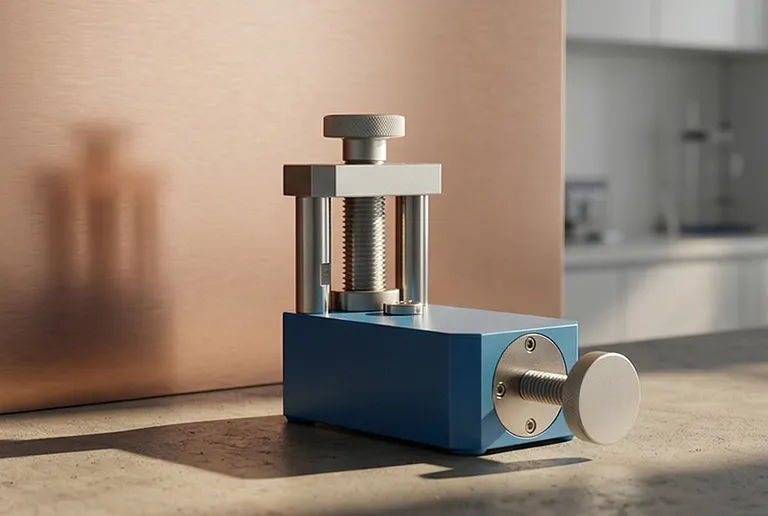
The laboratory hydraulic press is the bridge across this gap. It does not change the chemistry; it masters the physics of the sample to allow the chemistry to speak.
The Geometry of the Signal
For Solid-State NMR, the challenge is one of volume. To get a high-resolution signal-to-noise ratio, you need mass.
- The Filling Factor: Loose powder occupies space without providing substance. Axial pressure eliminates these internal voids, packing the maximum number of molecules into the active volume of the NMR coil.
- Rotational Equilibrium: Magic Angle Spinning (MAS) requires samples to rotate at breathtaking frequencies. An unevenly packed rotor is a vibration risk. A pressed "green body" provides the balance necessary for stability.
In short: Density is the prerequisite for spectral intensity.
The Translucency of Matter

Infrared (IR) spectroscopy demands a different kind of physical transformation. Here, the goal is not just density, but clarity.
When preparing 6,12-diboraanthanthrene for IR, the press induces plastic deformation. Under roughly 17 MPa of pressure, the crystalline particles and the KBr matrix cease to be a collection of grains and become a single, homogenous medium.
- Eliminating Scattering: Air-powder interfaces act like thousands of tiny mirrors, scattering the IR beam.
- The Resulting Pellet: Proper pressing creates a thin, translucent window that allows light to pass through rather than bounce off.
- Baseline Stability: A uniform pellet produces a flat, reliable baseline, making the signature boron-ring peaks unmistakable.
The Engineering "Sweet Spot"
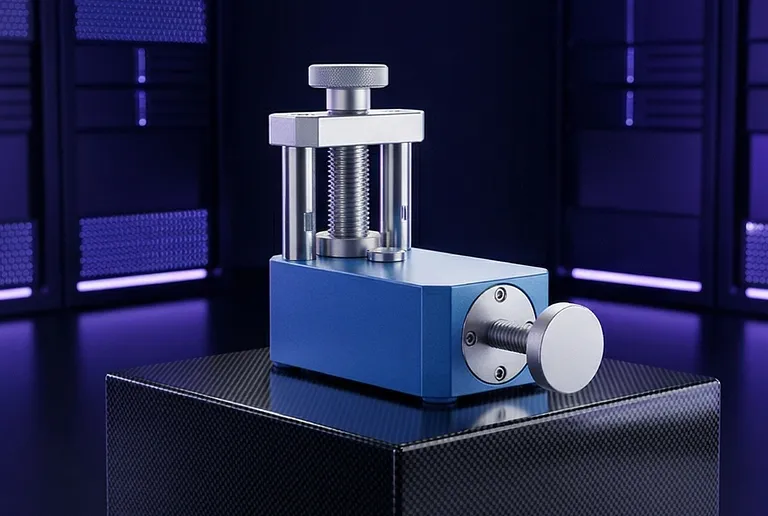
Pressure is a powerful tool, but it is not a blunt instrument. Engineering a perfect sample requires an understanding of the trade-offs:
| Risk Factor | Technical Consequence | Mitigation Strategy |
|---|---|---|
| Excessive Force | Polymorphic phase transitions | Calibrated pressure monitoring |
| Rapid Decompression | "Capping" or internal cracking | Slow-release hydraulic valving |
| Surface Residue | Ghost peaks in spectroscopy | Meticulous die cleaning protocols |
The goal is to find the equilibrium point where the sample is dense enough to be stable, but not so stressed that its crystalline lattice is altered.
Precision as a Standard

At KINTEK, we view the hydraulic press not as a piece of hardware, but as a critical stage of the analytical process. Whether you are working with sensitive battery materials or complex organic structures like 6,12-diboraanthanthrene, the tool must match the ambition of the research.
Our solutions are designed for the modern lab's specific constraints:
- Automatic & Manual Models: For high-throughput consistency or hands-on precision.
- Glovebox Compatibility: Ensuring air-sensitive samples never encounter the atmosphere.
- Isostatic Options: Applying uniform pressure from all directions for the most demanding material geometries.
Small inconsistencies in sample preparation lead to large errors in data. By controlling the physical state of your sample, you ensure that the results you see represent the molecule, not the defects of the powder.
To refine your sample preparation and achieve the highest resolution in your spectroscopy, Contact Our Experts.
Related Products
- Automatic High Temperature Heated Hydraulic Press Machine with Heated Plates for Lab
- Heated Hydraulic Press Machine with Heated Plates for Vacuum Box Laboratory Hot Press
- Manual Heated Hydraulic Lab Press with Integrated Hot Plates Hydraulic Press Machine
- Laboratory Hydraulic Press 2T Lab Pellet Press for KBR FTIR
- Laboratory Hydraulic Press Lab Pellet Press Machine for Glove Box
Related Articles
- The Architecture of Slow: Why Physical Precision Dictates Chemical Destiny
- The Architecture of Certainty: Why the Laboratory Press is the Anchor of Material Science
- The Vanishing Boundary: The Hidden Thermodynamics of LTCC Lamination
- The Alchemy of 160°C: Why Precision Pressing is the Silent Backbone of Rubber Science
- The Invisible Forge: Why the Laboratory Press is the Soul of Nano-Composites



















