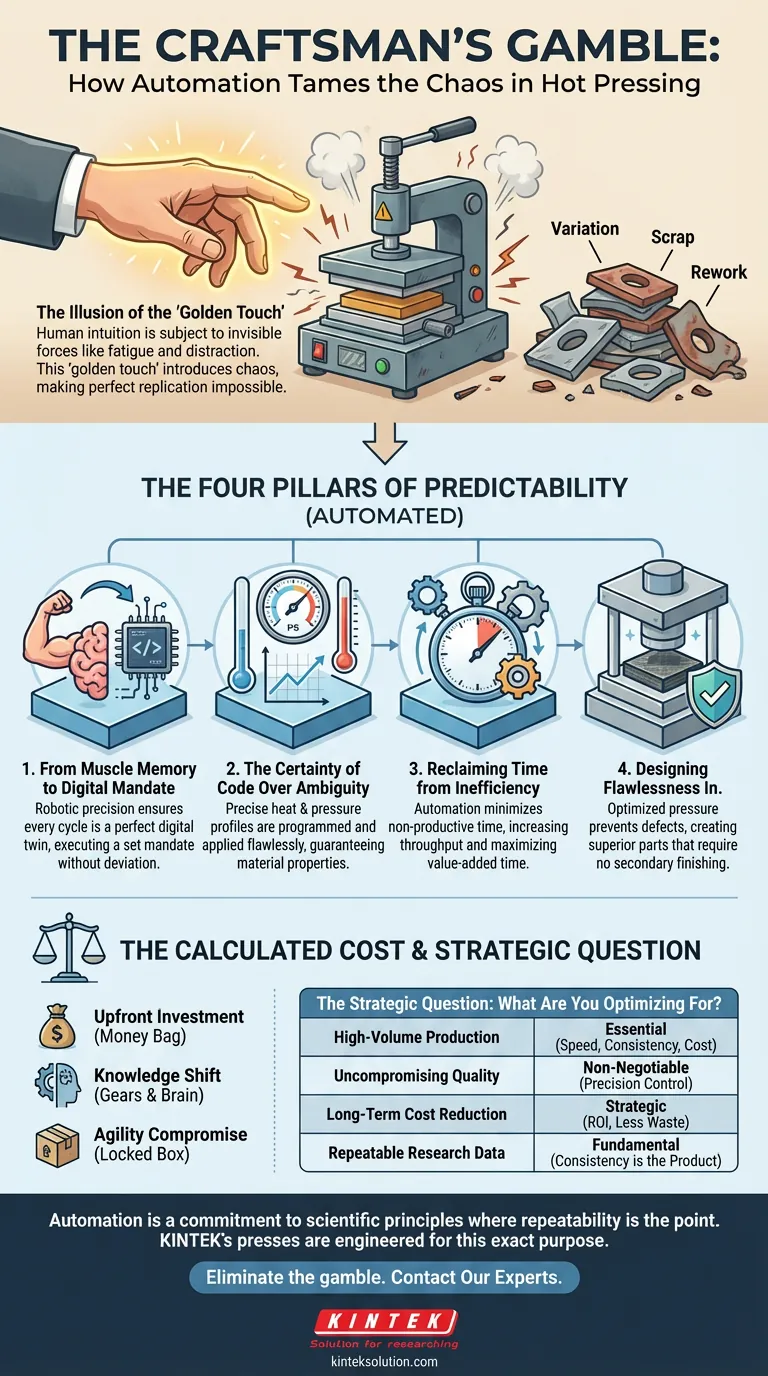
The Illusion of the 'Golden Touch'
In manufacturing, there's a romantic notion of the master craftsman—the operator who has a "feel" for the machine. They know its sounds, its quirks, and the precise moment to apply pressure. We trust this human intuition.
But this "golden touch" is also a gamble.
It's subject to the subtle, invisible forces of a long day: fatigue, distraction, a slight hesitation. The operator on Monday morning is not the same as the operator on Friday afternoon. This human element, our greatest asset in creative problem-solving, becomes a liability when the goal is perfect replication. It introduces chaos, a whisper of inconsistency into every cycle.
Manufacturing at scale, especially in a laboratory setting where data is sacred, cannot be built on a gamble. It requires a system. It requires the cold, unwavering certainty of science.
The Four Pillars of Predictability
Automation isn't about replacing the human; it's about replacing human inconsistency. It systematically transforms the hot pressing process from a variable art into a predictable science by locking in four key pillars of control.
From Muscle Memory to Digital Mandate
A skilled operator relies on muscle memory. An automated system relies on code.
Robotic precision in tasks like table feeding, forming, and demolding ensures that every cycle is a perfect digital twin of the last. The machine never has a "good day" or a "bad day." It simply executes its mandate, eliminating the tiny deviations in timing and placement that, over thousands of cycles, lead to scrap, rework, and unpredictable yields. This is the foundation of true process consistency.
The Certainty of Code Over the Ambiguity of 'Feel'
The structural integrity of a final part is dictated by its thermal and pressure history. A human estimates these parameters; a machine executes them.
With an automated system, the precise heat profile and pressure curve required for advanced composites or sensitive materials are programmed and applied flawlessly, every single time. There is no ambiguity. This level of granular control is impossible to achieve manually and is the only way to guarantee material properties when the margin for error is zero.
Reclaiming Time from Inefficiency
Manual operations are filled with non-productive time—the small pauses, the moments of transition between tasks. These seconds, seemingly insignificant on their own, accumulate into hours of lost production.
Automation is relentless in its efficiency. It minimizes the time between cycles by handling feeding, vacuuming, and demolding faster and more reliably than any human operator. This doesn't just increase throughput; it redesigns the workflow to maximize value-added time.
Designing Flawlessness In, Not Inspecting Defects Out
A manual process often relies on downstream quality control to catch errors. An automated process prevents them from happening in the first place.
By optimizing and consistently applying pressure throughout the forming stage, automation minimizes common defects like porosity and surface irregularities. This creates a superior part that often requires no secondary finishing. It's a fundamental shift from a philosophy of inspection to one of inherent quality.
The Calculated Cost of Certainty
Adopting automation is not a simple upgrade; it is a strategic investment in predictability. This requires a clear-eyed assessment of the trade-offs.
- The Upfront Investment: A fully automated hot press line requires a significant capital expenditure compared to its manual counterparts.
- The Knowledge Shift: The required expertise moves from mechanical skill to a deep understanding of software, programming, and systems maintenance.
- The Agility Compromise: A system optimized for a specific, high-volume run is inherently less flexible for small, high-mix production environments that require frequent retooling.
The Strategic Question: What Are You Optimizing For?
The decision to automate is a direct reflection of your primary goal. A simple matrix can clarify the choice:
| Primary Goal | The Role of Automation |
|---|---|
| High-Volume Production | Essential. The only way to achieve the required speed, consistency, and low per-unit cost. |
| Uncompromising Quality | Non-Negotiable. Precision control over temperature and pressure is the key to material integrity. |
| Long-Term Cost Reduction | Strategic. Delivers ROI by minimizing waste, reducing labor, and eliminating post-processing. |
| Repeatable Research Data | Fundamental. In a lab, consistency is the product. Automation removes variables to ensure data is reliable. |
Ultimately, moving from manual to automated hot pressing is a commitment to scientific principles. It's an acknowledgment that for the most demanding applications—from high-performance manufacturing to foundational laboratory research—repeatability is not just a feature, it's the entire point.
KINTEK's range of automatic and heated lab presses is engineered for this exact purpose: to provide the precise control and unwavering consistency needed to turn your material research into reliable, repeatable science. If you are ready to eliminate the gamble from your process, Contact Our Experts.
Visual Guide
Related Products
- Automatic High Temperature Heated Hydraulic Press Machine with Heated Plates for Lab
- Heated Hydraulic Press Machine with Heated Plates for Vacuum Box Laboratory Hot Press
- Automatic Heated Hydraulic Press Machine with Hot Plates for Laboratory
- Heated Hydraulic Press Machine With Heated Plates For Vacuum Box Laboratory Hot Press
- Laboratory Split Manual Heated Hydraulic Press Machine with Hot Plates
Related Articles
- The Architecture of Slow: Why Physical Precision Dictates Chemical Destiny
- The Architecture of Certainty: Why the Laboratory Press is the Anchor of Material Science
- The Vanishing Boundary: The Hidden Thermodynamics of LTCC Lamination
- The Alchemy of 160°C: Why Precision Pressing is the Silent Backbone of Rubber Science
- The Invisible Forge: Why the Laboratory Press is the Soul of Nano-Composites



















