
The Machine as a Reflection of Philosophy
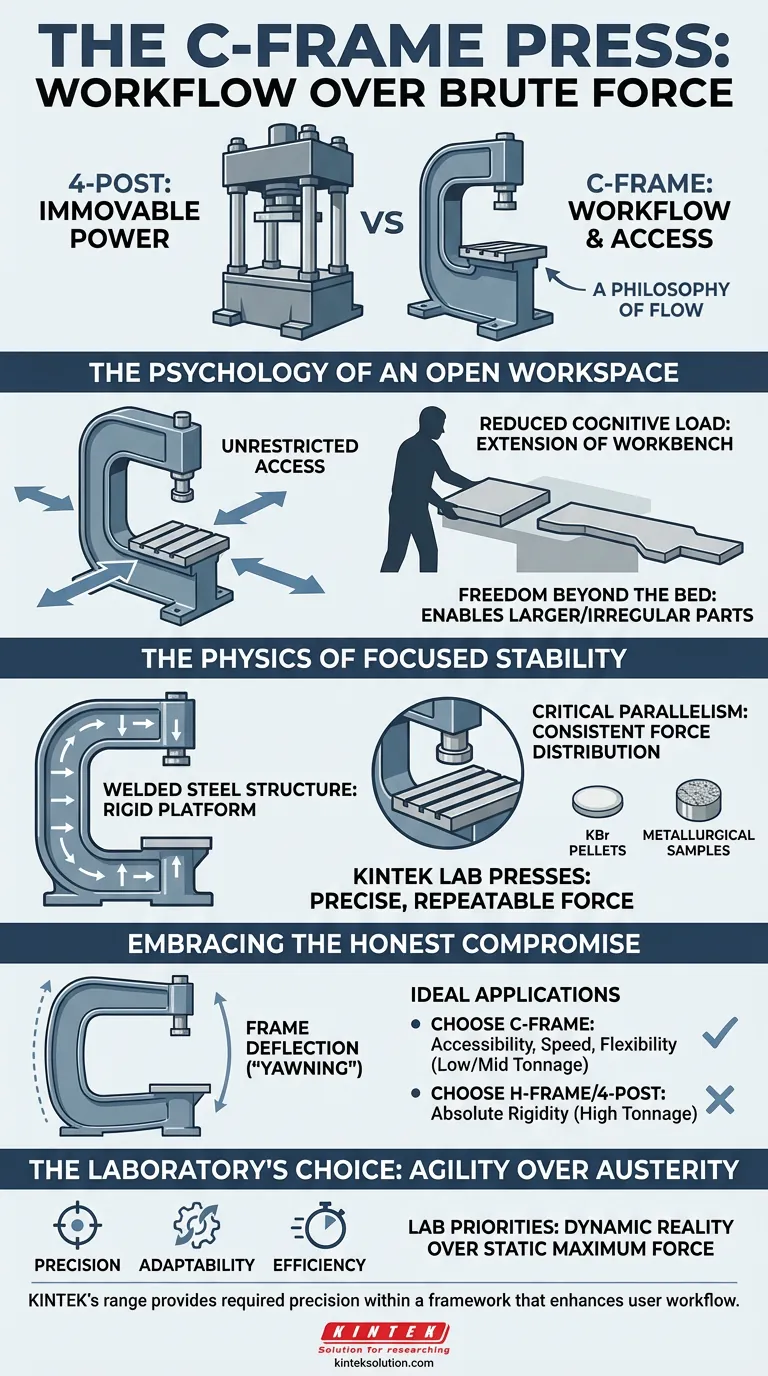
When choosing a tool, we rarely think we're making a philosophical choice. Yet, in engineering, design is a statement of priorities. A hulking, four-post press screams of immovable force and absolute rigidity. It is a monument to power.
The C-frame hydraulic press, however, tells a different story.
It’s a story about flow, access, and the human operator. Its design concedes that in many real-world scenarios, the biggest obstacle isn't a lack of force, but friction in the workflow. The bottleneck is often the simple, repetitive act of getting material in and out of the machine.
The Psychology of an Open Workspace
The defining feature of a C-frame press is its anatomy—a single, solid frame shaped like the letter "C." This isn't just an aesthetic choice; it’s a fundamental decision that shapes its entire operational character.
A Design Dictated by Movement
Unlike enclosed designs, the C-frame offers unrestricted access from the front and both sides. Imagine an operator preparing samples in a busy lab. With a 4-post press, they must carefully navigate material through a narrow opening. With a C-frame, they can slide workpieces in from the most convenient angle, without breaking their rhythm.
This ease of access reduces the cognitive load on the operator. It makes the machine feel less like a barrier and more like an extension of the workbench.
Freedom Beyond the Press Bed
The open sides create a liberating advantage: your workpiece can be wider or longer than the press bed itself. This is impossible in an enclosed frame. For laboratories working with irregularly shaped components or needing to feed long stock for sequential pressing, the C-frame isn't just convenient; it's an enabler.
The Physics of Focused Stability
Accessibility does not mean fragility. The C-frame is an exercise in intentional engineering, designed to be rigid where it counts most.
Forged for its Purpose
Most C-frames are built from a single, heavy-duty welded steel structure. This integral construction minimizes distortion under its intended load, ensuring the frame is a stable, reliable platform. It’s not designed for a million tons of force, but it’s masterfully engineered for the forces it was built to handle.
The Quest for Parallelism
This rigidity is crucial for maintaining parallelism between the moving ram and the stationary bed. For laboratory applications—like creating KBr pellets for spectroscopy or preparing metallurgical samples—this consistency is non-negotiable. Even force distribution ensures that every sample is prepared to the same exacting standard, a cornerstone of repeatable scientific outcomes.
This is where specialized lab presses shine. KINTEK's automatic and heated lab presses are built on this principle, delivering the precise, repeatable force necessary for consistent sample preparation, cycle after cycle.
Embracing the Honest Compromise
No design is without its trade-offs. The C-frame's greatest strength—its openness—is also the source of its primary limitation.
The Reality of Deflection
Under extremely high tonnage, the "C" has a natural tendency to open slightly, a phenomenon known as "yawning" or frame deflection. This is a fundamental characteristic of its geometry.
While this deflection is often microscopic and irrelevant for most tasks, it can become a factor in ultra-high-precision coining or blanking operations where micron-level parallelism is critical.
Know Your Application
This trade-off clearly defines the C-frame’s ideal role.
- Choose a C-Frame for: Accessibility, workflow speed, and operational flexibility in low to mid-range tonnage applications.
- Choose an H-Frame or 4-Post for: Absolute rigidity and minimal deflection under extremely high tonnage.
The Laboratory's Choice: Agility Over Austerity
In a laboratory environment, the priorities are often different from a heavy industrial factory. The workflow is rarely about stamping out thousands of identical parts with maximum force. Instead, it's about precision, adaptability, and efficiency for a variety of tasks.
The lab values a machine that can accommodate different sample sizes, allow for easy integration of heating or cooling platens, and doesn't create a physical barrier to the work. The C-frame design, as perfected in KINTEK's range of laboratory presses, is the ideal answer to this need. It provides the required precision and control within a framework that enhances, rather than hinders, the user's workflow.
The decision to use a C-frame press is a decision to prioritize the dynamic reality of the work over the static pursuit of maximum force. It’s an elegant solution for those who understand that true efficiency is found in seamless motion. To explore how this design philosophy can enhance your laboratory's capabilities, Contact Our Experts.
Visual Guide
Related Products
- Cylindrical Lab Electric Heating Press Mold for Laboratory Use
- Lab Cylindrical Press Mold with Scale
- Lab Cylindrical Press Mold for Laboratory Use
- Automatic Lab Cold Isostatic Pressing CIP Machine
- Manual Cold Isostatic Pressing CIP Machine Pellet Press
Related Articles
- The Geometry of Energy: Why Precision Pressing Dictates Radiation Outcomes
- The Conscience of the Lab: Precision, Pressure, and the Invisible Architecture of Rubber
- The Glass Transition Ritual: Why Heat is the Secret Language of High-Density Materials
- The Geometry of Resilience: Why the Electric Press is the Soul of Vulcanization
- Precision's Edge: The Physics and Psychology of Temperature Control in Laboratory Presses















