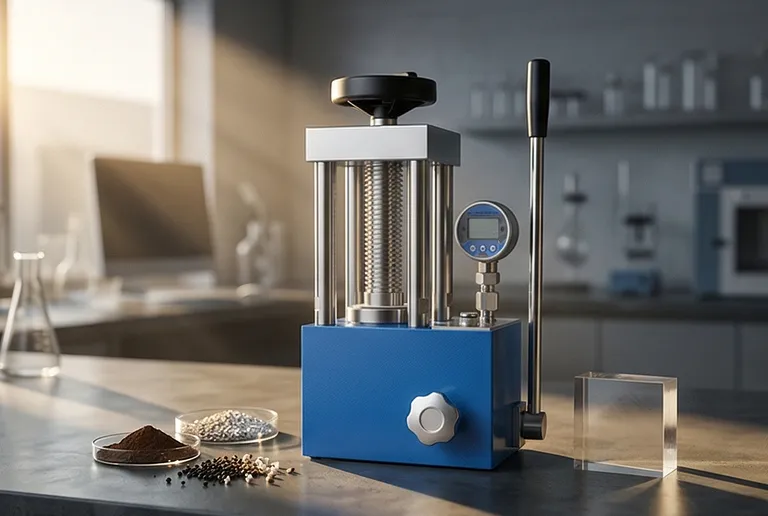
The Invisible Barrier of Bulk Material
In its raw state, a composite of recycled High-Density Polyethylene (rHDPE) and coffee grounds is a chaotic mosaic. To the naked eye, it is simply waste reimagined. To the microscope, it is an impenetrable fortress of opaque granules and irregular voids.
The challenge of materials science is not just innovation, but observation. You cannot improve what you cannot see.
The heated press resides at this critical junction. It is the tool that transitions a material from a bulk, unobservable mass into a "microscopically viable" sample. It is, in essence, an optical instrument that uses force instead of glass.
The Thermodynamics of Clarity
At 190°C, a subtle but profound transformation occurs. This is the thermal threshold where the rHDPE matrix relinquishes its crystalline rigidity and enters a molten state.
In this liquid phase, the polymer begins to flow around the coffee ground particles. This isn't just about melting; it’s about encapsulation. By creating a continuous phase, we allow light or electron beams to pass through or interact with the sample without being scattered by the "noise" of discrete granules.
- The Melt: Ensures the matrix fully wets the reinforcement.
- The Bond: Eliminates the gaps that hide true interfacial behavior.
- The Result: A sample that reflects the chemistry, not the local geometry.
The Geometry of Truth
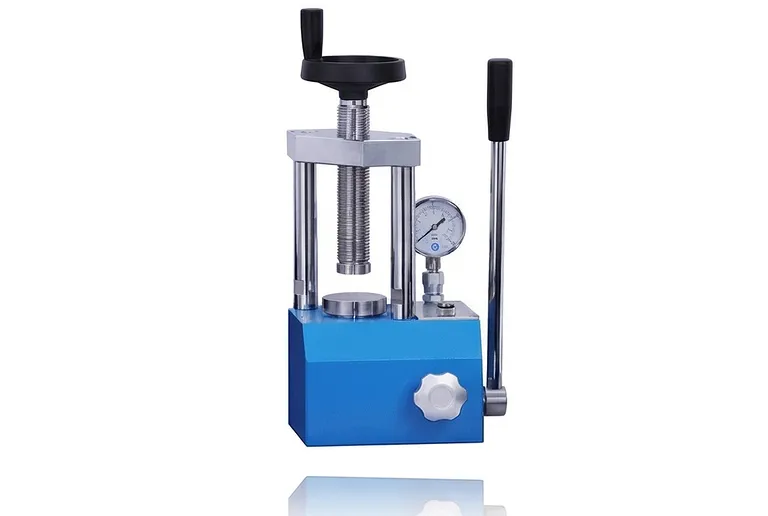
Precision in microscopy is a game of microns. If a film varies in thickness, the depth-of-field in an optical microscope becomes your enemy—parts of your sample will be in focus, while others are a blur.
Applying exactly 3 MPa of pressure serves a dual purpose. First, it forces the material into a perfectly flat plane, ensuring the entire field of view stays within the "sweet spot" of the lens. Second, it acts as a purge. It drives out internal air pockets that would otherwise be misidentified as material defects or pores.
| Variable | Target | Scientific Objective |
|---|---|---|
| Temperature | ~190°C | Reach a molten state for matrix encapsulation |
| Pressure | ~3 MPa | Achieve uniform thickness and eliminate voids |
| Dwell Time | Variable | Balance air escape with thermal stability |
| Platen Precision | High | Ensure consistent depth-of-field for SEM |
The Paradox of Over-Processing
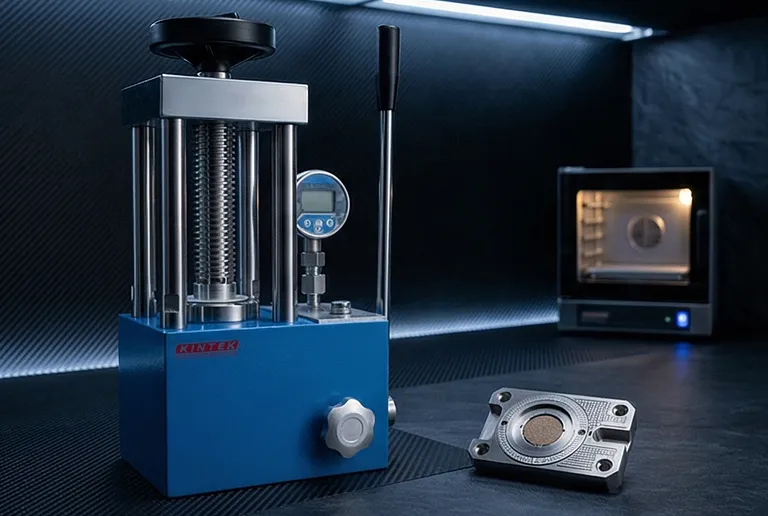
Every engineer knows that the same force that creates can also destroy. This is the "psychology of the press." There is a temptation to apply more heat or more pressure to ensure a "better" film, but materials have a memory.
If you apply heat for too long, you "cook" the sample. The polymer chains in the recycled plastic degrade, and the organic coffee grounds may char. The result is a sample that no longer represents the material you started with.
Similarly, excessive pressure can crush the coffee ground particles. If a researcher sees fractured fillers under the microscope, they must ask: Was the filler weak, or was the sample preparation too violent?
Systems for Systematic Success
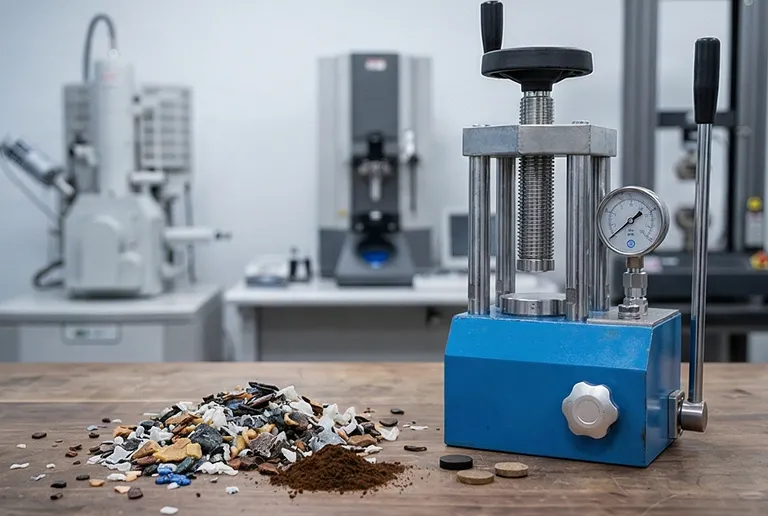
Achieving the perfect sample is not an act of luck; it is a result of systemic control. When dealing with recycled composites, your preparation strategy must match your analytical goals:
- For Optical Transparency: Prioritize temperature control slightly above the melt point to achieve a glass-like surface.
- For Particle Analysis: Minimize the time under high pressure to preserve the physical morphology of the coffee grounds.
- For Structural Integrity: Use a slow pressure ramp-up to allow trapped gases to escape before the matrix solidifies.
At KINTEK, we understand that the press is the bridge between raw material and breakthrough data. Our solutions—from manual and automatic heated presses to glovebox-compatible models—are engineered to provide the precision that excludes human error from the equation.
Whether you are refining sustainable composites or pushing the boundaries of battery research with isostatic pressing, the goal remains the same: transforming the opaque into the transparent.
Related Products
- Heated Hydraulic Press Machine with Heated Plates for Vacuum Box Laboratory Hot Press
- Automatic High Temperature Heated Hydraulic Press Machine with Heated Plates for Lab
- Heated Hydraulic Press Machine With Heated Plates For Vacuum Box Laboratory Hot Press
- Automatic Heated Hydraulic Press Machine with Hot Plates for Laboratory
- Automatic Heated Hydraulic Press Machine with Heated Plates for Laboratory
Related Articles
- The Architecture of Slow: Why Physical Precision Dictates Chemical Destiny
- The Architecture of Certainty: Why the Laboratory Press is the Anchor of Material Science
- The Vanishing Boundary: The Hidden Thermodynamics of LTCC Lamination
- The Alchemy of 160°C: Why Precision Pressing is the Silent Backbone of Rubber Science
- The Invisible Forge: Why the Laboratory Press is the Soul of Nano-Composites



















