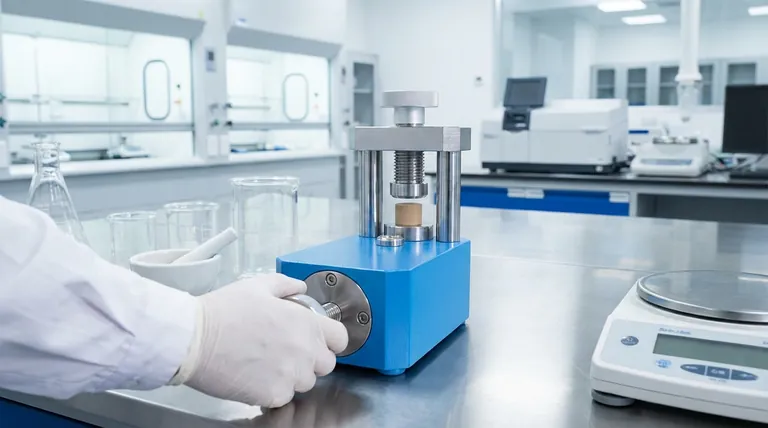
Beyond Brute Strength: The Psychology of Force
Imagine a materials scientist trying to create a perfectly uniform sample pellet for analysis. They need to compress a fine powder, but a simple, sharp impact from a mechanical device shatters it. The goal isn't just to apply force, but to apply it with deliberate, unwavering control.
This scenario reveals a fundamental misunderstanding of industrial and laboratory presses. The conversation often revolves around tonnage—a measure of brute strength. But the real engineering genius, especially in hydraulic systems, isn't about creating force, but about mastering it.
The shift in perspective is from "how much force?" to "how is the force applied?" This is the core psychological and engineering advantage of the hydraulic press.
The Power of a Sustained Push
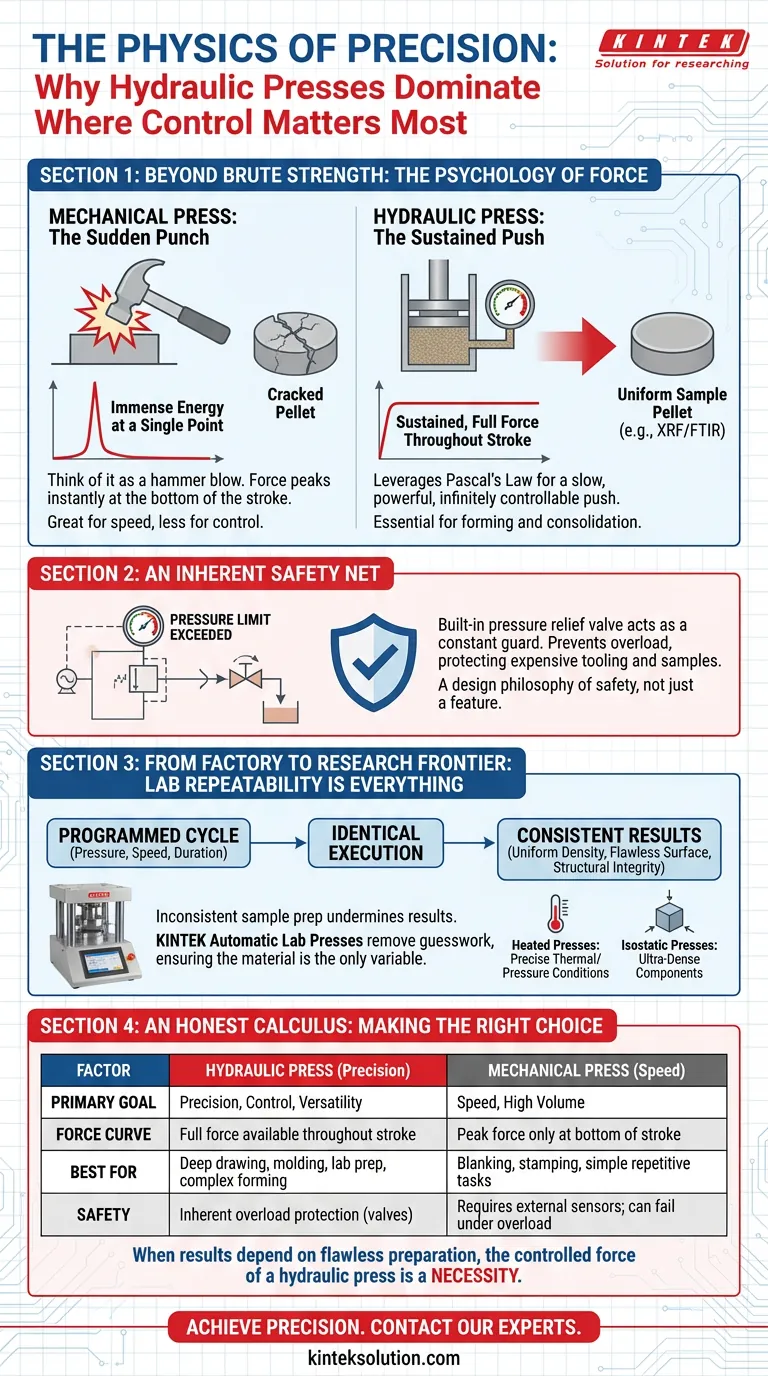
Unlike a mechanical press, which delivers its maximum force in a sudden punch at the bottom of its stroke, a hydraulic press operates on a different principle. It leverages Pascal's law of fluid dynamics to generate and sustain its full, rated force at any point, throughout its entire stroke.
- Mechanical Press: Think of it as a hammer blow. Immense energy at a single point in time and space.
- Hydraulic Press: Think of it as a slow, powerful, and infinitely controllable push.
This sustained pressure is critical for operations like deep drawing, where metal must be coaxed into a new shape without tearing, or in a laboratory, where a powder must be slowly consolidated into a dense, crack-free solid.
An Inherent Safety Net
Engineers know that perfection is a goal, not a reality. Dies can be slightly misaligned. Workpieces can have hidden material flaws. In a mechanical system, an overload can lead to catastrophic failure of the machine, the tooling, or both.
A hydraulic press has a built-in "understanding" of its limits.
A simple pressure relief valve acts as a constant guard. If the required force exceeds the machine's set limit, the valve opens, bleeding off pressure and preventing damage. This isn't just a feature; it's a design philosophy that prioritizes safety and protects expensive tooling and irreplaceable samples.
From the Factory Floor to the Research Frontier
The ability to precisely program every variable—pressure, speed, and stroke duration—makes a single hydraulic press an entire fleet of machines in one. This versatility is most valuable where the tasks are most demanding and the outcomes most critical.
The Laboratory: Where Repeatability is Everything
Nowhere is control more crucial than in the scientific laboratory. Inconsistent sample preparation is a notorious source of experimental error, wasting time, resources, and undermining the validity of results.
Consider the challenge of preparing samples for X-Ray Fluorescence (XRF) or Fourier-Transform Infrared (FTIR) spectroscopy. A perfect sample pellet must have:
- Uniform Density: To ensure the analytical beam interacts with the material consistently.
- Flawless Surface: To prevent scattering and measurement artifacts.
- Structural Integrity: To avoid crumbling during handling.
Achieving this by hand is nearly impossible. This is where specialized laboratory hydraulic presses become indispensable. For researchers and technicians, a machine like a KINTEK Automatic Lab Press removes the guesswork. It allows the user to program a precise pressure cycle that is executed identically every single time, ensuring that the only variable in the experiment is the material itself, not the preparation method.
For more advanced applications, this same principle of controlled force extends to specialized equipment:
- Heated Lab Presses: Allow for the molding and analysis of polymers and composites under precise thermal and pressure conditions.
- Isostatic Presses: Apply pressure equally from all directions, creating ultra-dense components and samples required for advanced ceramics and material science research.
An Honest Calculus: Making the Right Choice
No single technology is a universal solution. The deliberate nature of a hydraulic press comes with trade-offs.
| Factor | Hydraulic Press | Mechanical Press |
|---|---|---|
| Primary Goal | Precision, Control, Versatility | Speed, High Volume |
| Force Curve | Full force available throughout the stroke | Peak force only at the bottom of the stroke |
| Best For | Deep drawing, molding, lab sample prep, complex forming | Blanking, stamping, simple, repetitive tasks |
| Safety | Inherent overload protection via pressure relief valves | Requires external sensors; can fail under overload |
| Maintenance | Requires clean hydraulic fluid and seal integrity | More moving parts, requires lubrication and monitoring |
The decision isn't about which press is "better," but which is right for the task's core demand. If the goal is to punch out ten thousand identical washers an hour, the raw speed of a mechanical press is unmatched.
But if your goal is to form a complex aerospace component, mold a high-performance polymer, or prepare a flawless sample that will be the basis of a critical scientific discovery, the choice is clear. You need control.
When your results depend on flawless preparation and repeatable conditions, the controlled force of a hydraulic press is not just an advantage; it's a necessity. If achieving that level of precision is your goal, Contact Our Experts.
Visual Guide
Related Products
- Automatic High Temperature Heated Hydraulic Press Machine with Heated Plates for Lab
- Manual Heated Hydraulic Lab Press with Integrated Hot Plates Hydraulic Press Machine
- Heated Hydraulic Press Machine with Heated Plates for Vacuum Box Laboratory Hot Press
- Laboratory Hydraulic Press 2T Lab Pellet Press for KBR FTIR
- Laboratory Hydraulic Press Lab Pellet Press Machine for Glove Box
Related Articles
- The Architecture of Slow: Why Physical Precision Dictates Chemical Destiny
- The Architecture of Certainty: Why the Laboratory Press is the Anchor of Material Science
- The Vanishing Boundary: The Hidden Thermodynamics of LTCC Lamination
- The Alchemy of 160°C: Why Precision Pressing is the Silent Backbone of Rubber Science
- The Invisible Forge: Why the Laboratory Press is the Soul of Nano-Composites



















