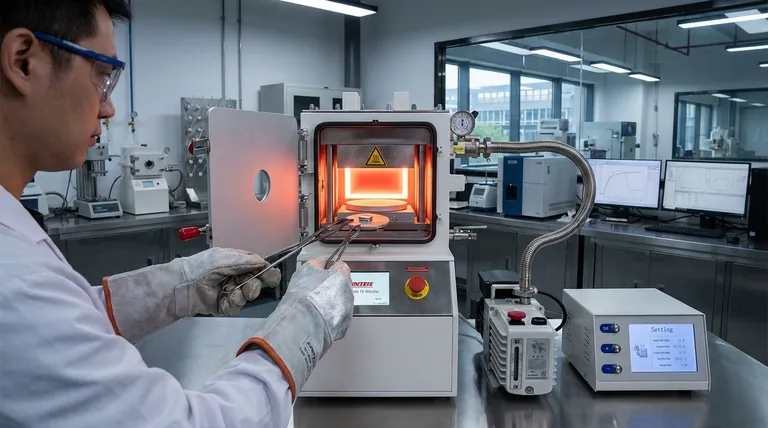
A materials scientist develops a new alloy. On paper, its theoretical strength is revolutionary. In practice, under stress, it fails prematurely. The culprit is not a flaw in the chemical formula, but an invisible saboteur hidden within its structure: porosity.
These microscopic voids—tiny pockets of nothing—are the primary source of failure in many advanced materials. They are the starting points for cracks, the barriers to electrical current, and the insulators that trap heat. The quest for stronger, more reliable materials is fundamentally a war against this emptiness.
The Unseen Enemy in Every Material
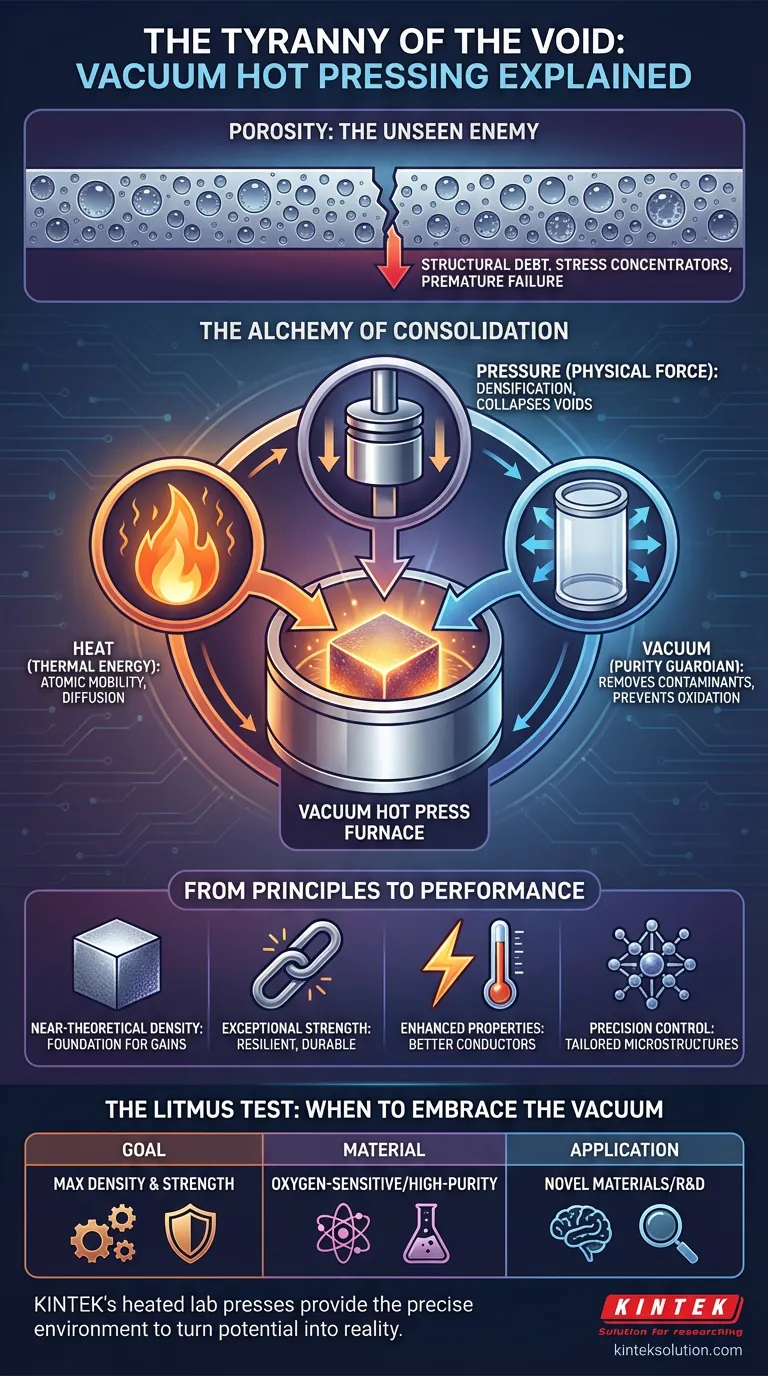
Porosity is more than just empty space. It is a structural debt. Each void is a discontinuity, a point where the bonds that give a material its strength do not exist.
Think of it as a series of microscopic fault lines. Under pressure, stress concentrates at the edges of these voids, creating fractures that a solid, monolithic structure would easily resist. This is why a material’s real-world performance so often falls short of its theoretical potential. Eliminating these voids is the first and most critical step toward closing that gap.
The Alchemy of Consolidation: Heat, Pressure, and Nothingness
This is where the vacuum hot press furnace enters the scene. It’s less a machine and more a crucible of controlled physics, designed to wage a three-pronged attack on porosity and contamination.
Its power lies not in any single function, but in the perfect synergy of its operations. It combines intense heat, immense pressure, and a pristine vacuum to force matter into its ideal state.
The Role of Heat: A Gentle Persuasion
Heat provides the thermal energy to make atoms cooperative. As a material is heated, its particles vibrate, soften, and become more mobile. This increased atomic mobility is crucial. It allows individual grains of powder or layers of laminate to begin diffusing into one another, preparing them to form strong, permanent metallurgical or ceramic bonds.
The Force of Pressure: An Inevitable Command
While heat makes the atoms willing to move, pressure commands them where to go. The high, uniform pressure exerted by a hot press is the physical force that drives densification. It systematically collapses the voids and pores, physically squeezing the material together until almost no empty space remains. It’s a brute-force solution to an elemental problem.
The Power of Vacuum: The Guardian of Purity
The vacuum is the unsung hero of the process. By removing air and other reactive gases, it creates an environment of extreme purity. This is non-negotiable for reactive materials like titanium, certain alloys, or non-oxide ceramics.
In an oxygen-rich environment, these materials would form undesirable oxide layers, compromising their integrity. The vacuum acts as a guardian, ensuring that the bonds being formed are between the pure material particles themselves, free from the contamination that weakens and degrades.
From Principles to Performance: The Tangible Results
This trinity of forces—heat, pressure, and vacuum—translates directly into superior material properties that are otherwise unattainable.
- Near-Theoretical Density: By systematically eliminating porosity, the process creates a final part that is incredibly dense and solid. This is the foundation for all other performance gains.
- Exceptional Mechanical Strength: With no voids to act as stress concentrators, the material’s true strength and hardness are unlocked. The part becomes more resilient, durable, and resistant to fracture.
- Enhanced Thermal & Electrical Properties: Porosity is an insulator. By removing it, a clear path is created for the flow of electrons (electricity) and phonons (heat). Materials become better conductors, performing as their chemistry intended.
- Precision Microstructure Control: The process allows engineers to finely control grain size and manage phase transformations. You are not just consolidating a material; you are architecting its internal structure for a specific application.
The Engineer's Dilemma: Precision Demands Discipline
A vacuum hot press is not a simple oven. It is a sophisticated instrument that demands expertise. Achieving its remarkable results depends on the careful optimization of temperature, pressure, vacuum level, and cycle times.
This complexity is not a flaw; it is a reflection of its power. It is the tool of choice when failure is not an option and material properties cannot be compromised. The investment in equipment and process development is a commitment to achieving the highest possible standard of material quality.
The Litmus Test: When to Embrace the Vacuum
How do you know if this technology is right for your application? Consider these questions:
| Scenario | Recommendation |
|---|---|
| Is your primary goal maximum density and mechanical strength? | A vacuum hot press is ideal for high-performance ceramics, composites, and powder metallurgy parts. |
| Are you working with oxygen-sensitive or high-purity materials? | The vacuum environment is essential for reactive metals, intermetallics, and non-oxide ceramics. |
| Are you creating novel materials with tailored microstructures? | The precise control offered is perfect for R&D and the production of specialized, high-value components. |
For laboratories dedicated to pushing these boundaries, achieving this level of control is the core mission. KINTEK's suite of heated lab presses provides the precise, reliable environment needed to turn theoretical potential into tangible, high-performance reality. To explore how this technology can elevate your work, Contact Our Experts.
Visual Guide
Related Products
- Heated Hydraulic Press Machine with Heated Plates for Vacuum Box Laboratory Hot Press
- Heated Hydraulic Press Machine With Heated Plates For Vacuum Box Laboratory Hot Press
- Automatic High Temperature Heated Hydraulic Press Machine with Heated Plates for Lab
- Automatic Heated Hydraulic Press Machine with Hot Plates for Laboratory
- Laboratory Manual Heated Hydraulic Press Machine with Hot Plates
Related Articles
- The Architecture of Slow: Why Physical Precision Dictates Chemical Destiny
- The Architecture of Certainty: Why the Laboratory Press is the Anchor of Material Science
- The Vanishing Boundary: The Hidden Thermodynamics of LTCC Lamination
- The Alchemy of 160°C: Why Precision Pressing is the Silent Backbone of Rubber Science
- The Invisible Forge: Why the Laboratory Press is the Soul of Nano-Composites



















