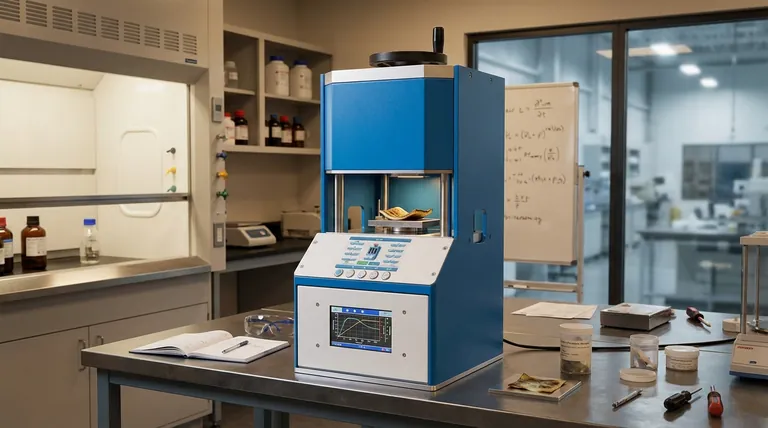
It’s a moment every materials scientist and process engineer dreads. You’ve spent weeks, maybe months, developing a promising new polymer, composite, or laminate. You place your carefully prepared material into the lab press, dial in the temperature and pressure settings, and run the cycle. When you open it, your heart sinks.
The sample is warped. The layers haven't bonded. Or worse, it looks perfect on the outside, but under a microscope, it’s riddled with voids and inconsistencies. It’s another failed run, another day lost, and you’re no closer to a reliable result.
Caught in the Loop: Why 'More Heat, More Pressure' Fails
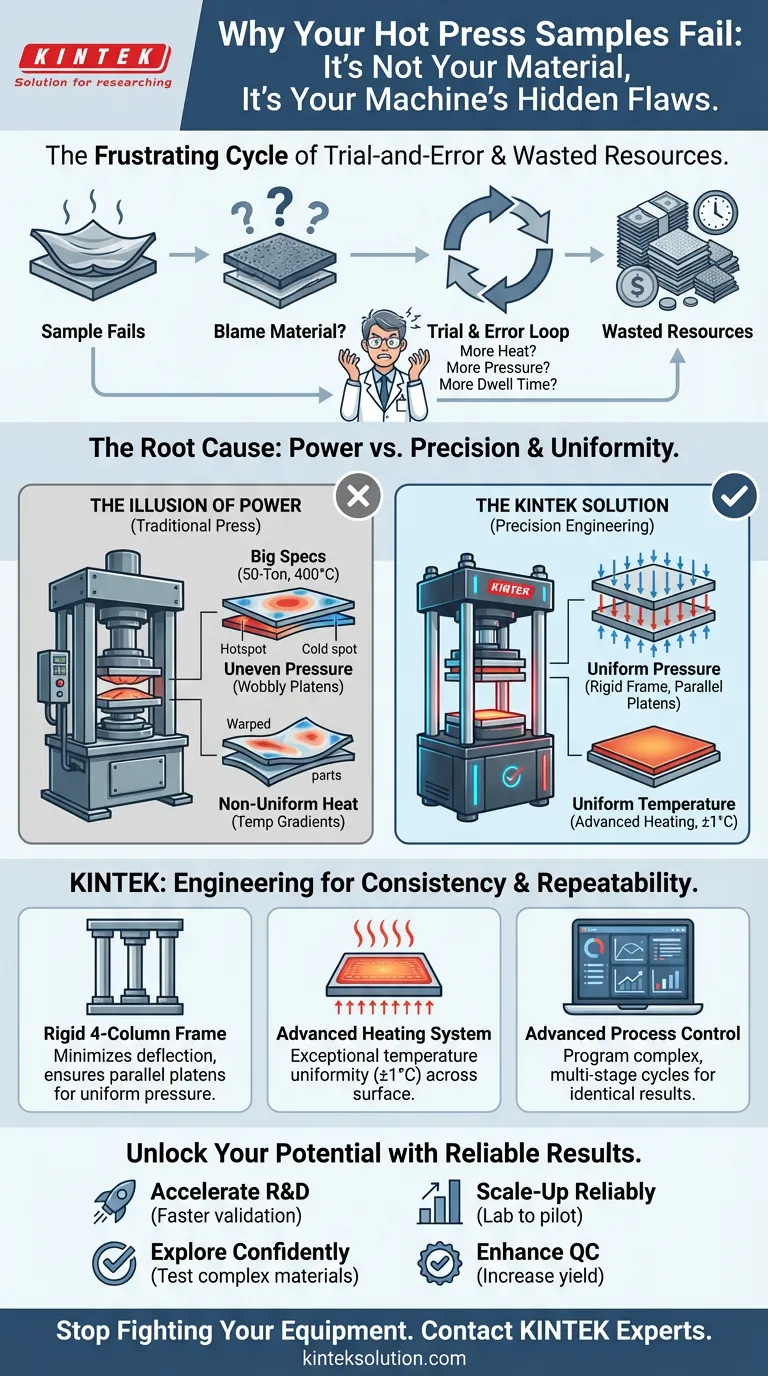
If this scenario sounds familiar, you are not alone. Many labs find themselves trapped in a frustrating cycle of trial-and-error. The common reaction is to blame the most obvious variables:
- "The bonding failed? Let's increase the pressure."
- "The material didn't cure properly? We need more heat."
- "It's still not working? Let's increase the dwell time."
You tweak one parameter at a time, running dozens of costly and time-consuming experiments, hoping to stumble upon the magic combination.
This isn't just a frustrating academic exercise; it has severe business consequences. Each failed sample represents wasted high-value materials, hours of squandered labor, and mounting project delays. When you can't produce consistent samples, you can't generate reliable data for a patent, you can't validate a new manufacturing process, and you can't guarantee the quality of a final product. The entire innovation pipeline grinds to a halt, stalled by a problem that seems to have no logical solution.
The Root Cause: The Critical Difference Between Power and Precision
Here is the turning point: the problem is almost never a simple lack of force or heat. The real culprit is a lack of control and uniformity. The common "solutions" of adding more power often just amplify these hidden flaws.
You’ve been treating the symptoms, but the disease lies in the fundamental capabilities of the machine itself.
The Illusion of Force vs. The Reality of Pressure
You bought a 50-ton press, so you assume it’s delivering 50 tons of force. But force and pressure are not the same thing. Pressure is force applied over an area. If your press has a weak, flexible frame or its platens are not perfectly parallel, that 50 tons of force is not being applied evenly.
Imagine trying to flatten dough with a bent or wobbly rolling pin. Some spots get crushed while others are barely touched. The same thing happens in your press. High-pressure "hot spots" can damage the material, while low-pressure "cold spots" result in poor bonding and voids. Cranking up the force on a non-rigid press only makes the unevenness worse.
The Myth of Maximum Temperature vs. The Mandate for Uniformity
Similarly, a press that can reach 400°C is useless if one part of the platen is 400°C and another is 370°C. This temperature non-uniformity is a primary cause of warped parts and internal stress. Different sections of your material cure at different rates, creating a built-in tension that ruins the sample as soon as it cools.
The common solutions fail because they don't address these core issues. They are based on the mistaken belief that bigger numbers on a spec sheet—maximum tonnage, maximum temperature—are what matter. In reality, repeatability comes from the precise and uniform application of that force and heat, every single time.
The Right Tool for the Job: Engineering for Consistency
So, if the true enemies are non-uniformity and a lack of control, how do you defeat them? You need an instrument that was engineered from the ground up to solve these specific problems. It’s not about finding a machine that is simply powerful; it’s about choosing one that is precise.
This is the core philosophy behind KINTEK’s line of laboratory press machines. Our presses are not designed to just get hot and squeeze; they are designed as precision instruments to deliver repeatable results.
-
To solve the pressure problem: Our automatic lab presses are built on rigid, four-column frames that minimize deflection even under extreme loads. This ensures the platens remain perfectly parallel, delivering uniform pressure across your entire sample and eliminating the guesswork.
-
To solve the temperature problem: We utilize advanced, segmented heating systems and high-conductivity platens to guarantee exceptional temperature uniformity (e.g., ±1°C) across the entire surface. This ensures every part of your material experiences the exact same thermal profile, eliminating internal stress and warping.
-
To solve the control problem: Our advanced control systems allow you to move beyond simple set-points. You can program complex, multi-stage cycles with precise control over heating/cooling ramps, pressure application, and dwell times. The system executes the process automatically, logging the data and ensuring that the 100th sample you make is identical to the first.
A KINTEK press isn't just another piece of hardware; it's the embodiment of a solution, designed by understanding the fundamental physics of why samples fail.
Beyond Troubleshooting: Unlocking New Research and Production Potential
When you stop fighting your equipment, you can finally focus on what truly matters: your work. By solving the persistent problem of inconsistency, a world of new possibilities opens up.
Suddenly, you can:
- Accelerate R&D: Dramatically reduce the number of experiments needed to validate a new material or process, cutting development cycles from months to weeks.
- Explore with Confidence: Test more complex materials and ambitious process parameters, knowing your results are a true reflection of your science, not a flaw in your machine.
- Scale-Up Reliably: Develop a process in the lab and confidently transfer it to pilot production, knowing the parameters are robust and repeatable.
- Enhance Quality Control: Implement a QC process that produces reliable data, increases product yield, and reduces costly scrap.
You shift your time and energy from troubleshooting the machine to driving innovation.
Stop letting inconsistent results dictate the pace of your progress. If you’re tired of fighting your equipment and want to see how a precision-engineered lab press can transform your workflow, our team of experts is ready to help. We can discuss your unique materials and project goals to find the right solution for your lab. Contact Our Experts.
Visual Guide
Related Products
- Automatic High Temperature Heated Hydraulic Press Machine with Heated Plates for Lab
- Heated Hydraulic Press Machine with Heated Plates for Vacuum Box Laboratory Hot Press
- Automatic Heated Hydraulic Press Machine with Hot Plates for Laboratory
- Heated Hydraulic Press Machine With Heated Plates For Vacuum Box Laboratory Hot Press
- Laboratory Split Manual Heated Hydraulic Press Machine with Hot Plates
Related Articles
- The Architecture of Slow: Why Physical Precision Dictates Chemical Destiny
- The Architecture of Certainty: Why the Laboratory Press is the Anchor of Material Science
- The Vanishing Boundary: The Hidden Thermodynamics of LTCC Lamination
- The Alchemy of 160°C: Why Precision Pressing is the Silent Backbone of Rubber Science
- The Invisible Forge: Why the Laboratory Press is the Soul of Nano-Composites



















