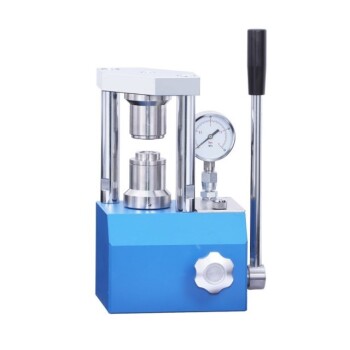
The primary function of a laboratory hydraulic battery crimping machine is to dictate the mechanical consistency of a coin cell battery. It influences performance by applying precise, uniform pressure to hermetically seal the battery casing, effectively compressing the internal stack—electrodes, separator, and electrolyte—into a single, cohesive unit. This mechanical compression is the governing factor in establishing the electrical connectivity required for the battery to function.
By eliminating internal gaps and ensuring a reliable seal, the crimping machine minimizes interfacial contact resistance and prevents chemical contamination. This mechanical stability is the absolute prerequisite for generating reproducible laboratory data and achieving long-term cycling stability.
Optimizing Electrochemical Connectivity
Minimizing Interfacial Resistance
The crimping machine applies constant pressure to force the active material layers, the separator, and the anode (such as metal zinc or lithium foil) into tight physical contact. This proximity is essential for reducing the impedance at the interfaces between materials.
Enhancing Electron Transport
Low contact resistance allows electrons to flow freely between the current collectors and electrode materials. By ensuring components are tightly joined, the machine ensures the battery can operate at its full electrochemical potential during cycling tests.
Handling Volume Expansion
For ultra-high loading batteries or thick electrodes, tight mechanical contact is critical for accommodating physical changes. Proper crimping helps manage the volume expansion pressure that occurs during cycling, preventing sudden capacity loss caused by the delamination of internal layers.
Ensuring Structural and Chemical Integrity
Preventing Electrolyte Leakage
The machine exerts radial pressure to bond the battery case with the sealing gasket. This prevents the escape of aqueous or organic electrolytes, which is necessary to maintain the cell's ionic conductivity over time.
Blocking External Impurities
A reliable seal isolates the internal chemistry from the external environment. This blocks the ingress of air and moisture, which are detrimental to sensitive battery chemistries.
Protecting High-Voltage Systems
For high-voltage systems like Lithium Nickel Manganese Oxide (LNMO) operating at 4.7 V, sealing is even more critical. In these scenarios, even trace amounts of external moisture can accelerate electrolyte decomposition and degrade cycle stability.
The Role of Consistency in Research
Eliminating Variable Data
In a laboratory setting, the goal is to test the chemistry, not the assembly method. A hydraulic crimper provides a repeatable pressure standard, ensuring that variations in test data are due to material changes rather than inconsistent assembly.
Long-Term Cycle Life
Mechanical integrity directly correlates to longevity. By preventing electrolyte evaporation and maintaining contact pressure, the crimper ensures that the battery yields accurate results during extended cycle life tests.
Understanding the Trade-offs
The Balance of Pressure
While high pressure is necessary to reduce resistance, there is a limit. Excessive force can crush the separator, leading to short circuits, or damage brittle electrode materials, rendering the cell useless before testing begins.
Hydraulic vs. Manual Variance
Manual crimpers often suffer from user-dependent force variations. Hydraulic machines mitigate this by offering controlled, quantifiable pressure, but they require regular calibration to ensure the pressure gauge reflects the actual force applied to the cell.
Making the Right Choice for Your Goal
To maximize the utility of your crimping process, consider your specific research objectives:
- If your primary focus is high-rate capability: Prioritize higher compression settings to minimize ohmic resistance and maximize electron transfer speeds.
- If your primary focus is long-term cycle life: Focus on the quality of the gasket seal to prevent electrolyte evaporation and the ingress of moisture over weeks of testing.
- If your primary focus is high-loading electrodes: Ensure the crimp pressure is sufficient to maintain contact during the significant volume expansion and contraction cycles of the active material.
The hydraulic crimping machine is not just a packaging tool; it is a precision instrument that defines the internal environment in which your battery chemistry lives or dies.
Summary Table:
| Factor | Influence on Battery Performance | Key Benefit |
|---|---|---|
| Interfacial Resistance | Minimizes gaps between electrodes and separators | Enhances electron transport & efficiency |
| Hermetic Sealing | Prevents electrolyte evaporation and air ingress | Ensures long-term cycling stability |
| Pressure Control | Manages volume expansion of active materials | Prevents delamination and capacity loss |
| Consistency | Standardizes assembly pressure across samples | Eliminates mechanical variables in data |
Elevate Your Battery Research with KINTEK Precision
Don't let inconsistent assembly compromise your breakthrough chemistry. KINTEK specializes in comprehensive laboratory pressing solutions, offering a range of manual, automatic, and heated models designed for the rigorous demands of modern energy research. From glovebox-compatible crimpers to advanced isostatic presses, our equipment ensures the mechanical integrity and reproducible results your battery studies require.
Ready to optimize your cell assembly? Contact our experts today to find the perfect pressing solution for your lab's specific needs.
References
- Basil Chacko, W. Madhuri. A comparative study on the structural, chemical, morphological and electrochemical properties of α-MnO2, β-MnO2 and δ-MnO2 as cathode materials in aqueous zinc-ion batteries. DOI: 10.1007/s40243-024-00281-8
This article is also based on technical information from Kintek Solution Knowledge Base .
Related Products
- Laboratory Hydraulic Press Lab Pellet Press Button Battery Press
- Automatic Laboratory Hydraulic Press Lab Pellet Press Machine
- Laboratory Hydraulic Press Lab Pellet Press Machine for Glove Box
- 24T 30T 60T Heated Hydraulic Lab Press Machine with Hot Plates for Laboratory
- Automatic Heated Hydraulic Press Machine with Heated Plates for Laboratory
People Also Ask
- How is a laboratory hydraulic press used for HAP composite gels? Master Mineral Substrate Standardization
- What role does a laboratory hydraulic press play in the preparation of piezoelectric ceramic discs for DC-PG? | KINTEK
- What role does a laboratory hydraulic press play in reaction pellets? Optimizing Lunar Soil and Metal Fuel Density
- Why is a laboratory hydraulic press required for PBAT and PLA sample preparation? Achieve Flawless Characterization
- What role does a laboratory hydraulic press play in the assembly of all-solid-state battery test cells? Expert Guide