
In short, laboratory presses are essential tools across a wide range of industries, most notably in pharmaceuticals, rubber and plastic molding, composites, and laminating. Their value stems from the ability to apply precise force and temperature in a controlled, small-scale environment, making them indispensable for research, quality control, and developing new materials.
The core benefit of a laboratory press isn't just its function, but its versatility. It serves as a miniature factory, enabling industries to test, validate, and prototype materials with high precision before committing to expensive, large-scale production.
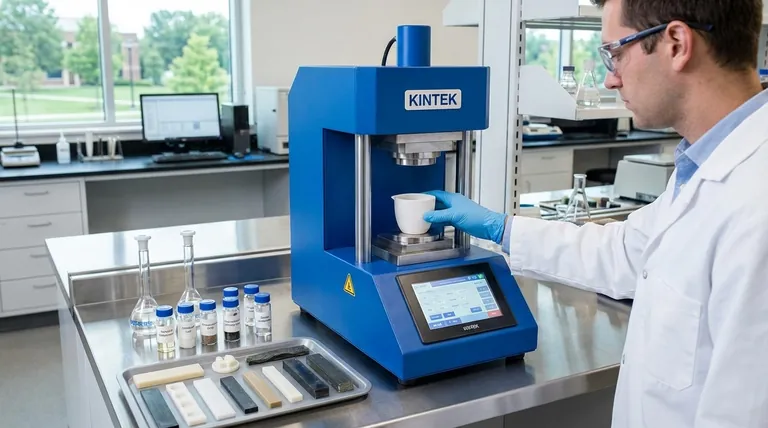
Why Precision is the Common Denominator
A laboratory press is fundamentally a tool for controlled compression. By precisely managing force, temperature, and time, it allows operators to understand and shape materials in a repeatable way. This core capability is applied in several critical functions.
Research and Development (R&D)
For scientists and engineers, a lab press is a foundational tool for innovation. It allows them to create and test new formulas for polymers, composites, and pharmaceutical compounds on a small, cost-effective scale.
This R&D function is critical in fields like aerospace and wood research, where new materials must be rigorously evaluated before they can be considered for use.
Quality Control and Material Testing
Industries rely on lab presses to ensure their raw materials and finished goods meet specific standards. The press is used to mold material samples—such as plaques or tensile bars—that are then subjected to further physical testing.
This ensures that a batch of rubber has the correct hardness, a polymer has the right flexibility, or a composite layer has the required strength. It is a cornerstone of quality assurance.
Prototyping and Short Production Runs
Before launching a full production line, companies use lab presses to create prototypes or conduct short production runs. This is common in lean manufacturing and cell manufacturing environments.
It allows for the creation of functional parts, such as a specific plastic component or a laminated ID card, to validate the design and manufacturing process without the massive overhead of industrial machinery.
Key Industrial Applications
While the functions are similar, the specific uses of laboratory presses vary significantly by industry.
Polymers, Rubber, and Composites
This is the most common domain for laboratory presses. They are used to mold test samples of new plastic and rubber formulations, study curing characteristics, and press multi-layered composite materials together.
Industries from automotive to aerospace and consumer electronics rely on this process to develop stronger, lighter, and more durable materials.
Pharmaceuticals
In the pharmaceutical industry, presses are used for compaction studies and sample preparation. They can press powdered active ingredients and excipients into solid tablets or pellets.
This is vital for R&D on drug formulation and for preparing samples, such as KBr pellets, for analytical testing methods like FTIR spectroscopy.
Laminating and Bonding
Any industry that bonds layers of material together under heat and pressure can benefit from a lab press. This is most visible in the manufacturing of credit cards, ID cards, and security credentials.
The process is also used in electronics to bond layers of printed circuit boards (PCBs) and in woodworking to test adhesives and create samples of plywood or other engineered woods.
Understanding the Limitations
A laboratory press is a precision instrument, not a mass-production machine. Understanding its limitations is key to using it effectively.
Not for High-Volume Manufacturing
The primary limitation is scale. Laboratory presses are designed for single-cycle, often manual, operation. Their cycle times are far too slow and their platen (surface) sizes are too small for mass production.
Optimized for Control, Not Speed
The goal of a lab press is perfect repeatability and control over process variables. This focus on precision inherently sacrifices the speed and automation found in industrial-scale presses. Using a lab press for a large production run would be incredibly inefficient.
How to Apply This to Your Goal
Your specific objective determines how you will leverage a laboratory press.
- If your primary focus is material innovation and R&D: Use the press to experiment with new formulations, test cure times, and create novel composite structures on a small, manageable scale.
- If your primary focus is quality assurance: Implement the press in your workflow to consistently mold samples of incoming raw materials and outgoing products for standardized physical testing.
- If your primary focus is prototyping or lean manufacturing: Use the press to create limited runs of new parts, allowing you to validate design and function before investing in expensive production tooling.
Ultimately, the laboratory press empowers you to bring certainty and control to the foundational stages of material science and manufacturing.
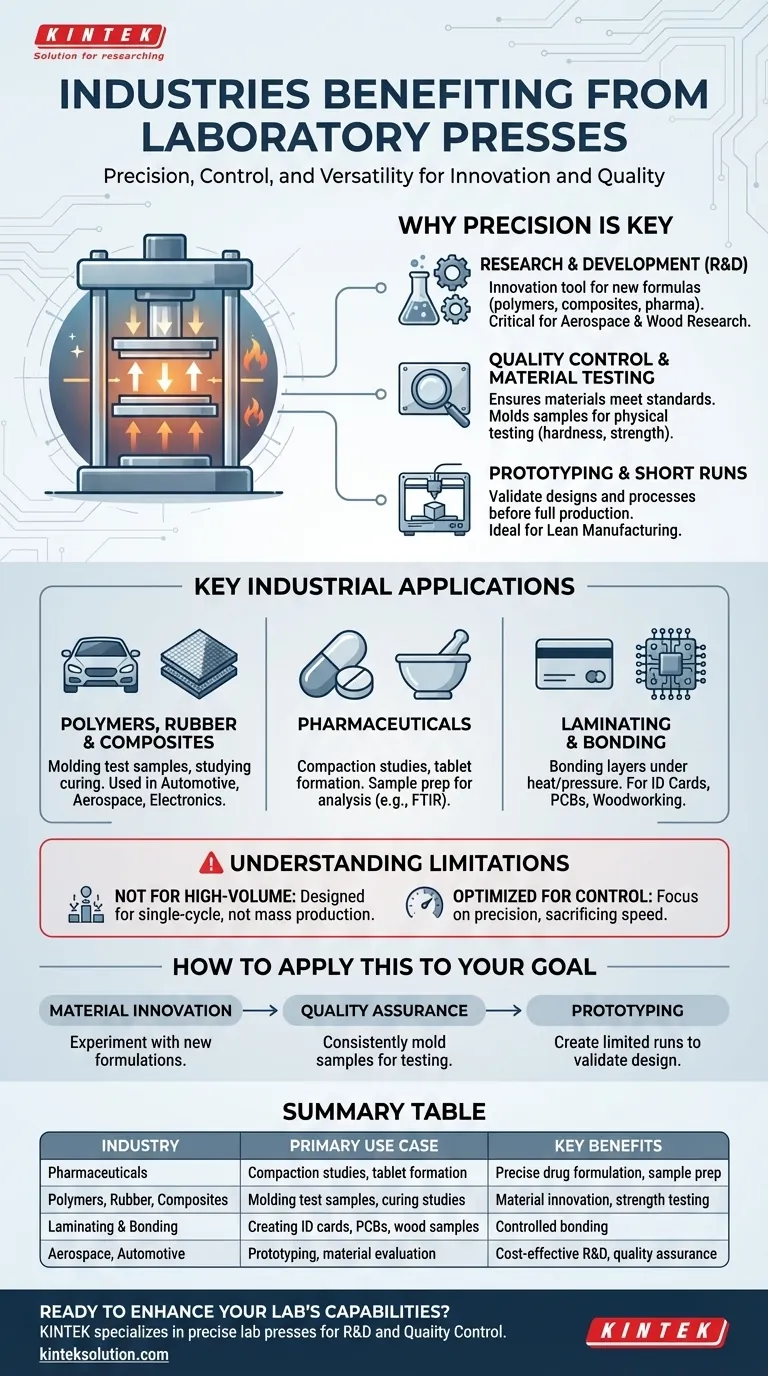
Summary Table:
| Industry | Primary Use Case | Key Benefits |
|---|---|---|
| Pharmaceuticals | Compaction studies, tablet formation | Precise drug formulation, sample prep for analysis |
| Polymers, Rubber, Composites | Molding test samples, curing studies | Material innovation, strength and durability testing |
| Laminating and Bonding | Creating ID cards, PCBs, wood samples | Controlled bonding under heat and pressure |
| Aerospace, Automotive | Prototyping, material evaluation | Cost-effective R&D, quality assurance |
Ready to enhance your laboratory's capabilities with reliable lab presses? KINTEK specializes in automatic lab presses, isostatic presses, heated lab presses, and more, designed to meet the precise needs of industries like pharmaceuticals, polymers, and composites. From accelerating R&D to ensuring quality control, our equipment delivers superior performance and efficiency. Contact us today to discuss how we can support your projects and drive innovation in your field!
Visual Guide
Related Products
- Laboratory Hydraulic Press 2T Lab Pellet Press for KBR FTIR
- Laboratory Hydraulic Press Lab Pellet Press Button Battery Press
- Laboratory Hydraulic Press Lab Pellet Press Machine for Glove Box
- Laboratory Split Manual Heated Hydraulic Press Machine with Hot Plates
- Laboratory Hydraulic Pellet Press for XRF KBR FTIR Lab Press
People Also Ask
- What is the role of a laboratory pressure machine and KBr in FTIR? Master Sample Preparation for Flame Retardants
- What is the role of a laboratory hydraulic press in high-loading NCM811 cathode prep for solid-state batteries?
- Why is a laboratory hydraulic press necessary for sample preparation? Precise Pelleting for Spiro Heterocyclic Analysis
- What role does a laboratory hydraulic press play in reaction pellets? Optimizing Lunar Soil and Metal Fuel Density
- What is the typical pressure capacity of a laboratory hydraulic press and what materials can it process?



















